
From Sea Voyages to Science: How Scurvy Shaped Human History
Thousands died without knowing why—until science uncovered the truth behind one missing vitamin.
Quick Summary
- Scurvy is a Vitamin C deficiency disease that once caused mass deaths during sea voyages.
- Lack of fresh fruits led to symptoms like weakness, bleeding gums, and slow healing.
- It can be easily prevented with daily intake of Vitamin C-rich foods like citrus fruits and greens.
There was a time when a simple lack of fresh food could decide life and death. Scurvy—now nearly forgotten—once haunted sailors, soldiers, and expeditions, silently claiming lives long before modern medicine understood its cause.
Diseases may be broadly classified into infectious, genetic, deficiency-related, and metabolic. Scurvy belongs to the third category—a disease caused not by invasion, but by deprivation. The absence of a single nutrient: Vitamin C.
A History Written in Hunger and Survival
The story of scurvy dates back to 1500 BC, recorded in the Ebers Papyrus. For centuries, it appeared wherever fresh fruits and vegetables were missing from the diet.
It resurfaced across defining moments in history—the Irish Potato Famine, the American Civil War, Arctic explorations, and the California Gold Rush—quietly exploiting one common weakness: nutritional neglect.
When Exploration Turned Into Tragedy
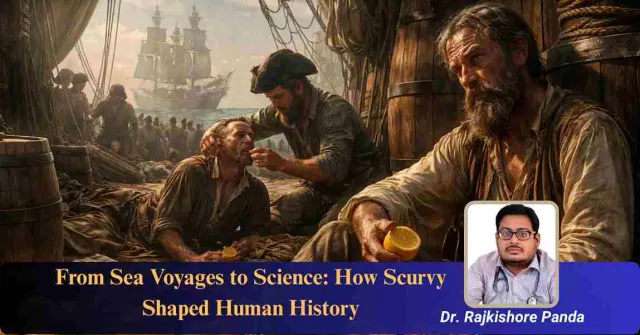
The age of exploration transformed scurvy into a mass killer. Long sea voyages between the 14th and 17th centuries became breeding grounds for the disease.
Crews set out in search of new lands but often met a slow, painful decline—fatigue, bleeding gums, and eventual death.
Even the most ambitious expeditions were not spared. Christopher Columbus’s settlement at La Isabela collapsed within years. Vasco da Gama lost nearly 100 of his 170 crew members. These were not failures of courage or navigation, but of nutrition.



The Simple Cure That Took Centuries to Accept
Relief came from an unexpected place—citrus fruits. Sailors who consumed lemons and oranges showed signs of recovery.
Yet, it took time for this observation to be taken seriously. James Lind eventually proved through systematic research that citrus fruits could treat scurvy.
The final breakthrough came in 1932 with the discovery and synthesis of Vitamin C, finally revealing the root cause of the disease.
What Happens When the Body Breaks Down
The science behind scurvy is simple but unforgiving. Vitamin C is essential for producing collagen, the protein that maintains the body’s structure.
Without it, the body begins to weaken from within—wounds heal slowly, gums bleed, and physical strength declines. Since the human body cannot produce Vitamin C, it must be supplied through daily diet.
Prevention Is Simple—If We Pay Attention
Preventing scurvy does not require advanced medicine. A daily intake of around 20 milligrams of Vitamin C is enough.
Citrus fruits, guava, amla, and green vegetables provide more than adequate supply. Yet, even something this basic can be overlooked—especially where awareness or access is limited.
Also Read: Cicada COVID Variant: The Silent Comeback That’s Raising Global Concerns
A Disease That Refuses to Fully Disappear
Scurvy may seem like a relic of the past, but it has not completely vanished. Cases have appeared even in recent decades, particularly in regions affected by conflict and food shortages.
Its presence today is not a medical failure, but a social one—a reminder that nutrition still does not reach everyone equally.



A Lesson History Still Whispers
In the 18th century, British sailors were mockingly called “Limeys” for consuming citrus fruits. What sounded like ridicule was, in reality, a life-saving habit.
Scurvy’s story goes beyond Vitamin C. It is a lesson in how something small and easily ignored can shape the course of human history.
Even today, the message remains clear: health is often protected not by complex solutions, but by simple, consistent choices.
Author Details

Dr. Raj Kishore Panda (MBBS, PGPN) is a medical professional and commentator who writes on socio-economic affairs, geopolitics, environmental challenges, and public health issues.
Reader Feedback
Was this article useful?
Stay Connected
Get the next important story before you miss it.
Subscribe to the newsletter for trusted updates, or join our WhatsApp channel for quick top-story alerts from The Eastern Times.
WhatsApp Channel
Prefer instant alerts? Join our WhatsApp channel for top stories and breaking updates.
Join on WhatsApp