
Global Conflict, Local Impact: How the Iran War Is Fueling India’s Energy Crisis
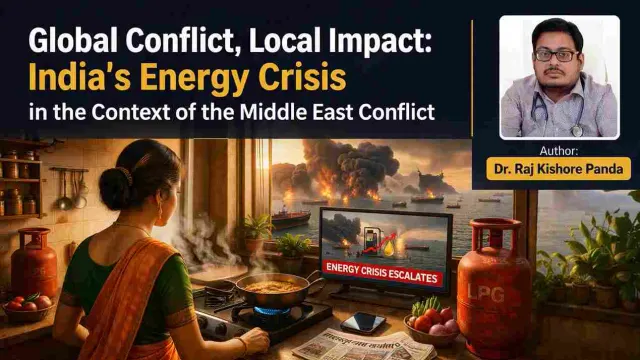
A recent media report reveals that in Patia, one of Bhubaneswar’s well-known posh areas, many hotels have shut down due to a shortage of cooking gas. Those that remain open have significantly increased food prices. What was once a distant geopolitical issue is now quietly affecting everyday life.
Before the United States attacked Iran, few could have imagined that the flames of this conflict would spread so rapidly across the world. Today, from Europe to Asia, its impact is clearly visible. In some regions, there is a gas shortage; in others, rising oil prices and supply disruptions are creating anxiety among people.
When a distant war starts affecting daily life
For India, the situation has become particularly serious due to disruptions in the Strait of Hormuz. Although Iran has allowed Indian ships carrying oil and gas to pass through this route, the lack of smooth movement has already pushed prices upward. The Strait of Hormuz is not just another trade route—it is the lifeline of the global energy system. Every day, around 14 million barrels of crude oil and 29 crore cubic meters of LNG pass through it. If this route remains disrupted for long, the world could face a severe energy crisis.
Understanding the fuels behind the crisis
At this moment, it becomes important to understand the role of LPG in India’s energy system. The government has recently advised citizens to shift from LPG cylinders to PNG wherever possible. However, terms like LPG, LNG, and PNG often confuse the common public, making it necessary to explain them in simple terms.
LNG, or Liquefied Natural Gas, is primarily methane (CH₄). It is natural gas cooled to extremely low temperatures—below minus 160 degrees Celsius—so that it turns into liquid and becomes easier to transport over long distances. With proper infrastructure, LNG can later be converted into PNG. It is widely used in fertilizers, petrochemicals, steel production, power generation, and even as fuel for ships.
CNG, or Compressed Natural Gas, is also methane, but instead of being cooled, it is compressed at very high pressure and stored in cylinders. It is commonly used today as a cleaner alternative fuel for vehicles. India’s current energy stress is largely linked to difficulties in LNG imports, as LNG is processed and converted into PNG and CNG within the national grid.
LPG, or Liquefied Petroleum Gas, is different. It is a mixture of hydrocarbons, mainly propane and butane, produced during crude oil refining and natural gas processing. Because it can be liquefied under moderate pressure, it is easy to store and transport in cylinders, making it the backbone of Indian kitchens. However, compared to LNG, LPG is more flammable and carries greater risk.
India’s growing dependence and rising pressure
India’s dependence on imports has now become a major concern. While crude oil imports may increasingly rely on Russia, LPG and LNG largely come from the Middle East, a region currently affected by conflict. As a result, around 54 percent of LPG and 30 percent of LNG imports have been disrupted. In 2025, the central government provided ₹30,000 crore in subsidies to public sector companies to absorb losses and maintain affordable supply.
The pressure is already visible. On March 7, domestic LPG prices increased by ₹60 per cylinder. At the same time, crude oil prices reached $120 per barrel—the highest since the Ukraine war. Shortly after, the Petroleum Ministry directed refineries to increase LPG production and prioritize domestic supply, even restricting the production of other petrochemical products.
India currently produces only about 40 percent of its LPG requirement domestically, with the rest dependent on imports. At the same time, demand continues to rise as people shift towards cleaner fuel. Government data shows that domestic LPG consumers increased from 1486 lakh in 2015 to 3305 lakh in 2025—a growth of 120 percent in a decade. LPG imports have also increased, from 16.48 million metric tonnes in 2020–21 to 18 million metric tonnes in 2025–26. Qatar remains the largest supplier, followed by the UAE and Kuwait, while nearly half of LNG demand is also met by Qatar. LNG imports have doubled over time, further increasing dependence on external supply chains.
Recent reports also indicate that IRGC naval commander Alireza Tangsiri, associated with the Strait of Hormuz, has been killed in an Israeli attack, adding to the uncertainty surrounding the region.


The push towards alternatives and the road ahead
In this backdrop, PNG is being promoted as a safer and more efficient alternative. Natural gas is transported as LNG, converted back into gas at terminals, and then supplied to consumers through pipelines under the national grid. This infrastructure is regulated by the Petroleum and Natural Gas Regulatory Board. PNG is safer because it is lighter and disperses quickly in case of leakage, reducing accident risks. In contrast, LPG, being heavier, can accumulate and increase the risk of accidents.
From an economic perspective, PNG is also cheaper, as it works like a utility service with direct billing, without dealer margins or theft concerns. However, LPG continues to dominate because it is easily available across both rural and urban areas, while PNG depends on pipeline infrastructure. The government is now expanding gas pipelines rapidly and has instructed consumers to shift to PNG where available. As per a directive issued on March 24, failure to switch within three months may lead to discontinuation of LPG supply.
Even though a ceasefire was announced until April 6, hostilities continue, suggesting that the conflict may persist. This situation highlights a deeper concern. India must gradually move towards energy self-reliance while also prioritizing alternatives like biogas.
What is unfolding is a reminder that global conflicts do not remain distant for long. They travel through supply chains and markets until they reach everyday life. And when they reach the kitchen, the crisis becomes personal.
Author Details

Dr. Raj Kishore Panda (MBBS, PGPN) is a medical professional and commentator who writes on socio-economic affairs, geopolitics, environmental challenges, and public health issues.
Reader Feedback
Was this article useful?
Stay Connected
Get the next important story before you miss it.
Subscribe to the newsletter for trusted updates, or join our WhatsApp channel for quick top-story alerts from The Eastern Times.
WhatsApp Channel
Prefer instant alerts? Join our WhatsApp channel for top stories and breaking updates.
Join on WhatsApp