
Oil, War and the World Economy
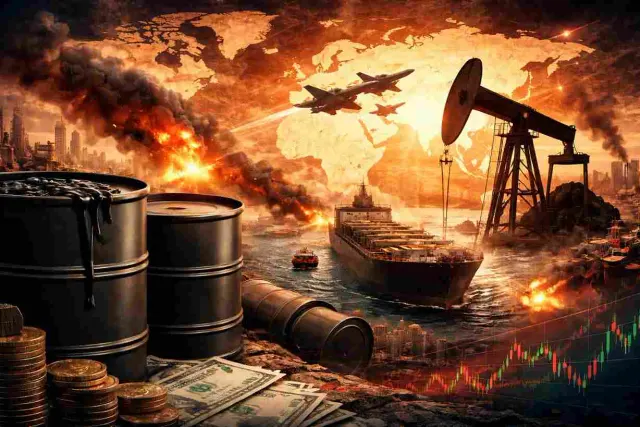
Crude oil is one of the most important natural resources in the modern world because it serves as a major source of energy and an essential raw material for many industries.
Petroleum products such as petrol, diesel, aviation fuel, and LPG are widely used to power transportation systems including cars, trucks, ships, and airplanes, making global trade and mobility possible.
In addition to energy, crude oil is the foundation of the petrochemical industry, which produces plastics, synthetic fibers, fertilizers, detergents, medicines, and many other everyday products.
Industrial production, agriculture, and electricity generation also depend significantly on petroleum fuels.
Moreover, crude oil plays a crucial role in the global economy as it is one of the most traded commodities, influencing inflation, government revenues, and international relations.
Because of these wide-ranging uses, crude oil remains strategically important for economic development and energy security across the world.
For this reason, any disturbance in the global oil market can rapidly translate into wider economic consequences.
Global Oil Demand and Supply Dynamics
At present, the world consumes approximately 100–102 million barrels of oil per day.
This enormous demand reflects the expanding global population, rapid industrialization, and the steady increase in the number of vehicles worldwide.
As emerging economies continue to grow and urbanization accelerates, global energy demand is expected to rise further in the coming decades.
However, global oil production is only marginally higher than consumption levels.
Because the balance between supply and demand is so delicate, the global oil market remains extremely sensitive to disruptions.
Even a relatively small decline of 1–2 million barrels per day in global supply can trigger significant price increases.
Consequently, fluctuations in the oil market often ripple through the entire global economy, influencing inflation, trade balances, and economic stability.
Geopolitical Tensions and the Oil Market
In recent months, rising geopolitical tensions in the Middle East, particularly the growing confrontation involving Iran, Israel, and the United States, have once again pushed the global oil market into a period of uncertainty.
The Middle East has long been regarded as the heart of global oil production, and instability in the region often leads to volatility in energy markets.
The present conflict has raised serious concerns about global energy security.
Military tensions, potential disruptions to production facilities, and threats to crucial shipping routes have heightened fears that global oil supplies could be significantly affected.
Global Oil Production and the Role of OPEC
The global oil industry is highly concentrated in a small number of countries.
The United States currently stands as the world’s largest oil producer, generating roughly 20 million barrels of petroleum per day, largely due to the expansion of shale oil production.
Saudi Arabia and Russia follow as major producers, each producing approximately 10–11 million barrels per day.
Other countries such as Canada, Iraq, China, and the United Arab Emirates also play significant roles in global supply.
Together, the top ten oil-producing nations account for nearly 70 percent of global oil production.
Because of this concentration, political developments or conflicts within these countries can have a profound impact on global energy markets.
Another important factor influencing global oil prices is the role of OPEC (Organization of the Petroleum Exporting Countries) and the broader OPEC+ alliance, which includes additional major producers such as Russia.
OPEC countries collectively contribute about 35 percent of global oil production, while OPEC+ controls nearly 60 percent of global supply.
By adjusting production quotas, these groups can influence global prices and maintain a certain level of market stability.
However, geopolitical tensions can disrupt these arrangements and trigger volatility in oil markets.
Historical Oil Crises and Price Surges
History offers several examples of how disruptions in oil supply can produce severe global economic consequences.
One of the most prominent examples is the 1973 oil crisis.
Following the Arab–Israeli war, Arab oil-producing nations imposed an embargo on oil exports to the United States and several Western countries.
As a result, global oil prices increased nearly fourfold within a few months.
The sudden price surge caused widespread inflation, economic recession, and unemployment in many parts of the world.
Similarly, the 1979 Iranian Revolution created another major shock to global oil markets.
Political instability in Iran led to a sharp decline in oil production, which pushed global prices dramatically higher.
These historical events clearly demonstrate how disruptions in oil supply can destabilize the world economy.
Recent Price Movements in the Oil Market
Before the latest escalation of tensions in the Middle East, global oil prices had remained relatively stable.
During the final months of 2025 and the early part of 2026, Brent crude oil prices fluctuated between 65 and 70 dollars per barrel, while the U.S. benchmark West Texas Intermediate traded between 63 and 67 dollars per barrel.
During this period, supply and demand in global markets were broadly balanced.
Production policies adopted by OPEC and OPEC+, combined with steady output from the United States and moderate global economic growth, helped maintain price stability.
However, the situation began to change when tensions between Iran and Israel started escalating.
As the possibility of military confrontation increased, global energy markets began to react.
Investors and traders feared that conflict in the region could disrupt oil production or shipping routes.
As a result, crude oil prices quickly rose to around 80–90 dollars per barrel.
The situation intensified further as military activity increased and the United States became more directly involved in the conflict.
With fears of supply disruption growing, oil prices crossed 100 dollars per barrel, and at certain moments Brent crude reached 115–118 dollars per barrel.
Some economists warn that if the conflict continues or expands further, oil prices could potentially rise to 130–150 dollars per barrel, which would place immense pressure on the global economy.
Strategic Importance of the Middle East and the Strait of Hormuz
Several factors have contributed to this sharp increase in prices.
Many of the world’s largest oil producers are located in the Middle East.
Countries such as Saudi Arabia, Iraq, Kuwait, the United Arab Emirates, and Iran collectively supply a substantial share of global oil.
Any military conflict or attack on oil production infrastructure in these countries could immediately disrupt global supply.
The geographical position of Iran makes the situation particularly sensitive.
Iran lies close to the Strait of Hormuz, one of the most strategically important maritime passages in the world.
This narrow waterway serves as the primary route through which oil from the Persian Gulf reaches international markets.
Approximately 20–21 million barrels of oil pass through the Strait of Hormuz every day, accounting for nearly 20 percent of global oil supply.
If military conflict disrupts shipping in this region or if the strait is blocked, global oil markets could face an immediate and severe supply shock.
Reports of attacks on oil infrastructure in the region have further intensified market fears.
Drone strikes and missile attacks on oil facilities have forced certain wells, pipelines, and refineries to suspend operations temporarily.
In addition, concerns over maritime security have made shipping companies increasingly cautious, and some oil tankers have been forced to take longer alternative routes, increasing transportation costs and delays.



Impact on the Global and Indian Economy
The consequences of rising oil prices extend far beyond energy markets.
Higher oil prices increase transportation costs for goods and services, which in turn raises the cost of industrial production.
Industries that depend heavily on petroleum products—such as aviation, shipping, petrochemicals, plastics, and fertilizer manufacturing—are particularly vulnerable.
Ultimately, these higher costs are passed on to consumers in the form of inflation.
The impact is especially significant for Asian economies, which are heavily dependent on imported oil from the Middle East.
Nearly 75 percent of oil exported from the Persian Gulf is consumed in Asia.
Major economies such as China, India, Japan, and South Korea rely heavily on these supplies to sustain industrial production and economic growth.
For India, the situation is particularly critical.
India is currently the third-largest oil consumer in the world.
The country’s daily oil demand is around 5.4 million barrels, yet domestic production is only about 0.7 million barrels per day.
As a result, India imports nearly 85 percent of its crude oil requirements from foreign sources.
Rising global oil prices therefore have a direct and substantial impact on the country’s economy by increasing the import bill and putting pressure on the balance of payments.
Nearly 40 percent of India’s oil imports pass through the Strait of Hormuz, making the country particularly vulnerable to disruptions in this region.
A Fragile World Built on Oil
The current crisis once again highlights a fundamental reality: the global economy remains deeply intertwined with oil.
Instability in the oil market is not merely an energy issue; it is a matter of geopolitics, economic stability, and national security.
To reduce this vulnerability, countries must accelerate the diversification of energy sources.
Expanding the use of renewable energy such as solar, wind, hydropower, and green hydrogen can gradually reduce dependence on fossil fuels.
Unless nations move decisively toward a more diversified and resilient energy structure, similar oil shocks will continue to threaten the stability of the global economy in the years to come.
Author Details

Dr. Rajanikanta Khuntia is a researcher and columnist with a Ph.D. in Commerce from Utkal University and an author of 5 books. His research focuses on business, finance and management.
Reader Feedback
Was this article useful?
Stay Connected
Get the next important story before you miss it.
Subscribe to the newsletter for trusted updates, or join our WhatsApp channel for quick top-story alerts from The Eastern Times.
WhatsApp Channel
Prefer instant alerts? Join our WhatsApp channel for top stories and breaking updates.
Join on WhatsApp