
Jhalmuri Theory: The Cultural Politics Behind Bengal’s 2026 Electoral Earthquake
Quick Summary
- The article argues that West Bengal’s 2026 election result was shaped not just by politics, but also by culture, emotion, symbolism, and media influence.
- It introduces the “Jhalmuri Theory,” comparing Bengal’s popular street snack to modern elections where multiple social emotions and narratives mix together to create a political wave.
- The piece highlights how cultural symbolism, digital media, and relatable political gestures by leaders like Narendra Modi influenced voter perception and reshaped political communication in India.
The 2026 West Bengal Assembly election was not merely an electoral event; it was a cultural and psychological turning point in contemporary Indian politics. At one level, the verdict appeared straightforward: the Bharatiya Janata Party secured a sweeping mandate, crossing the symbolic threshold of dominance in a state long considered politically resistant to its expansion.
Yet to interpret this transformation merely through seat tallies, vote shares, or anti-incumbency would be analytically insufficient. The Bengal verdict demands a broader interpretative framework—one that recognizes the interplay of culture, symbolism, emotion, media, and social psychology in shaping democratic behaviour. What emerged in Bengal in 2026 may best be understood through what can be called the ‘Jhalmuri Theory’.
Understanding the ‘Jhalmuri Theory’
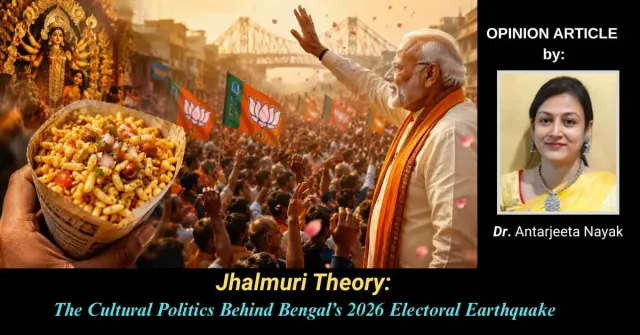
At first glance, the phrase appears colloquial, almost whimsical. Yet beneath its simplicity lies a sophisticated political metaphor. Jhalmuri is not merely a popular street snack in Bengal; it is a cultural expression of mixture, improvisation, familiarity, and participation.
Puffed rice, mustard oil, onions, peanuts, chilies, spices, tamarind—each ingredient retains its individuality, yet acquires meaning only after being rhythmically mixed into a coherent whole. The significance of Jhalmuri lies not simply in taste, but in composition.
Many Emotions, One Political Wave
The 2026 election unfolded in remarkably similar fashion. Economic dissatisfaction provided the base layer. Persistent unemployment concerns among educated youth, inflationary anxieties among lower-middle-class households, and perceptions of administrative fatigue contributed to a widening anti-incumbency environment.
Identity politics sharpened electoral polarization. Aspirational shifts among first-time voters and women introduced new electoral energy. Simultaneously, welfare delivery, digital campaigning, hyper-local mobilization, and aggressive narrative management created an ecosystem of constant political visibility.
Yet above all, cultural symbolism acted as the binding agent that transformed scattered sentiments into a coherent political wave. This is the essence of the ‘Jhalmuri’ Theory, where major electoral transformations are rarely produced by a single factor. They emerge when diverse social emotions are successfully mixed into one emotionally consumable narrative. To Bengal, Jhalmuri is something far more intimate. It is democracy in edible form.
The Scale of Bengal’s Political Realignment
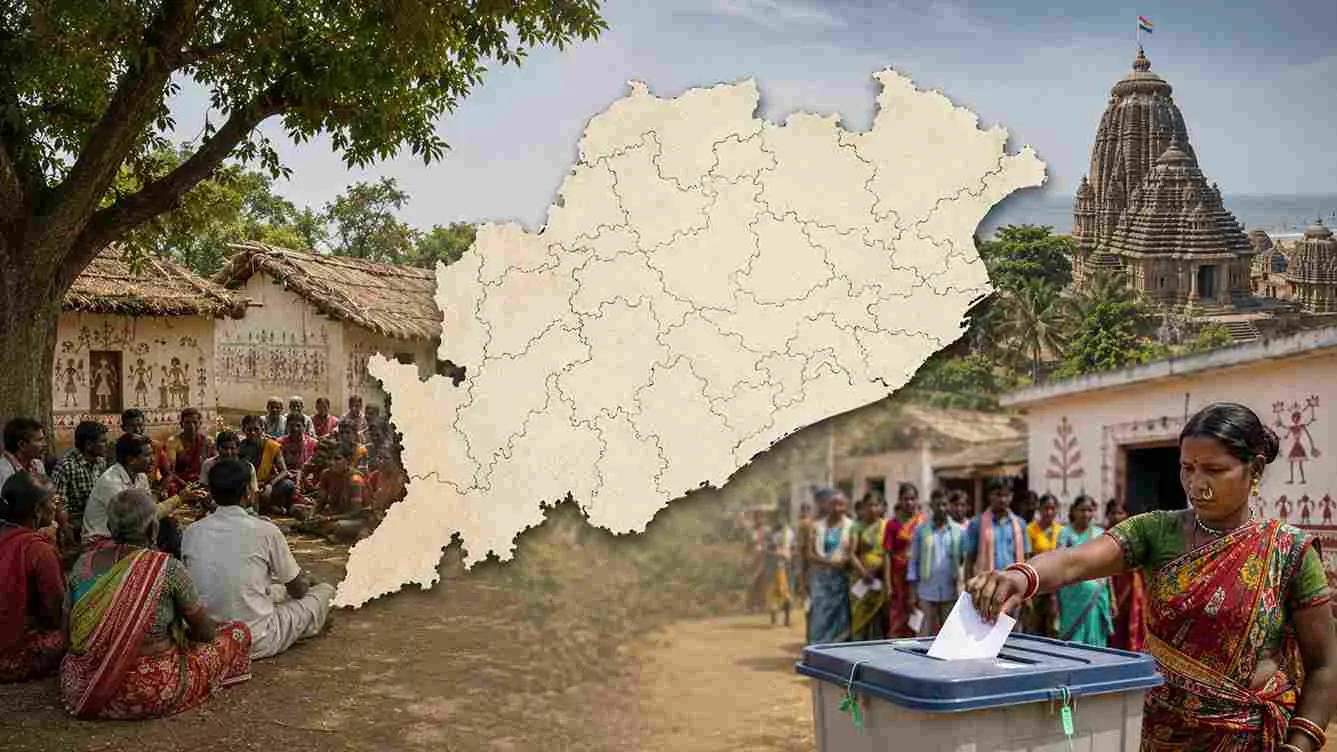
The statistical evidence demonstrates the scale of this realignment. The BJP’s vote shares reportedly climbed to nearly 46%, marking one of the most dramatic expansions of political support witnessed in contemporary Bengal. Seat conversion crossed the psychologically decisive 200-seat mark.
Voter turnout crossed 92% in several constituencies and remained exceptionally high statewide, indicating not voter apathy, but mass political mobilization. These figures point not merely to electoral victory, but to structural political reconfiguration. Yet statistics explain magnitude, not mechanism.
Also Read: Why India Still Struggles to Become an Economic Superpower Despite 35 Years of Reforms
Bengal’s Deep Cultural Politics
The deeper question remains: why did millions of voters emotionally accept this transition? The answer lies partly in Bengal’s distinctive political culture.
Unlike many regions where elections revolve primarily around welfare arithmetic or caste blocs, Bengal’s political identity has historically been intertwined with cultural legitimacy. Politics in Bengal lives in para conversations, literary memory, Durga Puja symbolism, intellectual performance, linguistic pride, and the emotional architecture of Bengali selfhood.
Political acceptance here requires more than organizational strength; it requires cultural embeddedness. For years, the All India Trinamool Congress successfully occupied that space. It positioned itself not merely as a governing party, but as the organic custodian of Bengali identity.
Modi’s Symbolic Connection With Bengal
The BJP, despite organizational expansion, frequently confronted the perception of being politically ambitious yet culturally external. The 2026 campaign marked a deliberate attempt to soften this insider-outsider binary.
It is within this context that symbolic campaign moments involving Narendra Modi acquired disproportionate significance. Among the most widely circulated images were those of Modi Ji publicly engaging with Bengal’s everyday street culture, symbolically represented through Jhalmuri.
Superficially, the gesture appeared ordinary—a leader consuming a local snack. Politically, however, it functioned as a semiotic intervention. The gesture communicated participation rather than mere presence. It suggested cultural familiarity rather than electoral distance.
Also Read: Why More Young People Are Suddenly Being Diagnosed With Parkinson’s Disease
Media Amplification and Narrative Power
In deeply cultural democracies, belonging is seldom established through ideological explanation alone; it is negotiated through recognizable gestures, rituals, textures, and symbols of everyday life. This is the central proposition of the ‘Jhalmuri Theory’ in culturally dense societies.
Media amplification further intensified this process. Campaign symbolism no longer remained confined to rallies or newspaper photographs. Short video clips, social media circulation, televised imagery, meme culture, and algorithm-driven repetition transformed isolated gestures into mass political narratives.
Whether praised as authentic or criticized as performative, the symbolism gained visibility. And in contemporary attention economies, visibility itself becomes political capital. Importantly, criticism did not necessarily weaken the symbolism; in many cases, it strengthened narrative circulation. The symbolic act ceased to be episodic. It became narrative infrastructure.
The Rise of ‘Sensory Politics’
The post-election phase perhaps offered the strongest validation to Jhalmuri, where it appeared repeatedly in celebrations following the results. What began as a campaign gesture evolved into a marker of political transition.
A simple cultural object had travelled from food, to performance, to symbol, to electoral iconography. This transformation carries wider implications for democratic analysis.
The Bengal election suggests that contemporary politics increasingly operates through what may be termed sensory politics—the politics of recognition, familiarity, aesthetics, emotional texture, and cultural participation.
Politics Beyond Governance
Voters do not engage with politics only through rational calculations of governance. They also ask deeper emotional questions—Who understands their cultural world? Who appears familiar rather than distant? Who can enter everyday life without appearing alien?
This is human political cognition functioning within cultural societies. This is what makes the ‘Jhalmuri Theory’ intellectually interesting. It demonstrates how symbolic capital can be converted into political capital.
The New Language of Indian Politics
Ultimately, the ‘Jhalmuri Theory’ is not about a snack, nor merely about campaign optics. It is about the mechanics of power in culturally rooted democracies.
Bengal’s transformation in 2026 was not delivered as a neatly packaged ideological doctrine. It emerged gradually—ingredient by ingredient, perception by perception, narrative by narrative—until millions encountered it as a coherent emotional experience.
Like Jhalmuri, the verdict was mixed from many elements—a little aspiration, a little anger, a little fatigue, a little symbolism, a little recognition, shaken together by media, culture, and political timing, and finally handed over to the electorate—light and simple in appearance, yet carrying the full weight of political history.
Author Details

Dr. Antarjeeta Nayak is a researcher and columnist with a Ph.D. in Economics from NIT Rourkela and a recipient of ICSSR Doctoral and Post-Doctoral Fellowships. Her research focuses on poverty and tribal development.
Reader Feedback
Was this article useful?
Stay Connected
Get the next important story before you miss it.
Subscribe to the newsletter for trusted updates, or join our WhatsApp channel for quick top-story alerts from The Eastern Times.
WhatsApp Channel
Prefer instant alerts? Join our WhatsApp channel for top stories and breaking updates.
Join on WhatsApp