
Rethinking Climate Action Through Tribal Ecologies: How Tribal Forest Practices Help India Combat Climate Change

Quick Summary
- Tribal communities protect forests, sacred groves, and biodiversity through sustainable traditional practices.
- Tribal-managed forests and agroforestry systems play a major role in carbon sequestration and climate change mitigation in India.
- Protecting tribal land rights and indigenous knowledge is essential for effective and sustainable climate action.
Tribal way of life is an essential tool for dynamic social change. Tribals are the custodians of indigenous and natural knowledge and key convenors of sustainable living and environmental conservation. They are guardians of the earth who do not appear in climate summits, sign no international treaties, and yet, quietly and consistently, shape one of the most effective responses to the climate crisis.
The tribal way of life is not merely a cultural identity; it is an ecological philosophy. Rooted in a sacred relationship between humans and nature, it offers a powerful counterpoint to extractive models of development.
At a time when the world is grappling with environmental degradation, tribal lifeworlds embody an alternative paradigm—one that is regenerative, respectful, and resilient.
Sacred Ecology and Tribal Settlements
Across regions such as Jharkhand, Chhattisgarh, Odisha, West Bengal, Bihar, and Assam, tribal villages are typically embedded within forests, farmlands, ponds, and pastures—landscapes that reflect a deeply integrated ecological design.
At the heart of these settlements lies the ‘Sarna Sthal’ or ‘Jaher Sthal’, a sacred public space of worship, often surrounded by Sal trees. These spaces are not merely religious sites; they are living ecological institutions.
Festivals such as Magh Parab, Baha Parab, Sohrai, and Sarhul are intimately tied to the Sal tree, which is considered the abode of the presiding deity.
For tribal communities, the Sal tree symbolizes the equilibrium between human life and nature. This reverence is not symbolic alone; it translates into sustainable practices. Leaves and seeds are harvested without harming the tree, ensuring continuity and regeneration.
What emerges here is an indigenous framework of environmental governance—one that modern policy discourse is only beginning to appreciate.
Carbon Sequestration and Climate Action
From an ecological point of view, public spaces are a unique means of ecological balance and natural carbon sequestration.
With rapid industrialization and population growth, carbon sequestration has become essential for India to meet its commitments to international climate goals by reducing atmospheric carbon emission levels, as the country is among the world’s largest emitters of greenhouse gases, accounting for about 7% of global carbon emissions.
Carbon sequestration is the process of capturing and storing atmospheric carbon dioxide (CO2) to mitigate the effects of climate change.
In a country like India, where more than 72.5 million hectares (21.67% of the geographical area) are forested (Forest Survey of India, 2013), there is immense potential for natural carbon sequestration, where tribals and their 'Sarna Sthal' covered with Sal trees play a major role.
Also Read: Why Has the PESA Act Not Been Implemented in Odisha Till Today?
Jharkhand’s Forest Contribution
Consider Jharkhand, which is home to a large tribal population and has a forest cover of 29.76%.
Most of these forests are managed through traditional tribal practices or indirectly through their cultural reverence for nature.
According to a 2022 estimate by the National Council of Agricultural Research, about 2.3 tonnes per hectare of carbon dioxide are sequestered from such vast forest areas every year.
This means that the forests of Jharkhand alone sequester about 54 million tonnes of carbon dioxide annually, a significant portion of which is managed by tribal communities.
Forests and Sacred Groves in West Bengal
According to the India State of Forest Report (ISFR) 2021, West Bengal has a total forest cover of 16,901 km2, which is 19.1% of the state's geographical area.
There are Santhal-specific areas such as Purulia with a forest cover of 1,655 sq km (about 29.5% of the district's area), Bankura with 1,506 sq km (about 22.5% of the district's area), Paschim Medinipur with 1,626 sq km (19.3% of the district's area), and Birbhum with 418 sq km (5.7% of the district's area).
Forests in the region, mainly comprising dry deciduous and Sal forests, are known for their high carbon sequestration capacity.
According to various environmental studies, Sal forests can sequester about 4–5 tonnes of carbon dioxide per hectare per year.
Based on these carbon sequestration rates, the combined forest cover area comprising the Santhal region of Purulia, Bankura, and Paschim Medinipur has the potential to sequester about 19 to 24 million tonnes of carbon dioxide annually.
The state has a forest cover of about 52,156 km2, which is 33.50% of the geographical area of the state (Forest Survey of India, 2023).
Most of this forest area is managed by indigenous communities and other tribes, including the Santhals.
Although the size of the public lands or Sarna sites varies, they are usually between 0.5 to 2 hectares.
Estimates suggest that the sacred Sal trees preserved in public lands or Sarna sites have the capacity to sequester 1.5 to 3 tonnes of carbon dioxide per hectare per year.
Also Read: Why Is Odisha Burning? The Real Reasons Behind Rising Forest Fires
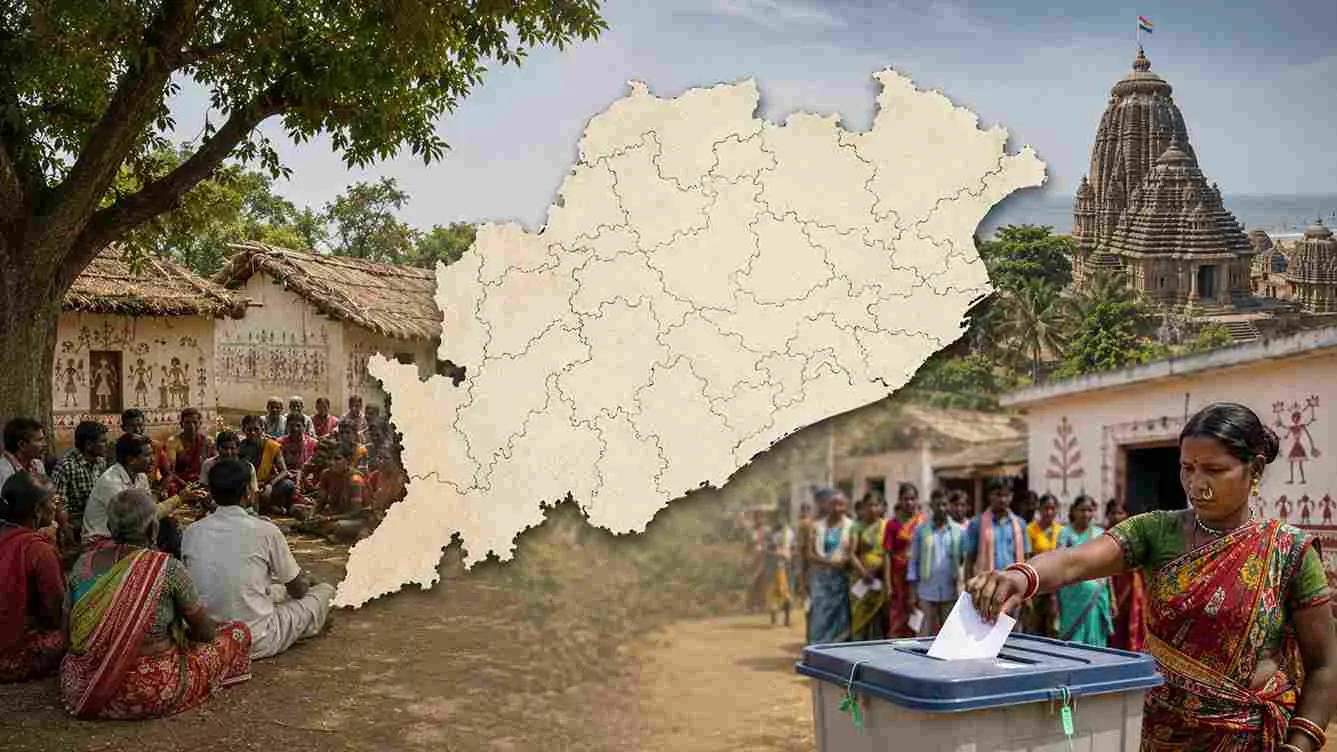
Odisha’s Tribal Ecology Model
In Odisha, where forest cover accounts for 33.50% of the geographical area (52,156 km²), the role of tribal communities is equally significant (Forest Survey of India, 2023).
Sacred groves or Sarna sites—typically ranging from 0.5 to 2 hectares—serve as micro-reserves of biodiversity and carbon storage (Malhotra, K. C., Gokhale, Y., Chatterjee, S., & Srivastava, S., 2001).
In districts like Mayurbhanj, which has approximately 3,966 tribal villages, these sacred spaces collectively span nearly 3,966 hectares (Census of India, 2011).
At sequestration rates of 1.5 to 3 tonnes per hectare annually, they capture between 5,949 and 11,898 tonnes of CO₂ each year—demonstrating how even small, community-managed spaces can generate substantial ecological benefits (International Union for Conservation of Nature (IUCN), 2022).


Agroforestry and Biodiversity Conservation
The importance of 'Sarna land' in carbon sequestration lies in its biodiversity and vegetation, especially large trees with extensive root systems that act as major carbon sinks.
Studies have shown that Sarna land managed by tribal villages, including tribal forests or sacred trees, stores 33% more carbon dioxide per hectare than other forest cover (International Union for Conservation of Nature, 2022).
In addition to preserving natural forests and sacred groves, indigenous peoples have historically practiced agroforestry, which includes the integration of trees and shrubs.
This practice not only ensures better crop yields and soil fertility but also increases carbon sequestration in agriculture.
Unlike monoculture farming, agroforestry increases biodiversity and stores carbon in both plants and soil.
Food and Agriculture Organization research has shown that agroforestry systems can sequester 1.1 to 2.2 tonnes of carbon dioxide per hectare per year, making it a powerful tool for climate mitigation.
Tribal villages, where agroforestry is central to agricultural practices, therefore play an important role in carbon sequestration.
Under programmes like Joint Forest Management, tribal communities have long been involved in reforestation efforts in collaboration with the government.
Through these initiatives, tribal communities not only help restore carbon-sequestering forests but also provide economic and environmental benefits.
In addition to direct carbon sequestration efforts, the contribution of tribal communities in conserving forest biodiversity and combating climate change is unparalleled.
For example, Similipal National Park in Odisha, which includes Santhal-managed forests, is a major biodiversity zone where different species of flora and fauna contribute to carbon sequestration.
Another example is bamboo forests in Santhal-administered areas of Jharkhand and Odisha. Bamboo can sequester up to 12 tonnes of carbon dioxide per hectare per year, making it one of the most efficient carbon sinks.
Threats to Tribal Lands and Knowledge Systems
Yet, despite these immense contributions, tribal communities remain on the margins of mainstream climate discourse.
Their lands are increasingly threatened by industrialization, mining, deforestation, and infrastructure expansion.
Displacement not only disrupts livelihoods but also dismantles ecological systems that have been sustained for generations.
This paradox—of being indispensable yet invisible—must be addressed if climate strategies are to be truly effective.
Why Indigenous Knowledge Matters
Aligned with United Nations Sustainable Development Goal 13 (Climate Action), the role of indigenous communities needs urgent recognition and integration.
Their practices offer more than cultural insight; they provide actionable frameworks for sustainability.
The knowledge of indigenous peoples about seasonal patterns and resource management also helps improve the environment, often without degrading the ecosystem.
Biodiversity conservation is an important component of climate action, as diverse ecosystems are increasingly important in reducing climate impacts.
Due to their deep connection with the environment, tribals have played an important role in the conservation of India's biological wealth.
Conservation of biodiversity by tribal communities not only helps in mitigating climate change by maintaining carbon-absorbing ecosystems, but also supports climate adaptation by ensuring sustainability and the well-being of local ecosystems.
As a result, it provides food security and water resources for both tribal and non-tribal populations.
Protecting tribal land rights, ensuring their participation in environmental governance, and embedding their knowledge systems into education and policy are not merely ethical imperatives—they are ecological necessities.
The Climate Wisdom the World Cannot Ignore
As the climate crisis intensifies, the world is searching for solutions.
Ironically, some of the most effective ones already exist—quietly practiced in the forests, fields, and sacred groves of tribal India.
To ignore them would be a profound oversight. To learn from them, however, could redefine the future of sustainability itself.
Author Details

Dr. Antarjeeta Nayak is a researcher and columnist with a Ph.D. in Economics from NIT Rourkela and a recipient of ICSSR Doctoral and Post-Doctoral Fellowships. Her research focuses on poverty and tribal development.
Reader Feedback
Was this article useful?
Stay Connected
Get the next important story before you miss it.
Subscribe to the newsletter for trusted updates, or join our WhatsApp channel for quick top-story alerts from The Eastern Times.
WhatsApp Channel
Prefer instant alerts? Join our WhatsApp channel for top stories and breaking updates.
Join on WhatsApp