
From Books to Reels: Endless Scrolling Is Silently Damaging Your Child’s Brain
A generation raised on screens is losing focus, imagination, and the habit of deep thinking.
Quick Summary
- Childhood reading habits are rapidly declining, replaced by excessive screen time, leading to reduced attention span, imagination, and love for books among children.
- Reading is crucial for brain development, emotional intelligence, empathy, and critical thinking, shaping not just individuals but the intellectual strength of society.
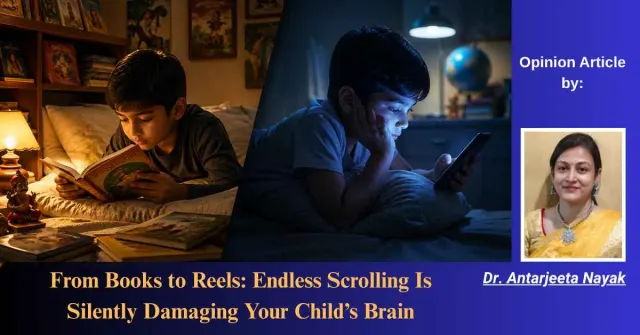
Once upon a time, the nights of childhood were filled with whispers of stories. Beneath soft pillows lay the familiar companions of growing minds — a worn copy of Chandamama, the playful pages of Tinkle, the clever wit of Tenali Rama, or the timeless wisdom of the Panchatantra. Before sleep, children travelled through kingdoms of talking animals, mischievous scholars, and brave princes.
Imagination was their passport, and books were the doorways. But today, that pillow hides something else. Bedtime stories have been replaced by endless scrolling, the calm turning of pages by the restless flicker of reels.
What once nurtured patience, wonder, and reflection has given way to a culture of speed, distraction, and instant gratification. This change has crept in almost unnoticed — yet it may be one of the most profound educational and social transformations of our time.
A Childhood Shift We Barely Noticed
Walk into any urban Indian home, and you’ll see a familiar scene — a child staring at a glowing rectangle, thumb dancing on the screen, eyes fixed in trance. On average, Indian children spend 3 to 4 hours a day on smartphones, according to a 2024 study by the Indian Council of Medical Research. The same study found a 40% decline in the time children spend on reading or outdoor play.
The shift isn’t just about time — it’s about attention. Reading builds patience, comprehension, and imagination. Scrolling rewards quick reaction and distraction. A Scholastic India survey revealed that only 32% of children say they “love reading books,” compared to over 60% two decades ago. The rest? They would rather watch a story than read one.
Why Books Are Losing to Screens
There are many reasons, each feeding into the next. The first is the digital temptation. The internet offers instant pleasure: short videos, flashing colors, quick rewards. It demands no patience, no imagination, no pause for reflection.
Reading, on the other hand, asks for stillness — it invites the mind to travel inward, to build worlds of its own. In an age addicted to speed, silence has become a rare luxury. The second culprit is our exam-centric education system, which teaches children to read for marks, not meaning. Textbooks have replaced storybooks, and comprehension has given way to cramming.

The Missing Libraries and Silent Homes
Then comes the vanishing library — the missing sanctuary of stories. According to UDISE 2023–24, only one in five government schools in India has a functional library. In many rural schools, the word “library” refers to a locked cupboard of outdated books.
How can we expect a child to fall in love with reading if there is no book to fall in love with? And finally, there are the silent homes — houses filled with smartphones but starved of stories. Children imitate what they see. A parent who reads raises a reader; a parent who scrolls raises a scroller.
When stories stop being told at dinner tables, when newspapers are replaced by newsfeeds, a subtle inheritance — of words, wonder, and wisdom — is lost.
Why Reading Shapes More Than Just Minds
Reading is not only an individual skill; it’s a cultural habit that shapes minds and societies alike. A nation that reads grows thinkers; a nation that stops reading breeds followers. Scientific research across neuroscience, psychology, and education confirms what grandparents have always known — reading transforms the brain.
Also Read: From Sea Voyages to Science: How Scurvy Shaped Human History
What Happens Inside the Brain While Reading
Reading is not merely a pastime; it’s a neurological symphony. Scientists call it “a miracle of the mind” — one of the most complex cognitive acts the human brain can perform. Functional MRI studies show that reading activates multiple regions simultaneously: the visual cortex for recognition of letters, the temporal lobe for language processing, the frontal lobe for reasoning, and the limbic system for empathy and emotion.
In short, each sentence a child reads strengthens the neural highways of thought, improving focus, comprehension, and emotional understanding. Children who read frequently develop denser neural connectivity, leading to stronger attention spans, better memory, and enhanced problem-solving ability.
A 2021 study in Nature Human Behaviour showed that reading fiction nurtures theory of mind — the capacity to understand others’ emotions and perspectives — which is vital for emotional intelligence and empathy. Moreover, the linguistic exposure from books builds a child’s vocabulary reservoir. Researchers at Ohio State University found that children exposed to regular reading learn 1.4 million more words by the age of five than those who did not.
Stories That Heal and Humanise
Reading is equally critical for emotional health. Psychologists call it “bibliotherapy” — reading as a tool for self-reflection and emotional regulation. Stories allow children to encounter fear, loss, courage, and kindness in safe, symbolic spaces. Through characters, they learn to navigate their own emotions.
Studies by the American Academy of Pediatrics highlight that children who read fiction display higher empathy scores and lower levels of aggression than those who don’t.
When a Society Stops Reading
Beyond the individual, reading builds collective intelligence — the capacity of societies to think critically and innovate. Reading builds cultural continuity, passing on stories, morals, and wisdom that shape collective identity.
It sustains democracy by fostering critical literacy — the ability to question, analyze, and evaluate information rather than consume it passively. The UNESCO Global Literacy Report warns that societies that lose their reading culture risk an “intellectual erosion” that weakens innovation and democratic participation.
When children lose the habit of reading, they lose the language of thought. They grow fluent in typing, but not in reflection; informed by data, but untouched by depth. The loss is not just academic — it is civilizational.

How We Can Bring Reading Back to Life
The remedies are not impossible; they only require imagination. Reading should not be preached — it should be made irresistible. Schools, parents, communities, and technology together can create a revival that feels both modern and magical.
Also Read: Dubai Economy After Iran Attack: Is It Still Safe for Investors?
Making Books Visible, Social, and Fun Again
Books shouldn’t be confined to classrooms. Reading corners can be created in bus stops, railway stations, panchayat offices, and health centres. Schools and housing colonies can set up “Book Banks” — shared shelves where children donate and borrow books freely.
Organising Book Exchange Melas once a month, where children trade stories they’ve read, creates excitement and circulation. Schools can appoint “Reading Ambassadors” — senior students who read aloud to juniors or conduct short sessions during breaks.
Families can make reading a daily bonding ritual. A simple “60-Minute Reading Hour” after dinner, where everyone reads silently, sends a powerful message that reading is not homework — it’s home work.
Encourage children to record audiobook versions of their favourite stories, turning them into digital storytellers. The aim is not just to make children read — it is to make reading fashionable, social, and joyful again.
The Crossroads We Stand At
Reading is the seed of civilization. It teaches children not just to decode words, but to decode the world. It builds imagination, empathy, and the courage to think independently.
Today, we stand at a critical juncture — between an age of information and an age of understanding. To cross safely, we need children who read.
Author Details

Dr. Antarjeeta Nayak is a researcher and columnist with a Ph.D. in Economics from NIT Rourkela and a recipient of ICSSR Doctoral and Post-Doctoral Fellowships. Her research focuses on poverty and tribal development.
Reader Feedback
Was this article useful?
Stay Connected
Get the next important story before you miss it.
Subscribe to the newsletter for trusted updates, or join our WhatsApp channel for quick top-story alerts from The Eastern Times.
WhatsApp Channel
Prefer instant alerts? Join our WhatsApp channel for top stories and breaking updates.
Join on WhatsApp