When Schools Become Factories: The Commercialisation of Education
Quick Summary
- Education is increasingly becoming a commercial enterprise rather than a public good.
- Rising school fees are placing a severe financial burden on middle-class families.
- Strong regulation and better public schools are essential to ensure quality, affordability, and equal opportunity.
Education has never been merely a service to be purchased in the marketplace. It is the foundation upon which democratic societies build citizenship, social mobility, innovation, and national character. Every constitutionally governed nation recognizes that schools are not commercial enterprises alone but public institutions entrusted with shaping future generations.
Yet across India, and increasingly in Odisha, a disturbing transformation is taking place. Many schools are gradually abandoning their educational mission to become commercial establishments where profit often takes precedence over pedagogy. The emergence of what may be described as "factory schools" poses a profound challenge to educational justice, social equality, and the constitutional promise of equal opportunity.
The Rise of Factory Schools
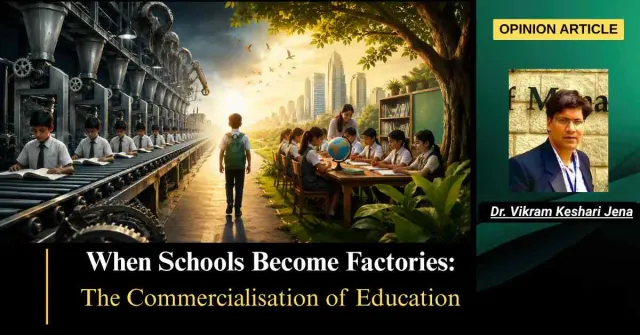
The expression "factory schools" reflects more than the rapid expansion of private education. It describes an institutional culture where education resembles an assembly line. Students are processed through standardized routines designed primarily to maximize examination scores and institutional revenues rather than intellectual curiosity, creativity, or civic responsibility.
The objective shifts from producing informed citizens to producing marketable academic results. Success becomes measured by rankings, admissions, and advertising campaigns instead of critical thinking, ethical reasoning, or independent judgment.
Beyond Marks: The Real Purpose of Education
This transformation has produced a troubling paradox. India undoubtedly produces some of the world's finest engineers, doctors, scientists, administrators, and entrepreneurs. Yet many educational institutions remain overwhelmingly examination-oriented.
Students often master memorization and competitive testing while receiving fewer opportunities to cultivate analytical reasoning, public ethics, creativity, or democratic engagement. Academic excellence should never be reduced to rote performance alone. A truly educated mind questions, evaluates evidence, respects diversity of opinion, and contributes constructively to society.
The Employability Gap
The consequences extend beyond classrooms into the broader economy. Every year thousands of students migrate from Odisha to other states in search of higher education and employment. Many possess excellent academic credentials but frequently encounter workplaces that increasingly value adaptability, communication, innovation, teamwork, and problem-solving alongside technical knowledge.
An education system that prioritizes marks over intellectual development risks producing graduates who excel in examinations but struggle to navigate rapidly changing professional environments. Education must prepare students not only for employment but also for responsible citizenship in a democratic society.
Also Read: Who Decides Indian Citizenship? Supreme Court Settles the Debate
The Burden of Rising School Fees
Perhaps the most alarming dimension of educational commercialisation is the relentless escalation of school fees. In several urban centres, annual fees charged by some private schools now rival or even exceed the tuition costs of many university programmes.
Parents routinely face additional expenditures for uniforms, transportation, books, digital platforms, compulsory activities, and miscellaneous institutional charges. For middle-class families, education has become one of the largest financial commitments of household life. Aspirations for quality education increasingly translate into long-term financial anxiety.
The Middle-Class Dilemma
The burden falls most heavily upon India's expanding middle class. Wealthier families often possess the resources to absorb rising educational expenses, while economically weaker sections benefit from various government welfare measures and reservation policies.
It is frequently middle-income households that experience the greatest pressure. Parents reduce savings, postpone healthcare, incur loans, or sacrifice other necessities to ensure that their children remain enrolled in reputed institutions. Education should represent an investment in opportunity, not a pathway into financial insecurity.
A Constitutional Responsibility
Such inequalities raise important constitutional questions. Article 21A guarantees the right to education, while the broader constitutional vision seeks equality of opportunity for all citizens.
Although private educational institutions perform an important role in expanding educational access, commercial considerations should never undermine the social purpose of education. The objective of educational policy must remain public welfare rather than unrestricted commercial expansion. Market principles alone cannot determine access to an essential public good.
Recognising the Contribution of Private Schools
This does not imply that private schools should be viewed as adversaries. Many private institutions have introduced excellent academic standards, modern infrastructure, innovative teaching methods, and global educational exposure. They have significantly contributed to educational development across the country.
However, excellence cannot become a justification for arbitrary fee escalation or opaque financial practices. Responsible regulation should encourage quality while preventing exploitation. Accountability strengthens genuine educational institutions by enhancing public confidence.
The Need for Sensible Regulation
Governments therefore have an important regulatory responsibility. Effective fee regulation does not mean imposing uniformity or discouraging private investment. Rather, it seeks transparency, fairness, and proportionality.
Independent fee regulatory committees, mandatory financial disclosures, public consultation, periodic audits, and grievance redressal mechanisms can ensure that educational costs remain reasonable while allowing institutions to maintain quality standards. Fee revisions should reflect demonstrable improvements in infrastructure, teacher development, and educational outcomes rather than unrestricted commercial discretion.
Revitalising Government Schools
Equally important is strengthening government schools. Parents often choose expensive private schools because they perceive significant differences in quality, infrastructure, English language instruction, extracurricular opportunities, and academic outcomes.
Improving public education would naturally reduce excessive dependence upon costly private alternatives. Investment in teacher training, digital learning resources, libraries, laboratories, sports facilities, and community participation can restore confidence in government institutions. A robust public education system remains the strongest guarantee against educational inequality.
Reimagining the Curriculum
Educational reform must also address curriculum. Schools should cultivate critical thinking, constitutional values, scientific temper, ethical reasoning, environmental responsibility, financial literacy, and civic participation alongside academic achievement.
Students must learn how to analyse evidence, question assumptions, engage respectfully with diverse viewpoints, and solve real-world problems. Nations prosper not merely because they produce skilled workers but because they nurture thoughtful citizens capable of democratic leadership and social responsibility.
Parents as Partners
Parents too deserve recognition as stakeholders rather than consumers. Their voices should be represented in school governance through meaningful parent associations and transparent institutional dialogue.
Educational institutions flourish when administrators, teachers, parents, and students collaborate in pursuit of shared educational goals instead of transactional relationships driven primarily by financial considerations.

Education Must Remain the Great Equaliser
The future of Odisha and India depends less upon the number of schools established than upon the quality and accessibility of education they provide. Schools cannot become exclusive spaces accessible only to those with increasing financial resources.
If rising educational costs continue to exclude deserving middle-class families, the promise of equal opportunity will steadily erode. Social mobility, which education has historically enabled, may gradually become constrained by economic privilege.
Education is the republic's greatest equaliser. It should expand opportunity rather than deepen inequality. Governments must ensure that regulation protects both educational excellence and social justice. Private institutions deserve the freedom to innovate, but that freedom must coexist with transparency, accountability, and affordability.
The purpose of a school is not simply to produce examination results or commercial success. Its highest responsibility is to cultivate informed minds, compassionate citizens, independent thinkers, and ethical leaders. A nation that allows education to become an unrestricted commercial marketplace risks transforming its classrooms into factories and its students into products. A democracy, however, requires something far more valuable: educated citizens whose minds remain free, critical, and capable of shaping a more just and inclusive future.
Author Details
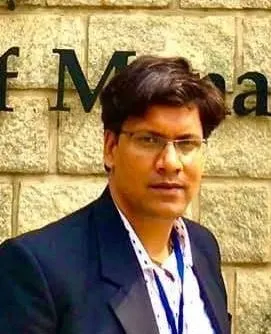
Dr. Vikram Keshari Jena is an academic, researcher, and public intellectual from Odisha. His work focuses on media, politics, development, public policy, and Indian knowledge traditions, with an emphasis on critical inquiry, social transformation, and interdisciplinary dialogue. He has authored numerous academic books and currently serves as the Founding Director of the Centre for Adivasi Research and Development (CARD), Odisha.
Reader Feedback
Was this article useful?
Stay Connected
Get the next important story before you miss it.
Subscribe to the newsletter for trusted updates, or join our WhatsApp channel for quick top-story alerts from The Eastern Times.
WhatsApp Channel
Prefer instant alerts? Join our WhatsApp channel for top stories and breaking updates.
Join on WhatsApp