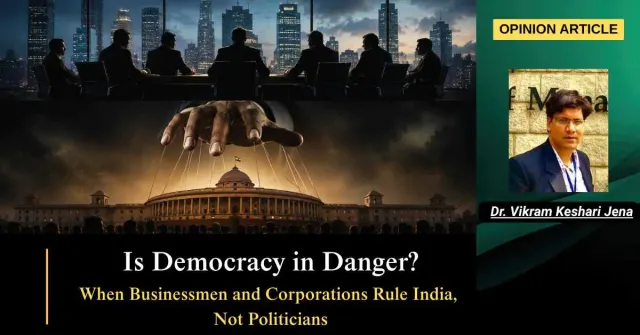
When Businessmen and Corporations Rule India, Not Politicians: Is Democracy in Danger?
Quick Summary
- Growing corporate influence over political funding and policymaking raises serious questions about who truly holds power in a democracy.
- Opaque political finance, lobbying, and policy capture can weaken institutional independence and public trust.
- India must strengthen transparency, accountability, and constitutional institutions to ensure that power ultimately remains with the people.
Throughout history, humanity has feared visible enemies. Empires conquered territories through military force. Terrorist organizations spread fear through violence. Yet the greatest threat to twenty-first-century democracies may neither arrive with armies nor announce itself through explosions. It advances quietly through boardrooms, campaign finance, lobbying networks, regulatory influence, and policy capture.
This silent concentration of economic power over democratic institutions represents one of the defining constitutional challenges of our age.
When Economic Power Begins Directing Democracy
The concern is not corporate enterprise itself. Modern economies cannot prosper without investment, innovation, entrepreneurship, and private industry. Corporations generate employment, create wealth, develop technology, and contribute significantly to national development.
The danger begins when economic power ceases to participate in democracy and instead starts directing it. When political authority becomes financially dependent upon concentrated corporate interests, democracy gradually transforms into an instrument of private influence rather than public representation.
The Constitutional Promise of “We, the People”
India’s Constitution begins with the timeless declaration, “We, the People.” Those three words establish the philosophical foundation of the Republic.
Sovereignty belongs neither to governments, political parties, bureaucracies, nor corporations. It belongs exclusively to the people. Every institution of governance derives legitimacy from this constitutional principle.
However, if public policy increasingly reflects the preferences of financial contributors rather than the aspirations of ordinary citizens, constitutional sovereignty risks becoming a legal fiction instead of a lived democratic reality.
Also Read:Maska Garla: How a Kandha Tribal Tradition Offers a Model for Sustainable Food Security
The Growing Cost of Elections
The growing cost of elections has intensified this challenge. Contemporary electoral campaigns require unprecedented financial resources for publicity, logistics, technology, digital outreach, and organizational management.
Such dependence inevitably creates incentives for political parties to seek substantial corporate funding. While campaign financing is not inherently unethical, opacity surrounding political donations undermines democratic accountability.
Citizens possess the constitutional right to know whether governmental decisions are influenced solely by public interest or whether financial relationships shape legislative priorities.
The Risk of Policy Capture
The consequences extend far beyond elections. Policy capture may influence taxation, mining concessions, environmental clearances, public procurement, infrastructure contracts, digital regulation, labour legislation, and natural resource governance.
Even where no criminal misconduct is legally established, excessive proximity between political authority and concentrated economic power creates conflicts of interest that weaken institutional credibility.
Democracy depends not only upon legality but also upon public trust.
The Rise of Informal Power Brokers
Equally concerning is the rise of informal power brokers operating between corporations, political leadership, and sections of the administrative machinery.
These intermediaries often exercise influence without constitutional responsibility. They neither contest elections nor remain accountable to Parliament, yet they may shape crucial governmental decisions behind closed doors.
Such networks undermine the neutrality of the civil service and diminish the rule of law by replacing transparent institutions with personalized access.
What Political Thinkers Warned Us About
Political philosophers have long warned against this concentration of influence. Aristotle argued that republics decay whenever rulers pursue private interests instead of the common good.
Kautilya insisted that the ruler’s prosperity depends entirely upon the welfare of the people. Mahatma Gandhi advanced the concept of trusteeship, emphasizing that wealth carries ethical obligations toward society rather than unlimited political authority.
Dr. B. R. Ambedkar repeatedly reminded the nation that political democracy cannot survive without social and economic justice.
These traditions converge upon a common insight: public institutions must remain accountable to citizens, not to concentrated centres of wealth.
Also Read: Odisha Becomes India’s Fourth Most Expensive State as Inflation Hits 5.15%
Corporate Influence Beyond Political Finance
Corporate influence today extends well beyond political finance. It increasingly shapes media ownership, digital platforms, public discourse, research priorities, educational institutions, and even the language through which development itself is understood.
Gross Domestic Product, stock market performance, and investment inflows frequently dominate policy debates, while questions concerning environmental sustainability, public health, educational quality, indigenous rights, labour dignity, and regional inequality receive comparatively less attention.
Development gradually becomes a financial statistic rather than a human achievement.
The Risk of an Oligarchic Republic
This trend poses a particularly significant challenge for developing societies. Economic inequality naturally translates into unequal political influence when institutional safeguards remain weak.
Citizens formally retain equal voting rights, yet access to policymakers, regulatory consultations, and legislative influence often becomes increasingly unequal.
Democracy therefore risks evolving into what political theorists describe as an oligarchic republic, where constitutional procedures survive but substantive equality steadily declines.
Strengthening Electoral Transparency
India possesses strong constitutional mechanisms capable of resisting such capture, but they require continuous strengthening.
Electoral finance must become substantially more transparent. Every significant political contribution should be disclosed through publicly accessible digital platforms within a defined timeframe. Political parties should undergo mandatory independent financial audits.
The Election Commission should receive enhanced institutional capacity to monitor campaign expenditure effectively. Parliamentary committees must exercise more rigorous scrutiny over regulatory decisions involving significant public resources.
Bringing Lobbying Into the Light
Equally important is the legal regulation of lobbying. Lobbying exists in every modern democracy. The objective should not be denial but transparency.
A statutory framework requiring disclosure of lobbying activities, meetings with public officials, policy submissions, and financial interests would allow citizens to understand how major policy decisions are shaped.
Transparency discourages undue influence while preserving legitimate policy consultation.
Protecting the Independence of the Civil Service
Civil service reforms must reinforce bureaucratic independence. Fixed tenure for key administrative positions, merit-based appointments, protection against arbitrary transfers, and stronger vigilance mechanisms would reduce opportunities for external influence.
Bureaucrats should remain accountable exclusively to constitutional authority and the rule of law rather than informal political or corporate pressures.
Preserving Institutional Autonomy
The judiciary, constitutional watchdog institutions, and investigative agencies must equally preserve institutional autonomy.
Their credibility depends upon the impartial enforcement of law, irrespective of economic or political status. Democratic legitimacy cannot survive if citizens believe that accountability varies according to wealth or influence.
Democracy Requires an Informed Citizenry
However, institutional reform alone cannot secure democracy. The deeper solution lies within civic culture.
Education must move beyond examination-oriented learning toward constitutional literacy, public ethics, economic reasoning, and critical thinking. Schools and universities should prepare informed citizens capable of evaluating public policy independently rather than merely producing employable graduates.
A democracy is ultimately protected not by its laws alone but by the political maturity of its citizens.
The Need for Better Political Leadership
Political leadership also requires renewal. Electoral success should not become the sole qualification for governance.
India needs leaders possessing intellectual depth, administrative competence, constitutional understanding, and ethical commitment beyond partisan calculations.
Public office must be regarded as a constitutional trusteeship rather than an avenue for personal enrichment or political patronage. The quality of governance ultimately reflects the quality of leadership that democratic society chooses to reward.
Technology as a Tool for Democratic Accountability
Technology offers unprecedented opportunities for democratic accountability.
Open government data, real-time disclosure of public expenditure, digital procurement systems, participatory budgeting, social audits, artificial intelligence-based compliance monitoring, and accessible citizen grievance platforms can substantially reduce opportunities for opaque governance.
Digital transformation should strengthen democratic participation rather than merely administrative efficiency.
India at a Defining Constitutional Moment
India stands at a defining constitutional moment. It aspires simultaneously to become a leading global economy and the world’s most vibrant democracy.
These ambitions are compatible only if markets remain accountable to constitutional values and governments remain accountable to citizens.
Economic growth cannot substitute for democratic legitimacy, just as electoral victories cannot replace constitutional morality.
The Greatest Danger Is Internal Capture
The greatest danger confronting any republic is not external conquest but internal capture.
Democracies seldom disappear overnight. They gradually lose their moral centre when wealth acquires greater influence than citizenship, when policy serves privilege rather than justice, and when public institutions begin responding more readily to financial power than constitutional principle.
The true measure of democratic success is therefore not merely the frequency of elections or the pace of economic growth. It is whether the poorest citizen possesses the same moral worth in the eyes of the state as the wealthiest corporation.
Preserving the Republic’s Founding Promise
India’s future will ultimately depend upon preserving this constitutional equilibrium.
Markets must generate prosperity. Governments must protect justice. Institutions must remain independent. Citizens must remain vigilant.
Only then will the Republic continue to honour its founding promise that sovereignty resides not in wealth, not in power, and not in privilege, but in the collective conscience of its people.
Author Details
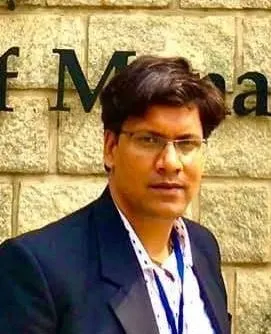
Dr. Vikram Keshari Jena is an academic, researcher, and public intellectual from Odisha. His work focuses on media, politics, development, public policy, and Indian knowledge traditions, with an emphasis on critical inquiry, social transformation, and interdisciplinary dialogue. He has authored numerous academic books and currently serves as the Founding Director of the Centre for Adivasi Research and Development (CARD), Odisha.
Reader Feedback
Was this article useful?
Stay Connected
Get the next important story before you miss it.
Subscribe to the newsletter for trusted updates, or join our WhatsApp channel for quick top-story alerts from The Eastern Times.
WhatsApp Channel
Prefer instant alerts? Join our WhatsApp channel for top stories and breaking updates.
Join on WhatsApp