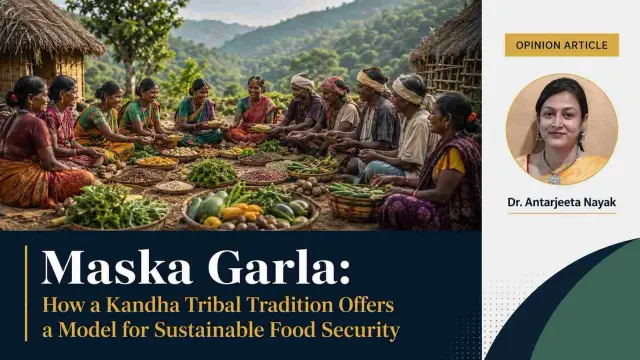
Maska Garla: How a Kandha Tribal Tradition Offers a Model for Sustainable Food Security
Quick Summary
- Maska Garla is a traditional Kandha system of food sharing and exchange that strengthens community food security.
- The practice promotes dietary diversity, reduces food waste and helps conserve agrobiodiversity and ecological balance.
- With community-owned technology and institutional support, it could evolve into a sustainable model for tribal livelihoods and food governance.
Among the Kandha tribes of Odisha, the traditional practice known as Maska Garla represents an indigenous system of community-based food sharing and exchange that functions as an informal yet highly resilient socio-economic institution.
In the Kandha language, Maska refers to “distributing and eating together,” while Garla denotes “exchange and collective consumption.” Together, the concept embodies a culturally embedded mechanism through which households circulate surplus food, forest produce, grains, tubers, seeds, and seasonal harvests within the community.
Rather than operating merely as a ritual or symbolic custom, Maska Garla functions as a localized system of mutual aid, redistributive exchange, and collective food security that sustains both social cohesion and ecological balance.
A Traditional System of Food Security
From the perspective of development economics and community resilience theory, Maska Garla can be interpreted as a localized system of informal/traditional food banking, risk-sharing, and cooperative redistribution.
In many remote tribal regions where access to formal markets, storage facilities, and institutional food-security mechanisms remains limited, such indigenous institutions play a crucial role in stabilizing food availability.
By enabling the circulation of surplus produce across households, the practice reduces the risk of food concentration within a few families and facilitates equitable access to available resources.
This redistributive mechanism effectively mitigates seasonal food shortages and buffers communities against agricultural uncertainties, climatic variability, and livelihood shocks.
Also Read: From Mann Ki Baat to Jan Ki Baat: Why India Needs Two-Way Communication
Strengthening Nutrition and Dietary Diversity
The system also contributes significantly to nutritional security and dietary diversity.
Through the exchange of diverse food items—including millets, pulses, wild fruits, edible leaves, mushrooms, tubers, and forest-derived foods—households gain access to a broader spectrum of locally available nutrients than they might produce individually.
From a nutritional science perspective, such diversity strengthens community health by improving micronutrient intake and reducing dependence on a limited set of staple crops.
In contrast to standardized monocultural diets, the food diversity embedded within Maska Garla reflects a more balanced and ecologically rooted nutritional framework.
Preserving Agrobiodiversity and Ecological Balance
Equally important is the ecological dimension of Maska Garla.
The food items circulating within the Maska Garla network largely originate from diverse agro-ecological systems, including millet-based agriculture, shifting cultivation, forest gathering, and household kitchen gardens.
Because the practice relies on a multiplicity of crops and forest foods rather than monocultural production systems, it implicitly promotes agrobiodiversity conservation and sustainable resource management.
Traditional seed varieties, seasonal harvesting cycles, and localized ecological knowledge are sustained through the continued cultivation, collection, and exchange of diverse food resources.
In this way, Maska Garla functions not only as a socio-economic institution but also as a cultural mechanism that maintains the ecological equilibrium between tribal communities and their surrounding landscapes.
Maska Garla and the Sustainable Development Goals
The relevance of Maska Garla can also be understood more clearly when examined through the lens of global sustainability frameworks, particularly the United Nations Sustainable Development Goals (SDGs).
These goals provide an integrated framework for addressing poverty, food security, ecological sustainability, and inclusive development. Many of the functional features of Maska Garla correspond closely with the principles embedded within this global agenda.
Also Read: Odisha Govt to Develop Model Villages on Smart City Lines
SDG 2: Zero Hunger
First, the practice contributes significantly to Sustainable Development Goal 2 (Zero Hunger) by enhancing equitable access to nutritious food and reducing seasonal food scarcity in vulnerable regions.
From an economic perspective, this system functions as a community-level risk-pooling mechanism, where food surpluses in one household compensate for shortages in another.
As a result, the probability of extreme food deprivation within the community declines, strengthening local food security without relying solely on external institutional interventions.
SDG 12: Responsible Consumption and Production
Second, the practice aligns with Sustainable Development Goal 12, which emphasizes efficient resource use, reduction of food waste, and sustainable consumption patterns.
In many modern food systems, surplus production often leads to waste due to inadequate storage, market access, or distribution channels. Maska Garla reduces such inefficiencies by ensuring that excess produce is redistributed within the community rather than wasted.
The collective sharing system promotes resource circularity, where food flows continuously among households instead of remaining idle or being discarded, minimizing waste while maximizing the social utility of available resources.
SDG 15: Life on Land
Third, the ecological dimensions of the system support Sustainable Development Goal 15, which focuses on protecting terrestrial ecosystems and biodiversity.
Because the practice encourages the circulation and consumption of a wide variety of crops and forest foods, it indirectly sustains agrobiodiversity.
This diversity strengthens ecological resilience by preventing overdependence on monocultural agriculture and by preserving indigenous seed varieties and traditional harvesting knowledge.
An Ecological Ethic of Sharing with Nature
An important ecological ethic embedded within Maska Garla, which aligns with SDG 12 (Responsible Consumption and Production), is that tribal households do not harvest agricultural produce exhaustively for human consumption.
Instead, a portion of the crop is intentionally left in the fields or surrounding landscapes, allowing insects, birds, small mammals, and other living organisms to feed on it.
This culturally embedded restraint reflects a traditional understanding that agricultural landscapes are shared ecological spaces rather than exclusively human domains.
By allowing other species to access part of the harvest, the system helps sustain local food chains, supports pollinators and soil organisms, and contributes to the maintenance of ecological balance.
Such practices enhance biodiversity at the farm level and reinforce the interdependence between human subsistence systems and the broader ecosystem.
In this way, Maska Garla not only promotes food sharing among people but also embodies an implicit principle of ecological reciprocity, where nature itself is recognized as a participant in the food system.
This reinforces biodiversity conservation while sustaining the long-term productivity and resilience of tribal agro-ecosystems.
Also Read: When the Right to Privacy Does Not Apply in India - What the Court's latest ruling said
Building Community Resilience and Social Solidarity
Beyond food and ecological systems, Maska Garla also contributes to broader social development objectives.
At the social level, the collective nature of the exchange network strengthens community resilience and social solidarity.
By strengthening social networks and collective responsibility, Maska Garla enhances the community’s capacity to cope with environmental, economic, and social uncertainties.
This demonstrates that traditional institutions can provide valuable models for sustainable development by integrating social cooperation, ecological stewardship, and economic resilience within a single community-based framework.
From Traditional Practice to a Tribal Food Commons
In the contemporary development context, Maska Garla holds significant potential to evolve into a hybrid traditional–technological food governance model that integrates indigenous knowledge systems with modern digital infrastructure.
With appropriate institutional support, this practice could be developed into a structured “Tribal Food Commons” that combines community-based exchange with decentralized food management systems.
Digital platforms and mobile-based applications could be used to document seasonal food availability, monitor surplus production, and coordinate exchange networks across villages.
Such systems could function as localized digital food banks, enabling tribal farmers and forest gatherers to record and share their produce within community networks and coordinate exchange, distribution, or collective marketing.
Integrating Technology with Indigenous Knowledge
Further integration with geospatial mapping technologies, blockchain-based traceability systems, and digital marketplaces could enhance transparency and ensure fair value realization for tribal producers.
These technologies would allow indigenous food products—including millets, forest honey, medicinal plants, and organically cultivated crops—to reach broader regional and digital markets while maintaining traceability and authenticity.
However, it is crucial that such technological integration remains community-owned and culturally sensitive, ensuring that the intellectual heritage and ecological knowledge embedded in tribal food systems remain under the control of the indigenous communities themselves.
Creating Sustainable Tribal Livelihoods
At the livelihood level, the modernization of Maska Garla could support community-centered value chain development.
Cooperative processing units could transform locally produced millets, dried forest foods, herbal products, and traditional nutritional mixes into value-added commodities linked to regional and digital markets.
Tribal youth trained in digital literacy, logistics coordination, and supply-chain management could operate inventory systems, digital marketing platforms, and decentralized distribution networks.
Through this process, Maska Garla could gradually evolve from a subsistence-oriented sharing mechanism into a community-driven circular economy, where biodiversity conservation, traditional knowledge, and technological innovation operate in synergy.
A Model for Sustainable Development
Ultimately, Maska Garla illustrates that indigenous institutions often embody highly sophisticated systems of social organization, ecological stewardship, and economic resilience.
Recognizing and strengthening such systems can provide valuable insights for contemporary development policy and sustainable food governance.
When supported by appropriate technological infrastructure, institutional recognition, and participatory governance frameworks, Maska Garla could serve as a replicable model for community-based food security, biodiversity conservation, and inclusive tribal livelihoods.
The broader lesson emerging from this example is profound: pathways toward sustainable development may not lie solely in the creation of new technological solutions, but also in the revitalization and adaptive integration of the ecological wisdom embedded within indigenous cultures.
Author Details

Dr. Antarjeeta Nayak is a researcher and columnist with a Ph.D. in Economics from NIT Rourkela and a recipient of ICSSR Doctoral and Post-Doctoral Fellowships. Her research focuses on poverty and tribal development.
Reader Feedback
Was this article useful?
Stay Connected
Get the next important story before you miss it.
Subscribe to the newsletter for trusted updates, or join our WhatsApp channel for quick top-story alerts from The Eastern Times.
WhatsApp Channel
Prefer instant alerts? Join our WhatsApp channel for top stories and breaking updates.
Join on WhatsApp