
India’s Child Mental Health Crisis: Unheard, Unseen, Unhealed
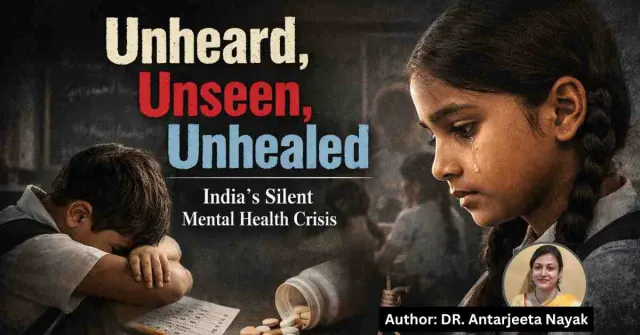
Quick Summary
- Mental health issues in children rising.
- Lack of awareness and support systems.
- Urgent need for intervention.
Amidst the global pursuit of educational excellence, economic development, and digital innovation, an invisible crisis is unfolding—one that is quietly eroding the future of humanity.
In a country celebrated for its demographic dividend and youth-driven potential, a silent erosion is occurring. Hidden behind exam ranks, school uniforms, and disciplined routines is a deep, unattended crisis: the quiet disappearance of mental wellness among Indian children.
It is not a sudden collapse but a gradual fading—a kind of vanishing that doesn’t make noise but leaves lifelong scars. India’s social structure, cultural expectations, and deeply ingrained stigmas have collectively rendered children’s emotional pain invisible, unspoken, and often invalidated.
As a result, mental health among children in India is not just neglected—it is denied.
Alarming Data and Growing Reality
Mental health disorders are now among the leading causes of illness among children and adolescents globally. According to the World Health Organization (2021), 1 in 7 children aged 10–19 experiences a mental disorder.
Depression, anxiety, and behavioral disorders are among the top causes of illness and disability for this age group. Suicide is the fourth leading cause of death among 15–19-year-olds.
In India, the situation is even more alarming. The country is home to over 430 million children under 18—the largest child population in the world. Yet, we remain unprepared for the scale of their mental health needs.
As per the National Mental Health Survey (2015–16), 13.7% of India’s population suffers from mental disorders. A Lancet (2021) study estimated a 23% rise in mental health issues among Indian children between 2000 and 2019.
UNICEF India (2021) reports that over 50% of adolescents show symptoms of anxiety and depression, yet fewer than 10% receive professional help.
This reflects not just an epidemic, but a systemic neglect of children’s emotional lives—a slow bleed.
Pressure, Screens, and Emotional Isolation
Today’s children grow up in hypercompetitive, overstimulated, and emotionally barren environments. The pressure to succeed academically and socially, combined with constant digital exposure, creates a toxic web of stress.
A 2023 UNICEF report found that over 37% of Indian teenagers feel stressed due to academics, while more than 50% experience exam anxiety.
Screen time has doubled in the last decade, leading to sleep disorders, anxiety, and attention problems.
The COVID-19 pandemic worsened this crisis. School closures, lack of peer interaction, and family stress created what experts call a “social drought”—a phase of emotional isolation.
Children today may know how to operate devices early, but many struggle to understand or express their own emotions.
Silence Within Families
In many Indian families, emotional distress is rarely acknowledged. Instead, it is often misinterpreted as drama, laziness, or disobedience.
Children are told things like:
- “Don’t cry like a girl”
- “What do you have to be depressed about?”
This denial stems from stigma, cultural expectations of endurance, and intergenerational silence around emotions.
A 2019 survey found that nearly 80% of Indian parents viewed mental health issues as attention-seeking. Another study showed 70% of parents were unwilling to accept that their child could have a mental health problem.
The need to maintain a “perfect family” image often overrides real emotional needs. As a result, children internalize distress, which later appears as aggression, withdrawal, or even physical illness.
School and Social Pressures
Beyond families, the wider environment reinforces emotional suppression. From a young age, children are judged by marks and ranks.
Despite high school enrolment, emotional well-being remains largely ignored. Most schools lack counsellors or mental health support systems.
Gender roles further worsen the issue:
- Boys are told to suppress emotions
- Girls are expected to adjust and stay silent
Marginalized children—those from SC, ST, OBC, rural, or low-income backgrounds—face additional emotional stress due to discrimination and lack of support.
This deepens their vulnerability and isolation.
Long-Term Consequences
Mental health is not isolated—it affects every aspect of a child’s life.
Untreated mental health issues can lead to:
- Poor academic performance and school dropout
- Physical health problems due to chronic stress
- Substance abuse and risky behavior
- Lifelong mental illness
Children with mental health disorders are three times more likely to drop out of school.
According to NCRB (2022), over 13,000 students died by suicide in India—a stark indicator of emotional distress.
The cost of ignoring this crisis is generational.



Signs of Hope
Despite the grim situation, there is hope. Early intervention, awareness, and supportive environments can reduce the impact of mental illness.
Countries like Finland, Canada, and Australia have integrated mental health education into schools.
In India, initiatives like Manodarpan, UNICEF’s campaigns, and school mental health programs are slowly building awareness and support systems.
Investing in counsellors, helplines, and parental education can make a real difference.
A Call to Listen
Mental health issues do not arrive loudly—they seep in silently through unspoken trauma, anxiety, and grief.
A generation is growing up learning how to compete and comply, but not how to cope or connect.
Every time a child is told to “be strong” instead of “what’s wrong?”, a door closes on their emotional growth.
This is not just a health issue—it is moral, social, and economic.
The silence of children is not always peaceful. Sometimes, it is a scream we have failed to hear.
Author Details

Dr. Antarjeeta Nayak is a researcher and columnist with a Ph.D. in Economics from NIT Rourkela and a recipient of ICSSR Doctoral and Post-Doctoral Fellowships. Her research focuses on poverty and tribal development.
Poll
What do you think is the biggest cause of stress among children today?
Reader Feedback
Was this article useful?
Stay Connected
Get the next important story before you miss it.
Subscribe to the newsletter for trusted updates, or join our WhatsApp channel for quick top-story alerts from The Eastern Times.
WhatsApp Channel
Prefer instant alerts? Join our WhatsApp channel for top stories and breaking updates.
Join on WhatsApp