
Are Parents Failing Their Children? The Paradox of Modern Parenting
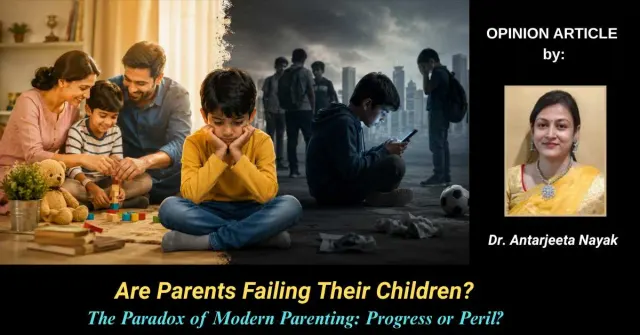
Quick Summary
- Modern parenting often prioritises protection over discipline, reducing children's resilience and accountability.
- Overindulgence and weak boundaries can contribute to entitlement, poor emotional coping, and behavioural problems.
- Children need both love and discipline to grow into responsible, resilient adults and responsible citizens.
Think back forty years. Childhood looked very different.
Returning home with a bruised knee after an afternoon of play rarely earned instant sympathy. Instead, mothers often greeted us with stern questions: "Why were you running so carelessly? How many times have I told you to be careful?" A quick slap or a sharp scolding frequently followed.
The same happened after playground quarrels. Parents did not immediately defend their children or confront the neighbour. Their first instinct was to ask, "What did you do?" If their own child was responsible, another scolding—or sometimes a beating—was likely.
Such methods would rightly be questioned today. Yet behind them lay an important lesson: childhood was seen as preparation for life. Before comfort came responsibility. Children learned that actions had consequences, mistakes required correction, and discipline was part of growing up.
The Rise of Protective Parenting
Modern parenting has changed dramatically.
Physical punishment has rightly fallen out of favour. But what should have replaced it—patient guidance, moral reasoning, and consistent discipline—has often been replaced by overprotection and excessive indulgence.
Many parents today hesitate to say "no." With smaller families and often a single child, restrictions feel harsh. Love increasingly becomes permission.
When children misbehave, parents often look for someone else to blame. Teachers, classmates, schools, or society become the convenient targets. Instead of correcting their children, many parents become their lawyers—defending every action, justifying every mistake, and shielding them from criticism.
This instinct comes from love. Yet by protecting children from every discomfort, parents may also be protecting them from the very experiences that build resilience, accountability, and emotional strength.
When Good Behaviour Goes Unnoticed
A troubling pattern is becoming increasingly visible.
Polite, disciplined children are often expected to adjust, while aggressive or stubborn children dominate social situations. The child who follows rules is told to compromise. The child who breaks them often faces few consequences.
Good behaviour receives little recognition, while misconduct attracts endless excuses.
Children quickly learn this lesson. If bad behaviour carries no cost, why change?



Friendship as a Strategy
Even childhood friendships are changing.
What was once spontaneous and innocent is increasingly becoming transactional. Some children are encouraged—directly or indirectly—to befriend classmates whose parents hold influential positions, believing such relationships may provide academic or social advantages.
Friendship becomes an investment rather than a bond.
When children grow up believing relationships exist for personal gain, they gradually lose the values of loyalty, empathy, and mutual responsibility.
Children Need Boundaries, Not Just Love
Developmental psychology has long shown that children require boundaries to develop self-control, moral judgement, and emotional maturity.
Children who are never corrected do not become freer. They become less prepared for life.
Without experiencing disappointment, failure, or consequences, they struggle to regulate anger, accept rejection, or respect authority. Constant praise creates an expectation of constant validation.
As these children grow older, unchecked behaviour often evolves into entitlement, and entitlement can easily turn into aggression.
Also Read: Organic Farming vs Modern Agriculture: Can India Feed 145 Crore People Without Chemical Fertilizers?
A Growing Social Concern
This concern is no longer merely theoretical.
Data from the National Crime Records Bureau (NCRB) shows a steady rise in juvenile involvement in offences ranging from assault and theft to cybercrime and sexual offences. Significantly, many young offenders now come from financially secure and educationally privileged families.
The issue is increasingly not one of poverty, but of parenting.
Researchers studying juvenile delinquency repeatedly identify poor parental supervision, emotional overindulgence, and the absence of consistent discipline as major contributing factors.
Children who never face consequences at home often struggle to accept rules outside it.
The Hidden Mental Health Cost
Overprotection carries another, less visible consequence.
Many young adults who appear deeply loved still struggle with anxiety, depression, and emotional breakdowns when confronted with failure.
Having rarely experienced setbacks during childhood, they often lack the resilience to cope with academic disappointment, unemployment, career stagnation, or relationship failures.
Failure no longer feels temporary. It feels catastrophic. Without emotional endurance, disappointment can become overwhelming.
Also Read: From Books to Reels: Endless Scrolling Is Silently Damaging Your Child’s Brain
When Parenting Shapes Society
The consequences extend beyond individual families.
A child raised without accountability may grow into an adult who blames others, manipulates relationships, rejects authority, and avoids responsibility.
When such patterns spread across millions of households, society itself begins to weaken. Trust declines. Institutions struggle. Civic responsibility erodes.
Parenting is therefore not merely a private matter—it is a public one.
Finding the Right Balance
None of this is an argument for returning to fear-based or violent parenting.
Children deserve affection, respect, and emotional security. But they also need correction, boundaries, and consequences.
Parenting is not about protecting children from every hardship. It is about preparing them to face hardship with character, resilience, and responsibility.
The family is society's first classroom. When families fail to teach accountability, schools cannot fully compensate. When schools struggle, society eventually pays the price through rising crime, emotional instability, and weakened social trust.
India's future will not be determined by technology or economic growth alone. It will also depend on the values being taught around dining tables, in playgrounds, and within families today.
Bad parenting does not merely shape difficult childhoods. It shapes the future of society itself.
Author Details

Dr. Antarjeeta Nayak is a researcher and columnist with a Ph.D. in Economics from NIT Rourkela and a recipient of ICSSR Doctoral and Post-Doctoral Fellowships. Her research focuses on poverty and tribal development.
Reader Feedback
Was this article useful?
Stay Connected
Get the next important story before you miss it.
Subscribe to the newsletter for trusted updates, or join our WhatsApp channel for quick top-story alerts from The Eastern Times.
WhatsApp Channel
Prefer instant alerts? Join our WhatsApp channel for top stories and breaking updates.
Join on WhatsApp