
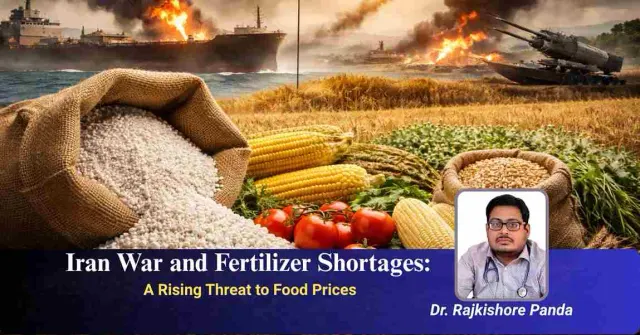
Iran War and Fertilizer Shortages: A Rising Threat to Food Prices
Quick Summary
- Iran conflict is disrupting fertilizer supply, pushing up food prices.
- Global dependency and export restrictions are worsening the crisis.
- India may face rising costs despite better fertilizer stocks.
As the conflict in the Middle East continues to escalate, a worrying possibility is emerging — people across the world may soon have to pay more for food.
The Middle East, especially the Persian region, is not just rich in oil and gas. It is also a major hub for fertilizer production, thanks to the easy availability of energy. Over time, this has led to the growth of large-scale factories producing essential raw materials for fertilizers, particularly nitrogen-based ones.
Nitrogen fertilizers are critical for soil health, and urea is one of the most widely used examples. At present, while fertilizer production in the region is running smoothly, exports are facing disruptions. The key reason behind this is the blockade of the Strait of Hormuz.
If this situation continues, prices of both raw materials and fertilizers like urea will rise sharply. This, in turn, could significantly reduce global food grain production.
Chris Lawson, Vice President of the London-based research firm CRU, has described this situation as “unfortunate,” warning that the world remains heavily dependent on the Middle East for fertilizers and their components.
A Lesson the World Has Seen Before
This is not the first time such a crisis has unfolded. During the Russia-Ukraine war, the world witnessed a similar disruption.
Both Russia and Ukraine are major exporters of fertilizers. When the war broke out, supply chains were affected, leading to food shortages from Africa to Asia. Farmers, facing fertilizer scarcity, reduced usage, which ultimately lowered crop yields.
Fertilizers are broadly classified into three types — nitrogen, phosphorus, and potassium.
According to the International Fertilizer Association, five key countries using the Hormuz route — Iran, Saudi Arabia, Qatar, Bahrain, and the UAE — together produce more than one-third of the world’s urea, one-fourth of ammonia, and one-fifth of phosphate-based fertilizers.
Qatar Energy has also pointed to shortages of LNG (liquefied natural gas) as a contributing factor.
Experts believe that this heavy global dependence on a few Middle Eastern nations is the root cause of the current crisis. The situation serves as a clear reminder — overdependence on a specific region for essential resources can have serious consequences.
In response, several countries have already started investing in renewable energy like solar and wind to reduce reliance on oil and gas.
Can India Reduce Its Dependence?
Raju Patel, a researcher at the University of Texas, suggests that India should reduce its dependence on fertilizers routed through Hormuz.
In recent times, India and Brazil have been encouraging farmers to use alternatives like cow dung and locally available fertilizers. Patel has appreciated this move, calling it a step in the right direction.
However, from a practical standpoint, this approach may work in the long term, but it is not a viable immediate solution.
Prices Rising, Pressure Increasing
China, another major fertilizer exporter, has imposed restrictions on exports to protect its domestic farmers amid geopolitical uncertainty.
At the same time, urea prices have jumped from $485 per ton to $565 — an increase of nearly 17%.
This rise will have widespread consequences. Many African and Asian countries may be forced to increase subsidies on food, putting additional pressure on their economies.
Since fertilizers are traded globally in US dollars, higher prices will strengthen the dollar while weakening other currencies.
As fertilizer costs rise, food prices will follow — increasing the risk of malnutrition in poorer nations.
Supply Chains Under Stress
Another important but often overlooked element is sulphur, a byproduct of oil refining.
Currently, nearly half of the world’s sulphur supply is stuck at Hormuz. One-third of it is meant for China, where it is used in phosphate fertilizer production, while a portion is also sent to Indonesia for nickel production.
With disruptions in transit, these supply chains are now under serious threat.



India’s Fertilizer Reality
India is also vulnerable to this crisis.
Nearly 40% of the country’s urea and phosphate fertilizers are imported from the Middle East.
Natural gas (LNG) plays a crucial role in India’s fertilizer ecosystem. It is used to produce ammonia, which is then converted into fertilizers. In the 2024–25 financial year, around 30% of India’s LNG imports were used for fertilizer production.
Urea remains the most widely used fertilizer in India, and LNG is its primary raw material. Earlier, naphtha was used, but due to environmental concerns, LNG has largely replaced it.
In 2024, India consumed 382 lakh metric tonnes of urea, while domestic production stood at 310 lakh metric tonnes. This gap makes imports unavoidable.
However, due to the Middle East conflict, both production and imports are being affected.
India imported over 7,300 lakh metric tonnes of urea in 2024, with the majority coming from Arab nations — including Oman, Saudi Arabia, Qatar, and the UAE via the Strait of Hormuz.



Government Steps In
Recognising the seriousness of the situation, the Indian government has implemented the Natural Gas (Supply Control) Bill 2026, giving priority to the fertilizer sector.
On March 10, the government announced that India’s urea stock has reached 71.51 lakh tonnes — around 10 lakh tonnes more than last year.
This is a positive sign ahead of the upcoming Kharif season.
Author Details

Dr. Raj Kishore Panda (MBBS, PGPN) is a medical professional and commentator who writes on socio-economic affairs, geopolitics, environmental challenges, and public health issues.
Reader Feedback
Was this article useful?
Stay Connected
Get the next important story before you miss it.
Subscribe to the newsletter for trusted updates, or join our WhatsApp channel for quick top-story alerts from The Eastern Times.
WhatsApp Channel
Prefer instant alerts? Join our WhatsApp channel for top stories and breaking updates.
Join on WhatsApp