
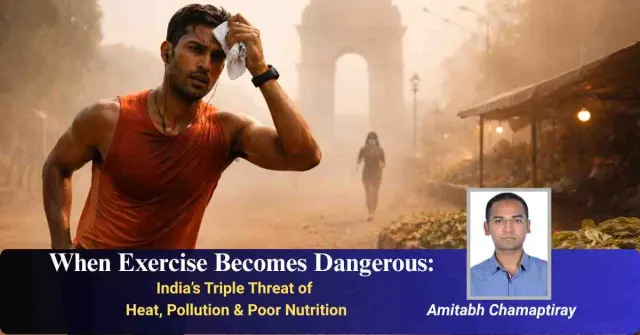
When Exercise Becomes Dangerous: India’s Triple Threat of Heat, Pollution & Poor Nutrition
Quick Summary
- Exercise is no longer risk-free due to rising air pollution and extreme heat exposure.
- Climate change is reducing safe outdoor activity time and worsening urban heat conditions.
- Nutrition security is declining as CO₂ levels and erratic monsoons affect food quality and supply
World Health Day 2026 arrives at a moment when health is no longer just about personal choices but about navigating environmental realities.
In tropical countries like India, the once straightforward prescription of “eat well and exercise” now collides with global warming, hazardous air quality, and nutritional insecurity.
Together, these form a Tropical Health Triad that demands urgent attention.
Exercise Is Essential—But Is It Still Safe Outside?
Physical activity remains a cornerstone of cardiovascular and metabolic health.
Yet in India’s urban centers, exercise increasingly carries hidden risks.
During vigorous workouts, breathing rates can rise 10–20 times above resting levels, magnifying exposure to pollutants.
In Delhi, PM2.5 concentrations often exceed safe limits by dozens of times, embedding toxic particles deep into the lungs.
Heat adds another layer: high ambient temperatures divert blood flow to the skin for cooling, straining the heart and reducing muscular efficiency.
Despite these hazards, research shows that physically active individuals still enjoy lower mortality rates compared to inactive peers exposed to the same pollution.
The challenge is not whether to exercise, but how to exercise safely—timing, location, and protective environments become critical.
Rising Heat Is Quietly Stealing Our Ability to Work and Move
The tropics are at the frontline of climate change.
With global temperatures breaching the 1.5°C threshold, India faces “uncompensable heat stress,” where sweating alone cannot cool the body.
Outdoor activity windows are shrinking.
For every 1°C rise, safe exercise time may drop by five minutes daily.
By mid-century, large parts of India could see outdoor work and play curtailed for hours each day.
Deforestation worsens this crisis.
Forest loss removes natural cooling zones, creating urban “heat islands” up to 10°C hotter than surrounding areas.
For millions of outdoor workers and athletes, this erodes resilience and accelerates physical inactivity.
When Air Becomes Toxic, Staying Indoors Becomes the Only Option
Air pollution compounds the climate challenge.
When the Air Quality Index (AQI) crosses 400, experts advise avoiding all strenuous outdoor activity.
In North India’s winters, this forces entire populations indoors, driving screen-based sedentary lifestyles.
The result is rising obesity, diabetes, and cardiovascular risk.
Access inequality deepens the divide.
Wealthier groups retreat to filtered gyms, while poorer communities remain exposed to toxic air.
This “sedentary transition” is not a voluntary lifestyle choice but an environmental imposition.



Climate Change Is Also Changing What—and How Well—we Eat
Climate change also undermines the nutritional foundation of health.
Elevated CO2 levels dilute essential nutrients in staple crops.
Erratic monsoons threaten rain-fed agriculture that sustains 65% of India’s farmland.
For vulnerable populations already facing under-nutrition, this is a double blow.
National programs like POSHAN Abhiyaan must now integrate climate resilience into nutrition strategies.
This includes supporting diversified cropping, fortifying foods, and protecting small farmers against climate shocks.
What Can We Do Now to Protect Our Health?
To safeguard health in tropical regions, adaptation must be both personal and systemic:
- Smart Timing: Shift exercise to early mornings or low-pollution days
- Indoor Alternatives: Use HEPA-filtered gyms or community halls when AQI exceeds 200
- Nature-Based Design: Expand urban afforestation to create shaded, cooler exercise zones
- Nutrition Resilience: Promote climate-resilient crops and strengthen food fortification programs
Health Can No Longer Be Separated from the Environment
World Health Day reminds us that health is inseparable from environment.
In India and across the tropics, exercise, climate, and nutrition form a triad that must be addressed together.
The path forward lies in climate-smart health strategies—balancing physical activity with environmental safety, protecting food systems, and re-imagining public health in an era of global warming.
Only then can the promise of health truly extend to all.
Author Details

Amitabh Champatiray holds a postgraduate degree in Commerce from Utkal University and has previously served as a Probationary Officer in a public sector bank. He writes on global economic trends, personal finance, and sustainability, focusing on their impact on everyday life.
Reader Feedback
Was this article useful?
Stay Connected
Get the next important story before you miss it.
Subscribe to the newsletter for trusted updates, or join our WhatsApp channel for quick top-story alerts from The Eastern Times.
WhatsApp Channel
Prefer instant alerts? Join our WhatsApp channel for top stories and breaking updates.
Join on WhatsApp