
What Is the Real Proof of Indian Citizenship? India's Growing Identity Debate Explained
 The Eastern Times
 Quick Summary
- India has no single, universally accepted proof of citizenship.
- Recent government and court clarifications have raised questions about Aadhaar, Passport, and Voter ID as citizenship documents.
- The article explores whether India needs a dedicated National Citizen Identity Card.
The question of what constitutes valid proof of Indian citizenship has become increasingly significant in recent years. Statements made by government agencies and judicial observations have highlighted an uncomfortable reality: India possesses several identity documents, but none serves as a universally accepted and conclusive proof of citizenship in every legal situation.
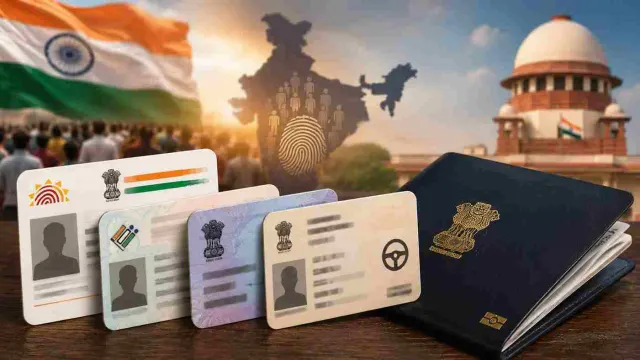
India has over 1.4 billion people, and almost every adult carries one or more government-issued identity documents. Aadhaar, Voter ID, Passport, PAN Card and Driving Licence have become part of everyday life.
But an important question remains unanswered:
Which of these documents actually proves that a person is an Indian citizen?
There is no simple answer. Recent statements by the government and observations made during court proceedings have brought this issue into the national spotlight. For a country aspiring to become a developed nation by 2047, this legal ambiguity deserves serious attention.
How Did This Debate Begin?
The current debate did not arise overnight. It developed through a series of statements and judicial observations over the past year.
- Supreme Court (2025): During hearings related to the Special Intensive Revision (SIR) of electoral rolls in Bihar, the Supreme Court observed that Aadhaar cannot be treated as conclusive proof of Indian citizenship. The Court noted that Aadhaar is primarily an identity document and that citizenship must be established separately when required.
- Election Commission of India (2025): Following the court proceedings, the Election Commission reiterated that Aadhaar alone cannot establish citizenship for inclusion in electoral rolls, as citizenship is a legal requirement for voting.
- Ministry of External Affairs (24 June 2026): On the occasion of the 14th Passport Seva Divas, the Ministry of External Affairs clarified that an Indian passport is primarily a travel document and not conclusive proof of citizenship. The statement triggered a nationwide debate because many citizens had long regarded a passport as the strongest proof of Indian citizenship.
These developments have left many citizens asking a fundamental question: If Aadhaar is not proof of citizenship and a passport is also not considered conclusive proof, what document finally establishes that a person is an Indian citizen?
This question lies at the heart of the present debate and highlights the need for greater legal clarity regarding citizenship documentation in India.
Different Documents, Different Purposes
Many people assume that Aadhaar or a Passport automatically proves citizenship. However, that is not how Indian law works.
Each document has a specific purpose.
-
Aadhaar proves identity and residence.
-
Passport is mainly a travel document and is strong evidence of citizenship, but not always conclusive if citizenship itself is challenged.
-
Voter ID allows citizens to vote but is not treated as final proof in every legal dispute.
-
PAN Card is for taxation.
-
Driving Licence permits a person to drive.
In other words, India has many identity documents, but none is a universal citizenship certificate.
Why Does This Matter?
Most citizens never face this question in their daily lives.
However, the issue becomes important during legal disputes, immigration matters, property and inheritance cases, government recruitment, or citizenship-related proceedings.
In such situations, authorities often require multiple documents instead of relying on a single identity card.
This creates confusion, delays and uncertainty for ordinary citizens.
Also Read: Who Will Guard the Guardians? When Anti-Corruption Institutions Become Corrupt
What Does the Law Say?
The Citizenship Act, 1955 defines who is an Indian citizen by birth, descent, registration, naturalisation or incorporation of territory.
The law also empowers the Central Government to prepare a National Register of Indian Citizens (NRIC) and issue national identity cards if such a system is implemented.
However, despite this legal provision, India has never introduced a nationwide Citizen Identity Card.
As a result, citizenship is often established through a combination of documents rather than one official certificate.
Is Aadhaar the Solution?
Many people ask why Aadhaar cannot simply become India's citizenship card.
The answer lies in its purpose.
Aadhaar was created as an identity and residence document—not as proof of citizenship.
Certain non-citizen residents are also eligible to obtain Aadhaar.
Therefore, converting Aadhaar into proof of citizenship without comprehensive legal verification would create serious complications.
Should India Introduce a National Citizen Identity Card?
Many policy experts believe that India should consider introducing a dedicated Citizen Identity Card.
Such a card could:
-
Provide one legally recognised proof of citizenship.
-
Reduce legal disputes.
-
Simplify identity verification.
-
Strengthen national security.
-
Help identify illegal immigrants.
-
Improve delivery of welfare schemes through accurate citizen records.
-
Reduce dependence on multiple documents.
Also Read: Organic Farming vs Modern Agriculture: Can India Feed 145 Crore People Without Chemical Fertilizers?
The Challenges
Introducing a nationwide citizenship card would not be easy.
India's population is enormous.
Millions of citizens may not possess historical documents needed for verification.
The government would also have to ensure strong data protection and create a transparent appeal process so that no genuine citizen is excluded due to documentation errors.
What Should the Government Do?
The first requirement is legal clarity.
The government should clearly define the purpose of every major identity document.
Citizens should know:
-
Which document proves identity.
-
Which proves residence.
-
Which proves citizenship.
If a National Citizen Identity Card is introduced in the future, it should strengthen the existing identity system rather than abruptly replacing it.



The Bottom Line
India has built one of the world's largest digital identity systems through Aadhaar. Yet it still lacks a single document that is universally accepted as conclusive proof of citizenship in every legal circumstance.
The issue is not that Indians lack identity documents.
The issue is that every document serves a different legal purpose.
As India moves toward becoming a developed nation by 2047, providing citizens with a clear and legally recognised proof of citizenship would strengthen governance, reduce confusion and increase public confidence in the legal system.
A modern democracy should ensure that every citizen knows exactly how to prove their citizenship when required. Legal certainty is not merely an administrative necessity—it is a fundamental pillar of good governance.
Reader Feedback
Was this article useful?
Stay Connected
Get the next important story before you miss it.
Subscribe to the newsletter for trusted updates, or join our WhatsApp channel for quick top-story alerts from The Eastern Times.
WhatsApp Channel
Prefer instant alerts? Join our WhatsApp channel for top stories and breaking updates.
Join on WhatsApp