
Justice Nagaratna on ECI: Why Election Commission Independence Matters for Democracy
 The Eastern Times
 Quick Summary
- Justice BV Nagarathna warned in Patna that democracy depends on independent institutions.
- She said the Election Commission must remain free from political influence.
- Her remarks highlighted the risks of weakening checks and balances in a democracy.
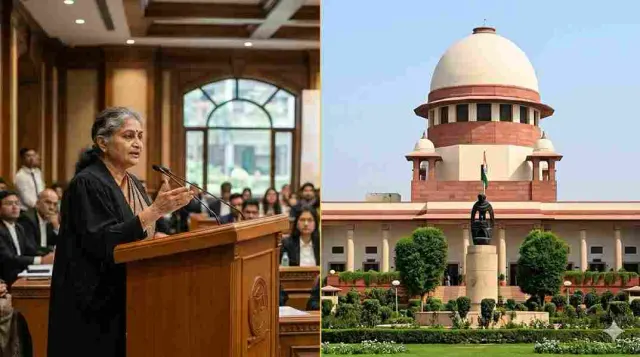
On April 4, 2026, Supreme Court Justice B.V. Nagarathna delivered a significant address in Patna, warning that the strength of Indian democracy depends heavily on the independence of its institutions—particularly the Election Commission of India (ECI).
Her remarks come at a time when concerns around institutional autonomy and electoral fairness continue to be debated across the country.
What Justice Nagarathna Said?
Justice Nagarathna cautioned against what she described as the “hollowing out” of democratic institutions. She emphasized that even strong democracies can weaken gradually if checks and balances are undermined.
Her key observations included:
-
The conflict of interest: If political actors gain influence over the body responsible for conducting elections, the neutrality of the process can be compromised.
-
Invisible institutional decay: A democracy may appear stable outwardly, but its institutions can be quietly weakened over time through structural or political pressures.
How It Affects Democracy
Democracy requires a level playing field. Without an independent "referee":
* Loss of Neutrality: The Election Commission of India (ECI) might favor the ruling party in choosing election dates or ignoring rule-breaking.
* The "Fourth Branch" Fails: Beyond the Legislature, Executive, and Judiciary, we need "Fourth Branch" bodies (like the ECI and CAG) to act as independent watchdogs. If these are captured by the government, the system of checks and balances collapses.
Why Election Commission Independence Matters
The Election Commission of India plays a central role in ensuring free and fair elections. Its credibility depends on its ability to function independently of political influence.
Without an impartial “referee,” several risks emerge:
-
Loss of neutrality: Decisions such as election scheduling, enforcement of the Model Code of Conduct, and oversight of violations may be perceived as biased.
-
Weakening of checks and balances: Institutions like the ECI and the Comptroller and Auditor General (CAG) act as watchdogs in a democracy. If their autonomy is compromised, the broader democratic framework can weaken.



Broader Democratic Implications
Justice Nagarathna also highlighted the distinction between legality and legitimacy.
-
Legality vs legitimacy: Actions may be legally valid but still undermine democratic principles.
-
Risk of centralised control: If governments influence institutions that oversee elections, it creates a situation where those in power effectively oversee their own continuation in office.
Such developments, she suggested, could gradually erode public trust in democratic processes.
Why This Matters for Citizens
For voters, the independence of electoral institutions is not an abstract concept—it directly affects the value of each vote.
-
Meaningful participation: A fair election process ensures that every vote carries real weight.
-
Equal application of rules: Independent bodies ensure that laws apply equally to all, regardless of political position.
-
Federal balance: In a diverse country like India, impartial institutions help prevent undue influence over state-level electoral processes.
The Bottom Line
Justice Nagarathna’s message underscores a fundamental principle: democracy is not defined solely by the act of voting, but by the integrity of the system that conducts and counts those votes.
Her remarks serve as a reminder that safeguarding institutional independence is essential to maintaining public trust and ensuring the long-term health of Indian democracy.
Poll
Do you agree with Justice B.V. Nagarathna?
Reader Feedback
Was this article useful?
Stay Connected
Get the next important story before you miss it.
Subscribe to the newsletter for trusted updates, or join our WhatsApp channel for quick top-story alerts from The Eastern Times.
WhatsApp Channel
Prefer instant alerts? Join our WhatsApp channel for top stories and breaking updates.
Join on WhatsApp