G7 Summit 2026 Highlights: Key Outcomes and Why It Matters for India
 The Eastern Times
 Quick Summary
- The G7 Summit 2026 focused on major global challenges including the Ukraine war, Iran tensions, artificial intelligence, energy security, and critical mineral supply chains.
- India attended as a special invited guest, with Prime Minister Narendra Modi highlighting the concerns of the Global South and emphasizing maritime security, technology access, and sustainable development.
- The summit strengthened cooperation on Ukraine, AI governance, and critical minerals while reinforcing India's growing role in global decision-making, trade, technology, and international diplomacy.
Évian-les-Bains, France:
The Group of Seven (G7) is an informal forum of seven advanced economies—Canada, France, Germany, Italy, Japan, the United Kingdom, and the United States. The leaders meet annually to discuss major global challenges, including economic growth, international security, climate change, energy security, trade, and emerging technologies. The summit serves as an important platform for coordinating policies and addressing issues that impact the global economy and international stability.
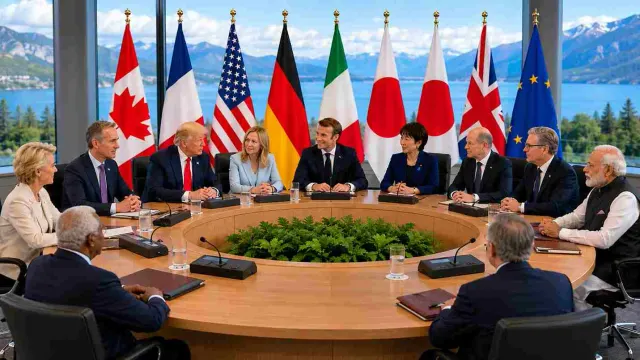
The 2026 G7 Summit brought together leaders of the world's major economies to discuss global security, economic growth, artificial intelligence, climate action, and supply chain resilience.
India attended the summit as a special invited nation, with Prime Minister Narendra Modi representing both India and the Global South.
What Was the Focus of the Summit?
The summit focused on:
-
Global security
-
Economic resilience
-
Energy security
-
Artificial intelligence
-
Climate action
-
Supply chain diversification
Leaders called for stronger international cooperation to address global challenges and ensure responsible technological development.
India Represents the Global South
Prime Minister Modi emphasized India's role as a voice for developing nations.
India highlighted concerns related to:
-
Energy security
-
Food security
-
Climate finance
-
Technology access
-
Economic development
India's participation reinforced its position as a bridge between developed and developing countries.
Maritime Security and Global Trade
PM Modi also stressed the importance of secure maritime trade routes.
This is important because:
-
India depends heavily on global trade.
-
Lakhs of Indians work as seafarers.
-
Global tensions are affecting shipping routes.
Safe sea routes are essential for economic growth and global commerce.
Key Issues Discussed
Ukraine War
The Ukraine conflict remained a major topic.
G7 leaders:
-
Reaffirmed support for Ukraine.
-
Called for diplomatic solutions.
-
Discussed regional stability.
Iran and Middle East Tensions
Leaders discussed:
-
Regional security
-
Global energy supplies
-
Shipping route protection
-
Impact on oil prices
China and Critical Minerals
The G7 explored ways to reduce dependence on China for critical minerals such as:
-
Lithium
-
Nickel
-
Rare earth elements
These resources are essential for electric vehicles, batteries, renewable energy, and advanced manufacturing.
India emerged as a key alternative partner in future supply chains.
Artificial Intelligence
AI was one of the summit's biggest topics.
Leaders discussed:
-
AI safety
-
Governance frameworks
-
Ethical standards
-
Future regulations
India called for inclusive AI development that benefits both developed and developing countries.
What Leaders Said
Donald Trump
Trump described PM Modi as "a very tough cookie" and praised his leadership. He emphasized practical solutions to global economic and geopolitical challenges.
Narendra Modi
PM Modi highlighted:
-
Global cooperation
-
Maritime security
-
Inclusive development
-
Global South priorities
Emmanuel Macron
The French President called for stronger cooperation on:
-
Ukraine
-
Security
-
AI governance
-
Economic stability
Volodymyr Zelenskyy
The Ukrainian President urged continued international support and stronger diplomatic efforts to achieve peace.
Major Outcomes
Key outcomes of the summit included:
-
Continued support for Ukraine
-
Greater focus on diplomatic solutions
-
Stronger cooperation on critical minerals
-
Progress on AI governance and safety
For India, the summit strengthened its role in discussions on technology, trade, energy security, and international cooperation.
Why Was India Invited?
India attended the summit as a special guest after being invited by French President Emmanuel Macron.
Although India is not a G7 member, it is increasingly seen as an indispensable global partner because of its:
-
Fast-growing economy
-
Young population
-
Strategic location
-
Technological capabilities
-
Leadership of the Global South
India is also viewed as a key partner in supply chains, clean energy, AI, and Indo-Pacific security.
Why the G7 Matters for India
The summit gives India an opportunity to:
-
Attract foreign investment
-
Strengthen trade ties
-
Expand technology partnerships
-
Influence global decisions
As countries seek alternatives to China-centric supply chains, India is emerging as a major hub for:
-
Manufacturing
-
Semiconductors
-
Critical minerals
-
Clean energy
The forum also allows India to shape discussions on AI, climate change, energy security, and sustainable development.
Summit at a Glance
The biggest takeaway from the G7 Summit 2026 was the growing recognition of India as a major global power.
From representing the Global South to contributing to discussions on AI, trade, energy security, and geopolitics, India played an increasingly important role at the summit.
As global challenges become more complex, India's participation in forums like the G7 is becoming more important than ever.
Reader Feedback
Was this article useful?
Stay Connected
Get the next important story before you miss it.
Subscribe to the newsletter for trusted updates, or join our WhatsApp channel for quick top-story alerts from The Eastern Times.
WhatsApp Channel
Prefer instant alerts? Join our WhatsApp channel for top stories and breaking updates.
Join on WhatsApp