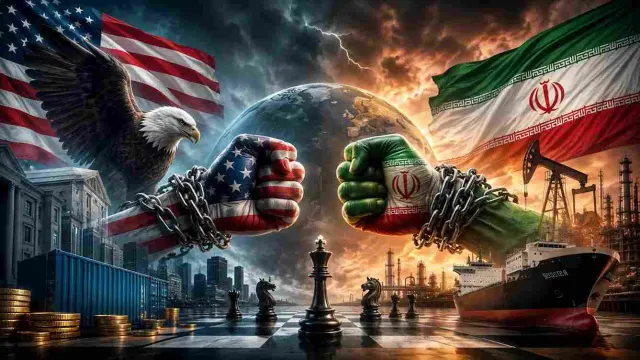
Trump’s Economic War on Iran:Why the World Should Worry
 The Eastern Times
 Quick Summary
- US intensifies economic pressure on Iran, targeting its oil trade, financial networks and international transactions.
- Iran rejects the pressure, arguing that sanctions will not force Tehran to change its position.
- The impact could spread globally, with oil prices, international trade and the wider economy facing potential risks
The United States, having failed to achieve its desired outcome in the war with Iran, is now preparing to intensify pressure through economic means. US President Donald Trump has announced what he describes as the biggest economic action yet against Iran, warning that Tehran could face increasing isolation.
Trump said Iran had missed an opportunity to reach an agreement and would now have to face the consequences. He also warned that countries and institutions supporting Iran could come under US action. The measures could target banks, companies, airports and government institutions.
The US administration is also seeking to disrupt Iran’s oil-smuggling networks and restrict the financial channels through which Tehran receives money. These include cash transfers, currency exchanges, ship registrations and companies involved in selling Iranian oil.
From Military Pressure to Economic Warfare
During the conflict, Trump claimed that the US had inflicted significant damage on Iran’s military capabilities. Iran’s navy and air force reportedly suffered heavy losses, while several military facilities were damaged or destroyed.
Iran is also facing severe economic pressure. Its currency remains under strain, while sanctions and disruptions to trade have made an already difficult economic situation worse.
Trump has described the new campaign as an “Economic D-Day”, signalling a major escalation in US economic pressure on Tehran. He has also urged other countries to stop supporting Iran and join Washington in its campaign.
Iran Rejects Trump’s Pressure
Iran has strongly rejected the US strategy.
In an indirect response, Iran’s military reportedly suggested that the Iranian government would trust a taxi driver more than the US president. Iranian officials have also criticised Trump’s approach as short-sighted and inconsistent, arguing that his constantly changing policies have damaged America’s credibility around the world.
Iranian Foreign Minister Abbas Araghchi has dismissed the new US economic measures as another failed attempt to pressure Tehran. He has maintained that sanctions will not force Iran to change its position.
Iran’s Oil Trade Could Be the Main Target
The biggest impact of the new measures could be felt in Iran’s oil industry.
Oil exports provide a major source of revenue for Iran. If banks, companies and foreign governments become increasingly afraid of US sanctions, they may reduce or stop doing business with Tehran.
This could make it much harder for Iran to sell its oil and receive payments from international buyers.
Iran has historically relied on complex networks involving intermediaries, shipping companies and other entities to move and sell its oil while attempting to avoid sanctions. Washington is now seeking to dismantle these networks.
The US strategy is not limited to stopping the physical movement of Iranian oil. It also aims to disrupt the financial system that allows Iran to receive payment after its oil is sold.
Banks, currency exchanges, intermediaries, shipping networks and cash-transfer mechanisms could all come under greater scrutiny.
In simple terms, Washington wants to make it increasingly difficult for Iran to sell its oil, receive the money and use that money internationally.
The Impact Could Go Beyond Iran
The consequences, however, may not remain limited to Iran.
If the US pressures countries, banks and companies around the world to stop dealing with Tehran, the economic impact could spread beyond Iran. Businesses may face higher compliance costs, financial institutions may become more cautious, and global oil markets could experience additional uncertainty.
This is why the latest US strategy is more than just another round of sanctions. It represents an attempt to use America's financial and economic power as a weapon.
A High-Stakes Gamble for Trump
Washington appears determined to use every available economic tool to weaken Tehran after the military confrontation.
But economic pressure can also carry risks for the country imposing it.
Trump has already used tariffs and trade restrictions against several countries, creating uncertainty in global markets. Expanding economic pressure against Iran could further complicate international trade and energy markets.
Threats alone cannot guarantee political success. Iran has lived under sanctions for years and has developed alternative channels for trade and finance.
The real question is whether Trump's latest economic offensive can force Tehran to change course—or whether it will deepen confrontation and create new economic problems for the wider world.
For Trump, this is therefore more than an economic campaign against Iran. It is a high-stakes test of how far America's financial power can be used to shape international politics—and what price the rest of the world may ultimately have to pay.
Reader Feedback
Was this article useful?
Stay Connected
Get the next important story before you miss it.
Subscribe to the newsletter for trusted updates, or join our WhatsApp channel for quick top-story alerts from The Eastern Times.
WhatsApp Channel
Prefer instant alerts? Join our WhatsApp channel for top stories and breaking updates.
Join on WhatsApp