
Top AI Developments in June 2026: 7 Breakthroughs Transforming the Future
 The Eastern Times
 Quick Summary
- Anthropic launched Claude Science and proposed a new framework for regulating advanced AI.
- Google, OpenAI, Meta, SpaceX, and Perplexity announced major AI products, infrastructure, and engineering breakthroughs.
- June 2026 demonstrated that AI is rapidly expanding beyond chatbots into science, enterprise computing, smart devices, and large-scale infrastructure.
Artificial intelligence continued its rapid evolution in June 2026, with some of the world's biggest technology companies unveiling innovations that could reshape research, business, and everyday life. Anthropic introduced an AI-powered scientific research platform, Google expanded Gemini across its ecosystem, Meta took another step toward superintelligence, OpenAI solved a long-standing engineering challenge, Perplexity launched a computer-wide AI assistant, and SpaceX entered the AI infrastructure market with a multi-billion-dollar deal. Together, these developments show that AI is moving far beyond chatbots and becoming a core technology across industries.
Claude Science: An AI Workbench for Researchers
Anthropic announced Claude Science, a new AI platform designed specifically for scientists, researchers, and students in the life sciences. Rather than functioning as a simple chatbot, Claude Science acts as a complete scientific workspace by combining research papers, coding tools, laboratory workflows, scientific databases, and high-performance computing in one application.
The platform can analyse large datasets, generate publication-ready charts, and connect directly with scientific databases such as UniProt, PDB, Ensembl, ClinVar, and ChEMBL. By automating time-consuming tasks like literature reviews, coding, and manuscript preparation, Claude Science allows researchers to spend more time on scientific discovery.
Currently, the platform is available in beta for Claude Pro, Max, Team, and Enterprise users on macOS and Linux.
Anthropic Calls for Smarter AI Regulation
Alongside its new research platform, Anthropic proposed an Advanced AI Framework aimed at guiding governments on regulating powerful AI systems.
The company argues that AI technology is advancing much faster than current regulations. Instead of applying strict rules to every AI model, Anthropic recommends focusing oversight on only the largest and most capable systems developed through multi-billion-dollar investments.
According to the company, advanced AI could potentially be misused for cyberattacks, biological threats, or other dangerous purposes if adequate safeguards are not introduced. At the same time, it emphasized that regulations should support innovation rather than slow technological progress.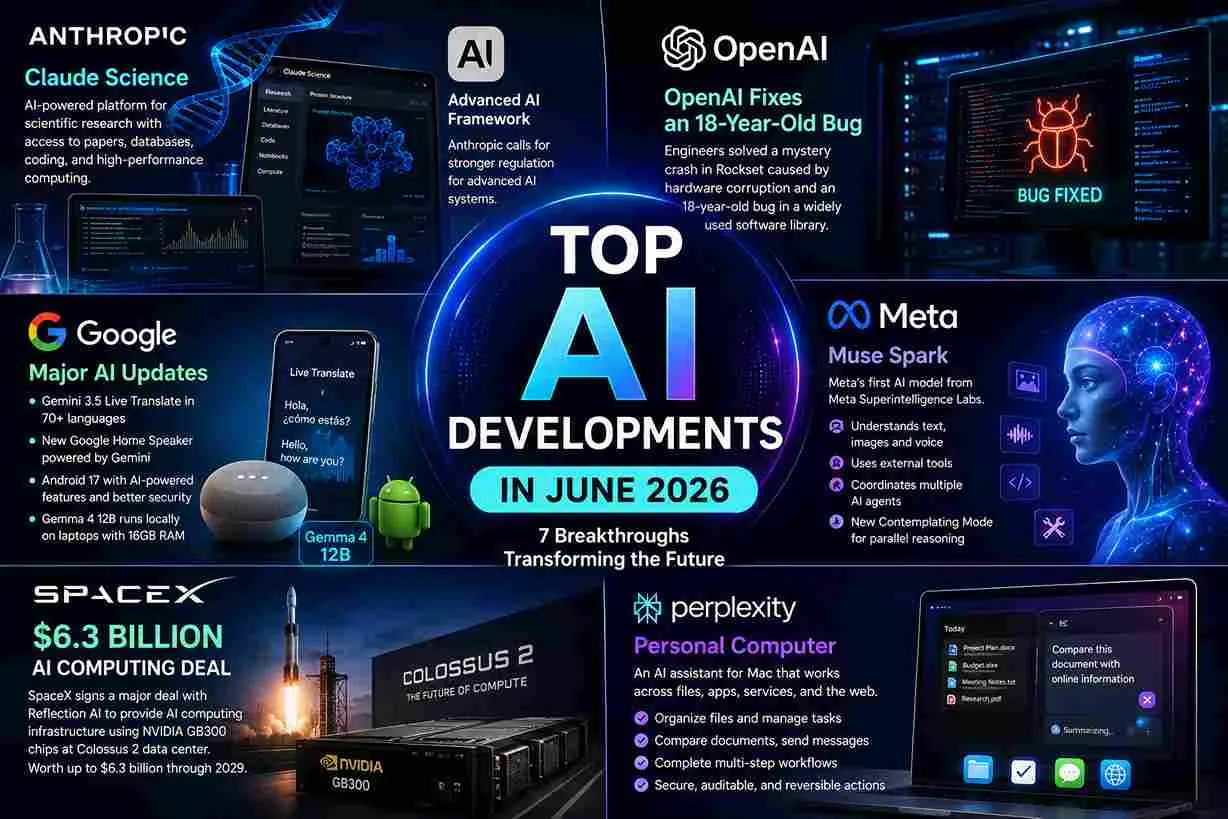
OpenAI Solves an 18-Year-Old Software Mystery
OpenAI shared an interesting engineering breakthrough after resolving a mysterious crashing issue affecting Rockset, the C++-based data infrastructure that powers parts of ChatGPT's search system.
Engineers initially believed the crashes were caused by a rare software bug. However, after studying numerous crash reports, they discovered two completely separate issues. One involved silent hardware corruption on an Azure server that occasionally produced incorrect CPU calculations. The second was an 18-year-old race condition hidden inside GNU libunwind, a widely used open-source library responsible for C++ exception handling.
The discovery highlights the complexity of modern AI infrastructure and the importance of deep engineering work behind reliable AI services.
SpaceX Makes a Multi-Billion-Dollar Bet on AI
SpaceX made headlines after signing a computing agreement worth up to $6.3 billion with open-source AI startup Reflection AI.
Under the partnership, Reflection AI will use Nvidia GB300 chips hosted at Elon Musk's Colossus 2 data centre to train advanced AI models. The agreement, valued at around $150 million per month through 2029, demonstrates the growing demand for large-scale AI computing infrastructure.
The deal also signals SpaceX's expansion beyond rockets and satellites into the rapidly growing AI computing business, positioning the company alongside major cloud infrastructure providers.
Google Expands Gemini Across Its Ecosystem
Google unveiled several major AI updates designed to make artificial intelligence more useful in everyday life.
One of the biggest announcements was Gemini 3.5 Live Translate, capable of translating conversations in more than 70 languages while preserving the speaker's original voice and tone.
The company also introduced a new Gemini-powered Google Home Speaker, enabling more natural conversations and smarter home automation.
In addition, Android 17 brings several AI-powered features, including floating app windows, improved security, AI-assisted video creation, and enhanced multitasking.
Google also released Gemma 4 12B, an open AI model capable of running locally on laptops with just 16GB of RAM, allowing developers and businesses to build AI applications while keeping sensitive data on-device.
Also Read: G7 Summit 2026 Highlights: Key Outcomes and Why It Matters for India
Meta Moves Closer to Personal Superintelligence
Meta introduced Muse Spark, the first AI model developed by Meta Superintelligence Labs.
The multimodal system can understand text, images, and voice while coordinating multiple AI agents simultaneously. A new feature called Contemplating Mode enables several AI agents to reason in parallel, improving performance on difficult tasks.
According to Meta, Muse Spark can assist users with interpreting health information, solving visual problems, troubleshooting electronic devices, and creating interactive content. The company says the model has undergone extensive safety testing before its release.

Perplexity Introduces an AI Assistant That Controls Your Computer
Perplexity announced Personal Computer, an AI assistant for Mac that works across local files, applications, connected services, and the web.
Unlike traditional chatbots, the assistant can organise files, manage to-do lists, compare documents with online information, send messages, and complete multi-step workflows automatically.
To address privacy concerns, Perplexity says sensitive actions require user approval, all files are processed in a secure environment, and every action remains transparent and reversible.
What These AI Developments Mean for the Future
The AI announcements made throughout June 2026 reveal a clear trend. Artificial intelligence is no longer limited to generating text or answering questions. Companies are increasingly building AI systems that support scientific research, automate complex workflows, power smart devices, strengthen cybersecurity, and provide the computing infrastructure needed to train next-generation models.
As competition intensifies among leading technology companies, AI is becoming one of the defining technologies of the decade. The innovations announced in June not only demonstrate rapid technological progress but also highlight the growing need for responsible development, regulation, and collaboration to ensure AI benefits society as a whole.
Sources
- Claude Science Launch
- Anthropic Advanced AI Framework
- SpaceX Signs Computing Power Deal with Reflection AI
- Perplexity Personal Computer
Reader Feedback
Was this article useful?
Stay Connected
Get the next important story before you miss it.
Subscribe to the newsletter for trusted updates, or join our WhatsApp channel for quick top-story alerts from The Eastern Times.
WhatsApp Channel
Prefer instant alerts? Join our WhatsApp channel for top stories and breaking updates.
Join on WhatsApp