
Abraham Accords Explained: Why Pakistan Rejected Trump’s Proposal and Why It Matters for India and the Middle East
 The Eastern Times
 Quick Summary
- The Abraham Accords are diplomatic agreements that normalized relations between Israel and several Arab countries, reshaping Middle East politics and regional cooperation.
- Pakistan rejected US President Donald Trump’s suggestion to join the accords, maintaining that it will not recognize Israel without a solution to the Palestine issue.
- India views the accords positively because improved Israel-Arab ties support its interests in trade, energy security, regional stability, and partnerships like the I2U2 group.
The Abraham Accords have once again returned to global headlines after US President Donald Trump reportedly encouraged countries like Pakistan to normalize relations with Israel. Pakistan quickly rejected the idea, reaffirming its long-standing support for Palestine and refusing to recognize Israel without a resolution to the Palestinian issue.
The renewed debate has once again drawn attention to the Abraham Accords — agreements that significantly changed diplomatic and political equations in the Middle East.
What Exactly Are the Abraham Accords?
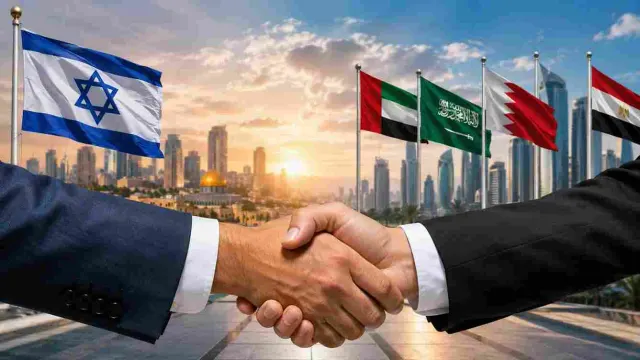
The Abraham Accords are diplomatic agreements signed in 2020 between Israel and several Arab nations with the support of the United States.
The name “Abraham” was chosen because Abraham is a respected figure in Judaism, Christianity, and Islam. The agreements aimed to normalize relations between Israel and Arab countries that had historically avoided formal ties with Israel.
The first countries to join the accords were:
-
United Arab Emirates
-
Bahrain
Later, Morocco and Sudan also became part of the process.
For decades, many Arab nations had refused to recognize Israel because of the Israel-Palestine conflict. The Abraham Accords marked a major shift from that traditional approach.
Also Read: Why CJP Has Become the Voice of Frustrated Youth
Why Were the Accords Considered Historic?
The agreements changed Middle Eastern diplomacy in a major way. Earlier, hostility and political distance between Israel and many Arab countries were common. The accords opened the door for direct cooperation.
After the agreements, countries began expanding ties in:
-
Trade and investment
-
Tourism
-
Technology
-
Agriculture
-
Security cooperation
-
Energy projects
Direct flights were launched, embassies were opened, and business partnerships increased rapidly. Supporters of the accords argued that economic cooperation and shared security interests were becoming more important than old political divisions.
At the same time, critics argued that the agreements weakened collective Arab pressure on Israel regarding Palestinian statehood.
Why Did Pakistan Reject the Proposal?
Pakistan’s rejection is rooted in its long-standing foreign policy.
Since its creation in 1947, Pakistan has not officially recognized Israel. Islamabad has consistently maintained that recognition of Israel can happen only after a fair solution to the Palestine issue and the establishment of an independent Palestinian state.
Pakistan’s position is influenced by several factors.
First, support for Palestine remains strong within Pakistan’s political and public discourse. Any move toward recognizing Israel is considered politically sensitive domestically.
Second, Pakistan has historically projected itself as a supporter of Muslim causes globally, and the Palestinian issue has remained central to that narrative.
Third, changing its position now could create political controversy internally as well as diplomatic complications in parts of the Muslim world.
This is why Pakistan immediately rejected suggestions linked to joining the Abraham Accords.
Why Does This Matter Globally?
The Abraham Accords are not just about diplomatic recognition between countries. They represent a broader geopolitical shift in the Middle East.
For decades, the region’s politics largely revolved around conflicts, ideological divisions, and hostility between Israel and many Arab nations. The accords signaled that some countries are now prioritizing economic cooperation, technology partnerships, investment, and regional security over older political rivalries.
This shift matters because the Middle East plays a major role in:
-
Global oil supply
-
International trade routes
-
Energy prices
-
Regional security
-
Global strategic alliances
Any major diplomatic change in the region can directly impact the global economy and international politics.
The accords also increased American influence in regional diplomacy while creating new strategic alignments involving Israel and Gulf nations.
Why Is India Watching the Situation Closely?
For India, the Abraham Accords carry major strategic and economic significance.
India has carefully built strong relations with both Israel and Arab countries over the years. Unlike many nations that chose one side, India maintained a balanced approach.
Israel is one of India’s key partners in:
-
Defense technology
-
Agriculture
-
Cybersecurity
-
Innovation
-
Water management
At the same time, Gulf countries like UAE and Saudi Arabia are extremely important for India’s:
-
Energy security
-
Trade
-
Investment
-
Employment of Indian workers abroad
Because of this, reduced tensions between Israel and Arab countries benefit India directly.
The Economic Angle for India
The Middle East is critical for India’s economy. A large share of India’s oil imports comes from Gulf nations. Any instability in the region affects fuel prices, trade routes, and economic planning.
The Abraham Accords created possibilities for new trade corridors and regional partnerships. As relations between Israel and Arab countries improved, India gained opportunities to expand connectivity, investment, and technology partnerships across the region.
The agreements also encouraged cooperation in sectors such as renewable energy, logistics, infrastructure, and food security — areas where India has growing interests.
I2U2 and the New West Asia Diplomacy
One major development linked to the Abraham Accords was the rise of the I2U2 grouping.
The group includes:
-
India
-
Israel
-
UAE
-
United States
The platform focuses on practical cooperation in:
-
Technology
-
Renewable energy
-
Infrastructure
-
Food security
-
Economic projects
The formation of this group became easier because UAE and Israel had normalized ties after the Abraham Accords.
This reflects how diplomacy in West Asia is gradually shifting from purely political conflicts toward economic and strategic cooperation.
India’s Balanced Position on Palestine
Even while strengthening ties with Israel, India has continued supporting the Palestinian cause and a two-state solution.
India’s policy has been to maintain relations with all major players in the region without directly entering regional rivalries. This balanced diplomacy helps India protect its economic, strategic, and energy interests simultaneously.
The renewed discussion around the Abraham Accords shows how rapidly geopolitical equations in West Asia are changing. While countries like UAE and Bahrain see normalization with Israel as an opportunity for economic and strategic growth, Pakistan continues to prioritize the Palestine issue in its foreign policy.
What's Next?
For India, the situation is different. New regional partnerships, improved connectivity, and stable relations between Israel and Arab nations create long-term strategic and economic opportunities. At the same time, India continues to follow a carefully balanced diplomatic approach, maintaining strong ties with both Israel and the Arab world.
As global politics increasingly shifts toward economic alliances and regional cooperation, the Abraham Accords are likely to remain a key factor shaping the future of Middle Eastern diplomacy and international relations.
Sources
-
White House Archives – Abraham Accords Declaration
-
Council on Foreign Relations – Abraham Accords Explained
-
BBC News – Middle East Diplomacy and Israel Relations
-
Ministry of External Affairs, India – India’s Position on Palestine and West Asia
Reader Feedback
Was this article useful?
Stay Connected
Get the next important story before you miss it.
Subscribe to the newsletter for trusted updates, or join our WhatsApp channel for quick top-story alerts from The Eastern Times.
WhatsApp Channel
Prefer instant alerts? Join our WhatsApp channel for top stories and breaking updates.
Join on WhatsApp