
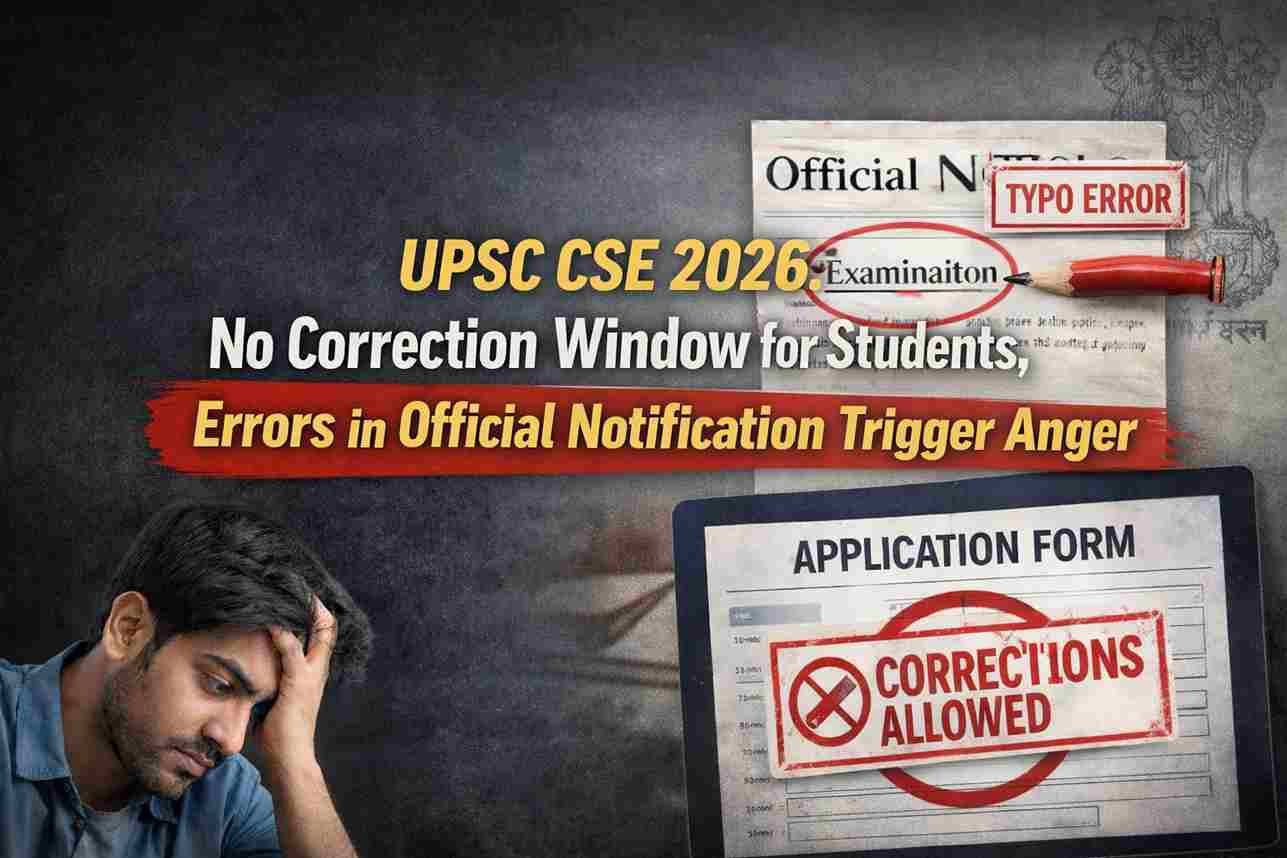
New Delhi: The Union Public Service Commission (Union Public Service Commission) is facing mounting criticism over its newly announced “zero error” policy for the Civil Services Examination (CSE) 2026, even as aspirants point out that the Commission’s own official notification contains multiple spelling mistakes.
No Correction Window, No Second Chance
For the first time in recent years, UPSC has removed the application correction window, meaning candidates will not be allowed to rectify even minor clerical errors after final submission. Any mistake—whether in name spelling, category, or optional subject—may result in outright rejection.

Aspirants argue that the move is excessively punitive, especially for a high-stakes exam attempted under immense pressure.
Mandatory Face Authentication & Live Photos
To curb impersonation and examination malpractice, UPSC has rolled out AI-driven security measures for CSE 2026:
Live Photo Capture: During the application process, candidates must capture a live photograph via webcam or mobile phone, in addition to uploading a standard passport-size photo. Both images must match.
Venue Authentication: On the day of the Preliminary Examination (May 24, 2026), mandatory face authentication will be conducted at the examination centre entry point. Candidates have been advised to arrive at least 60 minutes early to complete biometric verification and frisking.
Aadhaar Linkage: While not compulsory, UPSC has strongly encouraged Aadhaar-based registration to ensure seamless biometric verification and identity matching.
One-Time URN Update Only
Another significant change is related to the Universal Registration Number (URN). According to the new rules, a candidate will be allowed to modify their URN details only once in their lifetime, increasing the stakes for first-time applicants.
New Signature Upload Rule
Candidates must now upload a handwritten signature signed three times (one below the other) on a clean white sheet of paper. Any deviation from the prescribed format could lead to application rejection.
Also Read: Amit Shah to Launch ‘Bharat Taxi’, India’s First Cooperative Ride-Hailing Platform
Irony Sparks Outrage
The controversy deepened after aspirants highlighted that the 160-page UPSC notification reportedly contains over 40 spelling mistakes, despite the Commission’s insistence on “zero error” compliance from candidates.
Educators have termed this a clear double standard.
“A single typo by a student can cost an entire year, but dozens of errors in the rulebook are ignored,” said a senior UPSC mentor on social media.
Also Read: Secrets Behind a Healthy and Long Life
Notable Errors Flagged
Some of the frequently cited spelling mistakes include:
“Examinaiton” instead of Examination
“Cadidates” instead of Candidates
“Statuary” in place of Statutory
“Bechmark” for Benchmark
“Abbriviations” misspelled in a heading
“Kolkatta” instead of Kolkata
“Underkings” for Public Sector Undertakings
Why Aspirants Say It Matters
Mentors argue that UPSC evaluates candidates on precision, clarity, and attention to detail, making the presence of errors in its own notification particularly troubling.
“For an institution that represents administrative excellence, such lapses weaken trust,” said one educator.
No Relief Announced
Despite the backlash, UPSC has not announced any rollback of the zero-correction policy or revision of the notification. With the application deadline set for February 24, 2026 (6 PM), aspirants are being urged to verify every entry meticulously before final submission.
For now, the message is clear: the Commission’s mistakes may be typographical—but a candidate’s mistake could be career-defining.

click on icons to connect with us through official social media channels






You May Be Bathing the Wrong Way: Know the Correct Ayurvedic Way
Health Is Real Wealth: 7-Step Morning Routine to Live a Healthy Life
