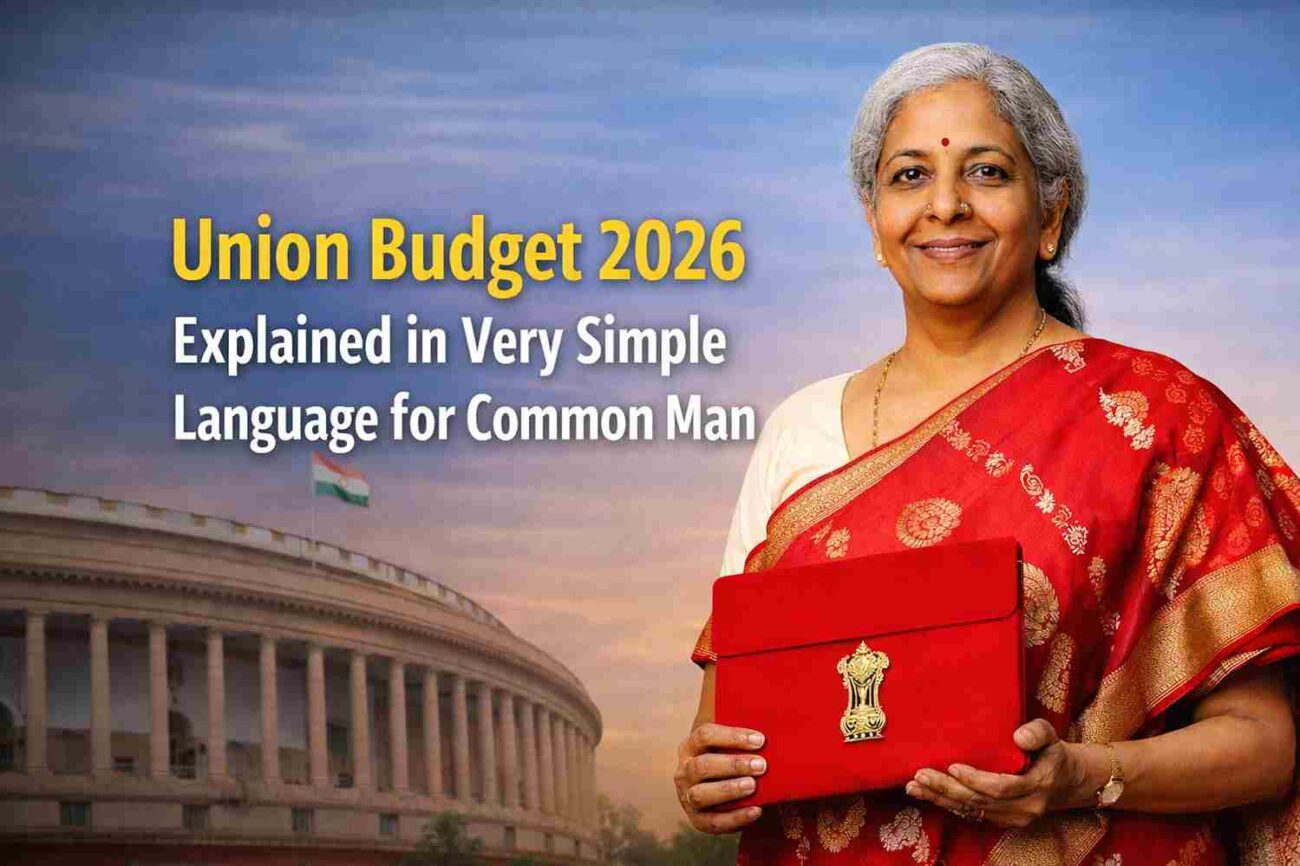
New Delhi: Finance Minister Nirmala Sitharaman presented the Union Budget today, outlining the government’s financial roadmap for the coming year. She began her speech by acknowledging the sacred occasion of Magha Purnima and the birth anniversary of Guru Ravidas. She framed the 2026-27 Budget not just as a financial document, but as a roadmap for “Viksit Bharat” (Developed India).
Budget simplified for Easy Understanding
Total Government Spending: ₹53.5 lakh crore,
Money planned for schemes, infrastructure, defence, salaries, and administration.

Total Government Income: ₹36.5 lakh crore,
Money earned through taxes and other sources.
Fresh Loans (Fiscal Deficit): ₹16.9 lakh crore,
Extra money borrowed because income is less than spending.
Total Loan Burden on Government: ₹197.5 lakh crore, by 2027 March expected to reach 214 lakh crore.
Total debt accumulated by the Central Government over the years.
Where Does ₹100 Come From? (Government Income)
To spend ₹100, the government earns and borrows money in this way:
₹39 – Direct Taxes
Income Tax (₹21) and Corporate Tax (₹18)₹25 – Indirect Taxes
GST (₹15), Excise Duty (₹6), Customs Duty (₹4)₹10 – Non-Tax Income
Fees, dividends, interest, and government services₹2 – Asset Sales and Loan Recovery
Selling government shares and recovery of old loans₹24 – Borrowed Money
Loans taken because income is not enough
Where Does ₹100 Go? (Government Spending)
This is how the government uses ₹100:
₹22 – Share to States
Funds transferred to states for development₹20 – Interest on Old Loans
Similar to paying EMIs on previous borrowings₹17 – Central Government Schemes
National infrastructure and development projects₹11 – Defence
Army, Navy, and Air Force₹8 – Centrally Sponsored Schemes
Joint projects of the Centre and states₹7 – Finance Commission and Other Transfers
₹6 – Subsidies
Support for food, fertilizer, and welfare schemes₹2 – Pensions
Payments to retired government employees₹7 – Other Expenses
Salaries, administration, and routine costs
In Simple Words
The government spends more than it earns.
The difference is filled by borrowing (Loans).
A large part of budget (20%) goes towards interest payments
The total loan burden keeps increasing over time
Top 15 Budget Projects & National Highlights
Strategic Manufacturing & Industrial Projects
1. ISM 2.0 (India Semiconductor Mission)
A major push to make India a global hub for computer chip manufacturing and Indian-owned chip design.
2. Biopharma SHAKTI – ₹10,000 crore
To develop advanced medicines, biotech research, and clinical trial infrastructure across India.
3. Rare Earth Corridors
Special industrial zones in Odisha, Kerala, Andhra Pradesh, and Tamil Nadu to process critical minerals used in EVs, electronics, and defence.
4. Electronics Components Scheme – ₹40,000 crore
Support for domestic manufacturing of mobile phone, laptop, and electronics components.
5. Container Manufacturing Hub – ₹10,000 crore
Local production of shipping containers to reduce import dependence and boost exports.
6. Legacy Industrial Cluster Revival
Modernisation of 200 old industrial clusters with better roads, technology, and facilities.
Urban & Infrastructure Development
7. City Economic Regions (CERs)
Development of Tier-II and Tier-III cities as growth hubs, with ₹5,000 crore allocated per region.
8. Dedicated Freight Corridor (West–East)
High-speed cargo corridor connecting Surat to Dankuni to reduce logistics costs.
9. High-Speed Rail Expansion
New bullet-train-style corridors proposed, including Mumbai–Pune and Delhi–Varanasi.
10. 20 New National Waterways
Expansion of river transport and creation of ship-repair hubs in Varanasi and Patna.
Education, Health & Digital Initiatives
11. Orange Economy (AVGC Labs)
Animation, gaming, and creative labs in 15,000 schools and 500 colleges to train future-ready talent.
12. University Townships
Five large integrated university campuses developed as education and research hubs.
13. National Caregiver Training Programme
Training of 1.5 lakh multiskilled caregivers for senior citizens and healthcare support.
14. Three New AI Institutes (Ayurveda)
Expansion of traditional medicine through new All India Institutes of Ayurveda.
15. SME Growth Fund – ₹10,000 crore
Dedicated fund to help small businesses grow into large, competitive industry leaders.
click on icons to connect with us through official social media channels






Also Read:
