
Highlights:
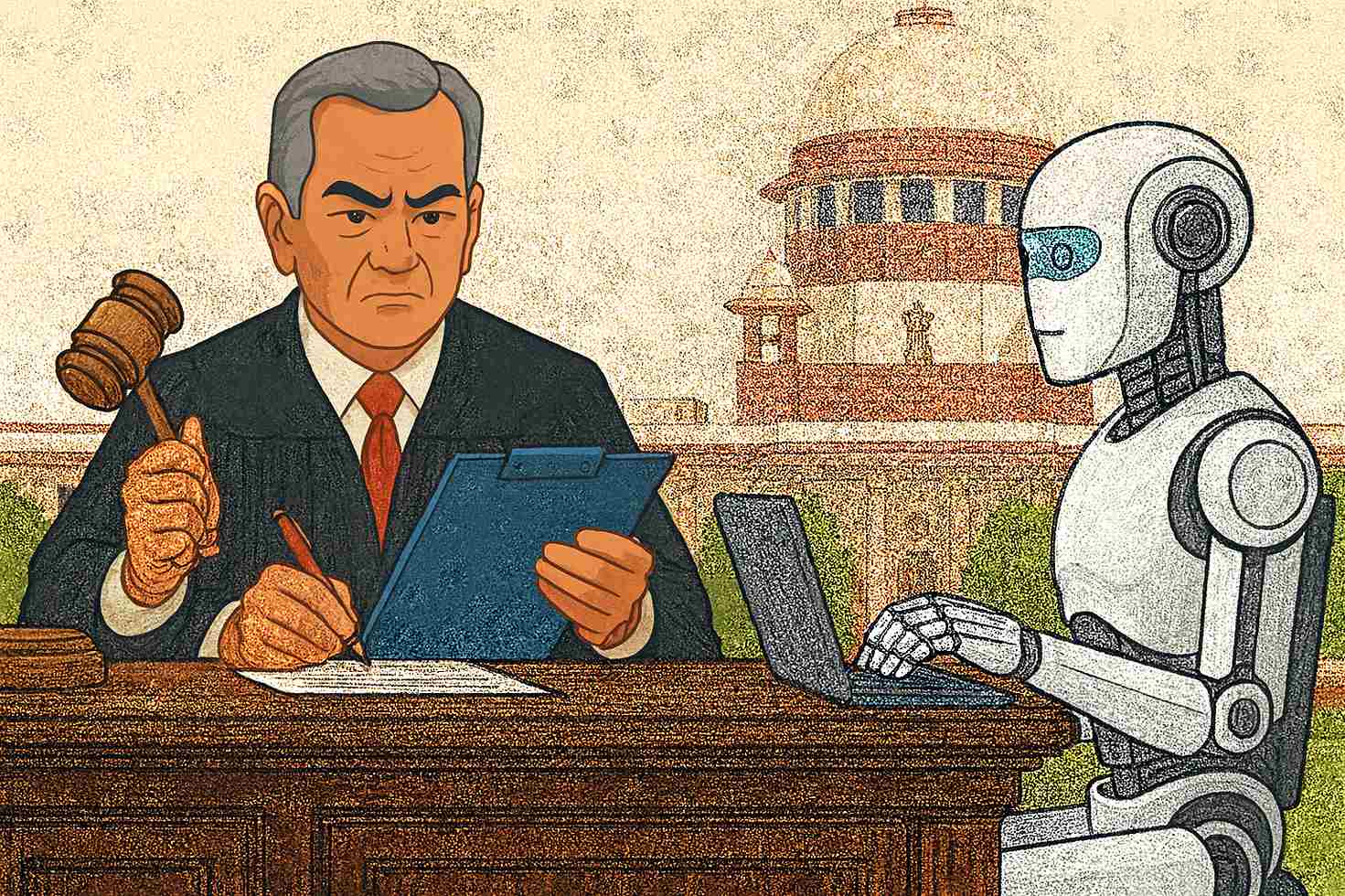
As artificial intelligence rapidly finds space in Indian courtrooms, the Supreme Court has sent out a firm message — technology may assist, but it will never overpower judicial reasoning.
New Delhi, Dec 5 — The Supreme Court on Friday said it is fully aware of the risks posed by artificial intelligence (AI) and machine learning (ML) in the justice system, but stressed that such concerns must be handled on the administrative side rather than through judicial directions. A Bench of Chief Justice Surya Kant and Justice Joymalya Bagchi made the observation while hearing a plea seeking safeguards against the unregulated use of AI-generated content in courts.
Petitioner Warns: AI Is Creating Fake Case Laws
Senior advocate Anupam Lal Das, appearing for petitioner Kartikeya Rawal, warned that AI tools sometimes create non-existent judicial precedents, which then get cited in real court proceedings.
He pointed out that some lower courts had passed orders citing “Supreme Court judgments that do not exist,” raising fears about AI hallucinations entering the judicial record.
CJI: Judges Must Verify, AI Cannot Guide Court Decisions
Acknowledging the concerns, the Chief Justice said the judiciary is already alert and cautious.

“We use AI in a very over-conscious manner and we do not want this to overpower our judicial decision-making,” CJI Surya Kant said.
He added that both judges and lawyers must verify AI-generated case laws and that this is already part of the judicial training curriculum.
The CJI reiterated that while AI can assist with research or transcription, it can never replace or influence judicial reasoning.
Court Says Issue Requires Administrative Action
Advocate Subhash Chandran noted that the Supreme Court has published a white paper on AI, and that the Kerala High Court has taken structured steps to regulate AI use.
He argued that similar safeguards were needed across the judicial system.
However, the Bench said it was already addressing these concerns internally.
Judges, the court emphasised, must cross-check all AI-generated material and rely on verified legal sources.
“This is taken care of through judicial academies. With time, the Bar will learn and we will also learn,” the CJI said.
SC Invites Suggestions, Allows Withdrawal of Plea
The Court clarified that the matter does not require judicial intervention and urged the petitioner to submit suggestions through the administrative channel.
“Someone with sincere intentions is most welcome to give us recommendations. You can mail them to us,” the CJI said.
The petitioner then sought permission to withdraw the plea, which the Bench accepted.
What Happens Next
The Supreme Court’s stance signals a shift toward structured internal regulation of AI use rather than court-issued mandates.
Judicial academies are expected to strengthen training on verifying AI-generated content, while bar bodies may introduce new guidelines for safe AI usage.
With more courts experimenting with AI tools, the judiciary’s focus now is on responsible adoption, accuracy, and human oversight — ensuring that technology supports justice but never defines it.
Also read: https://theeasterntimes.com/healthy-life-morning-routine-exercise-pranayam/
Health Is Real Wealth: 7-Step Morning Routine to Live a Healthy Life
Connect with us through social media
Facebook:
 https://www.facebook.com/profile.php?id=61577015427068
X (Twitter):
 https://x.com/tet_editor
Instagram:
 https://www.instagram.com/the_eastern_times_/?next=%2F&hl=en
Mail (Email):
 contact.theeasterntimes@gmail.com