
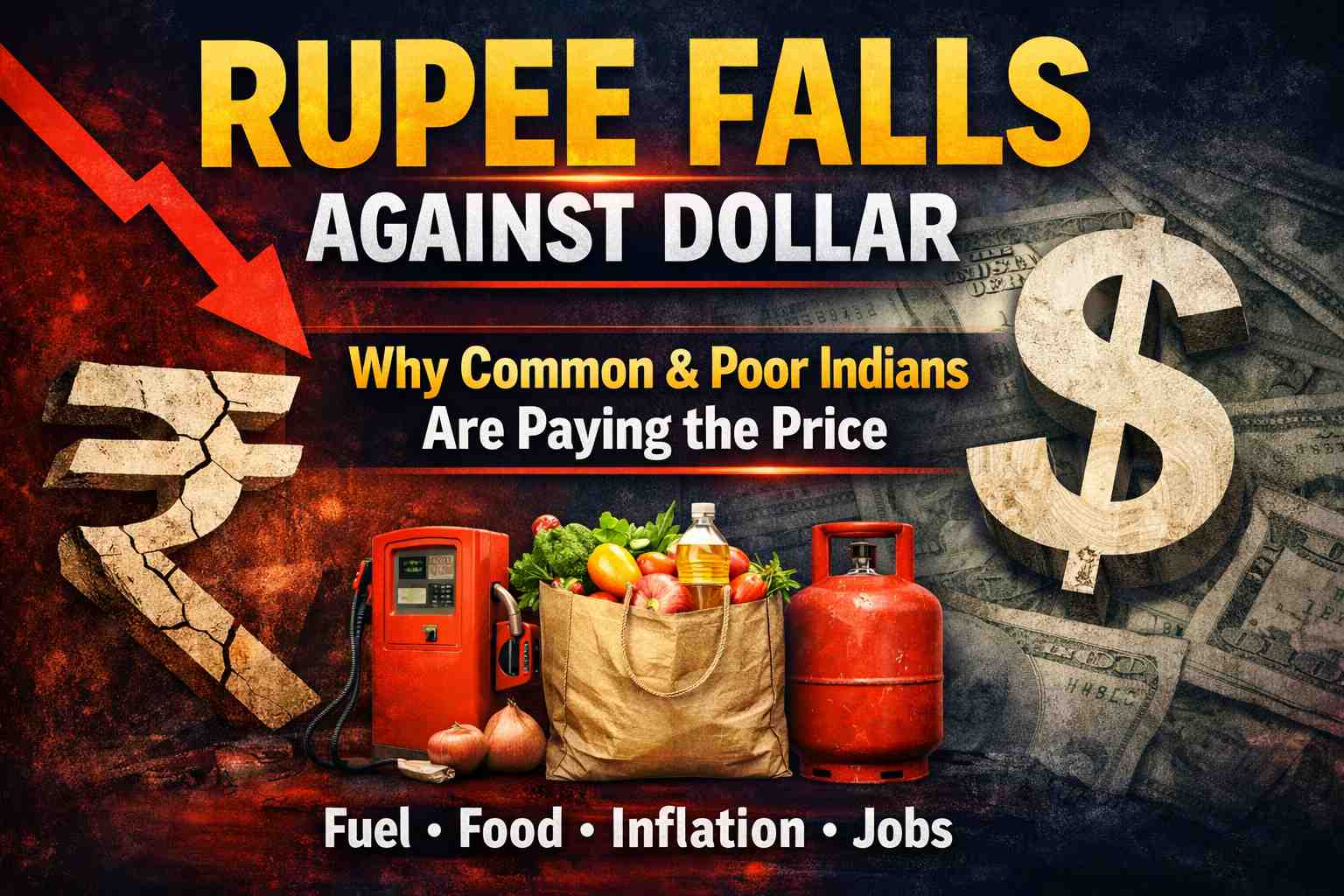
The Indian rupee has become Asia’s worst-performing currency and has been in the news for the past week after it crossed the ₹90 per US dollar mark. This means India now needs more than ₹90 to buy one dollar.
While this may sound like a market issue, the truth is simple: a falling rupee directly affects the lives of common and poor people in India. In this article, we explain how and why.
What People and Politicians Are Saying
Some people and politicians argue that:
A weak rupee will increase exports
The falling rupee has no connection with farmers, workers, or common citizens
This argument is only partially correct.

Yes, exports may benefit in the short term. But the bigger picture is disappointing, especially for an import-dependent country like India.
India Is an Import-Dependent Economy
| Year | Exports (USD bn) | Imports (USD bn) | Trade Deficit (USD bn) |
| 2021–22 | 676.53 | 760.06 | -83.53 |
| 2022–23 | 770.18 | 892.18 | -122.00 |
| 2023–24 | 778.13 | 856.52 | -78.39 |
| 2024–25 | 820.93 | 915.19 | -94.26 |
source: Pib
The data shows that our import is more than our Exports. and the trade deficit shows that how much we are depended on foreign countries.
India imports far more than it exports, especially:
Crude oil and fuel
Cooking gas
Fertilisers
Electronics, machinery, and defence equipment
When the rupee falls, all these imports become expensive. This extra cost finally reaches common people through higher prices.
Strong Currency vs Weak Currency (In Simple Words)
Strong currency: Cheaper imports, stable prices, stronger buying power
Weak currency: Costly imports, inflation, pressure on households
A rupee falling beyond ₹90 is not a sign of economic strength. It usually signals economic stress and rising costs.
Pros and Cons of a Falling Rupee
✅ Pros (Limited Benefits)
| Advantage | What It Means |
| Exports may rise | Indian goods become cheaper for foreign buyers |
| Remittances increase | Money sent from abroad has higher rupee value |
| Export companies gain | IT and export firms earn more |
Cons (Major Impact)
| Disadvantage | What it means |
| Fuel becomes expensive | Petrol, diesel, and LPG prices rise |
| Inflation increases | Food, transport, and electricity cost more |
| Farmers suffer | Fertilisers, diesel, and equipment become costly |
| Job pressure rises | Companies cut costs, freeze hiring, increase work hours |
| Household savings fall | Income stays the same while expenses keep rising |
| Government debt burden rises | Interest payments on international loans increase, reducing money for welfare and development |
How Common and Poor People Are Affected
Impact on Daily Essentials
| Item | Effect of Weak Rupee |
| Vegetables & fruits | Transport cost increases |
| Milk & eggs | Feed and fuel cost rises |
| Cooking oil | Import cost increases |
| LPG cylinders | Import-linked prices rise |
| Medicines | Imported raw materials become costly |
| Soap, shampoo | Chemical inputs become expensive |
For ordinary citizens, a weak rupee means:
Higher fuel prices
Costlier food and daily essentials (due to rise in transportation and fertiliser cost)
Increased gas and electricity bills
No matching rise in salaries
More pressure on jobs for extra working hours and targets
Farmers are hit as fertilisers and diesel become expensive, raising farming costs.
Who Benefits and Who Loses?
Benefited:
Export companies
IT firms earning in dollars
Families receiving remittances
Losers:
Common and poor people
Farmers
Salaried middle class
Small businesses
The Bigger Picture
Saying that a falling rupee helps everyone is misleading. While a few sectors benefit, most Indians lose purchasing power.
When the rupee becomes Asia’s worst-performing currency and crosses ₹90 per dollar, it is a warning sign, not an achievement.
The falling rupee is not just a currency issue — it is a people’s issue. In an import-dependent economy like India, a weak rupee hurts common citizens the most.
A strong economy builds a stable currency, protects purchasing power, and reduces daily hardship.
Connect with us through social media
Facebook:
 https://www.facebook.com/profile.php?id=61577015427068
X (Twitter):
 https://x.com/tet_editor
Instagram:
 https://www.instagram.com/the_eastern_times_/?next=%2F&hl=en
Mail (Email):
 contact.theeasterntimes@gmail.com