
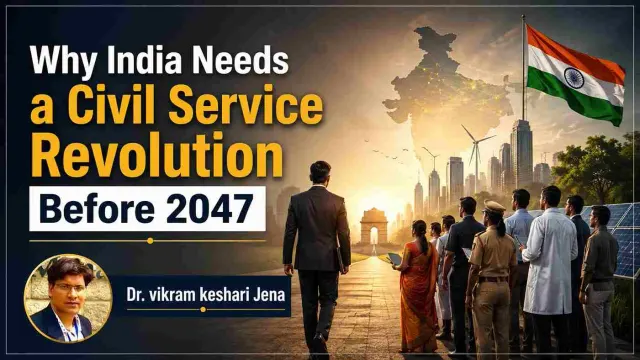
Why India Needs a Civil Service Revolution Before 2047
Quick Summary
- India’s civil service must evolve beyond colonial-era administrative thinking.
- Governance needs greater accountability, transparency, innovation and measurable performance.
- Odisha could become a laboratory for administrative reform before India@100.
The greatest tragedy of a nation is not poverty. It is the normalization of institutional complacency. Civilizations decline not because they lack resources, but because their governing institutions gradually lose the moral imagination to reinvent themselves. India today stands at precisely such a crossroads.
As the Republic approaches one hundred years of independence, the most uncomfortable question before us is not whether we have built enough highways, airports, or digital platforms. The real question is whether the architecture of governance itself has fulfilled the constitutional promise of justice, equality, and human dignity.
No institution should be above public criticism. Respect cannot be inherited through examinations, titles, or ceremonial prestige. Respect is earned every single day through public service.
The Colonial Mindset That Still Lingers
The Indian administrative system continues to carry the psychological inheritance of colonial rule. The British did not create district administration to empower citizens. They designed it to extract revenue, maintain order, and preserve imperial authority. Independent India replaced the rulers but often retained the administrative mindset. The vocabulary changed, yet the culture of hierarchy survived.
This contradiction has become increasingly visible. Citizens often experience government not as a partner but as an institution of distance. Files move slowly while aspirations move quickly. Rules become shields against innovation rather than instruments of justice. Authority frequently overshadows accountability.
The question, therefore, is not whether individual officers are capable. Many have demonstrated extraordinary courage and integrity. The deeper question is whether the present institutional design consistently rewards ethical leadership, intellectual curiosity, and measurable public outcomes.
What Is the Purpose of Public Office?
Every democracy must periodically ask a simple philosophical question: What is the purpose of public office? Is it to preserve administrative privilege, or is it to transform the lives of ordinary people?
If public service becomes merely another prestigious career rather than a moral vocation, the institution slowly loses its republican character. A democracy cannot indefinitely tolerate an administrative culture where public office is perceived as a ladder of privilege instead of an instrument of constitutional responsibility.
Every rupee entrusted to the State belongs to the people. Every misuse of public resources, every conflict of interest, every abuse of discretionary authority, and every act of corruption is ultimately a theft from the future of India's children. Such conduct is fundamentally incompatible with the ethics of public service and must invite swift, impartial, and lawful accountability.
India Needs Administrative Imagination
India's global aspirations cannot be fulfilled merely by celebrating economic growth. Nations become great when their institutions anticipate the future instead of merely administering the present. Administrative imagination matters as much as administrative efficiency.
For decades, India has spoken of becoming a global knowledge power. Yet our governance structures often remain excessively procedural, risk-averse, and resistant to experimentation. Visionary governance requires institutions that welcome ideas from scientists, teachers, entrepreneurs, economists, social workers, public health experts, environmentalists, and community leaders alongside career administrators.
The monopoly of one recruitment pathway should never become the monopoly of national imagination.
A twenty-first-century republic deserves a twenty-first-century civil service.
From Administrative Privilege to Public Accountability
Every senior public official should periodically disclose assets through legally mandated and independently verifiable declarations. Transparency is not an insult to honest officers. It is their strongest protection. Citizens are entitled to know that public office is not being used for unlawful private enrichment. Public trust grows when institutions willingly embrace scrutiny.
Performance must also become measurable. Promotion should increasingly reflect demonstrable outcomes in education, healthcare, environmental stewardship, poverty reduction, public grievance resolution, and institutional innovation, rather than relying predominantly on tenure and seniority.
India should also abandon the colonial symbolism embedded in administrative titles. The expression "District Collector" belongs to an empire that collected wealth from subjects. A constitutional democracy deserves a "District Sevaka" or "District Public Servant," reminding every administrator that sovereignty resides with the people.
Odisha Can Lead the Administrative Transformation
Odisha's centenary in 2036 offers an extraordinary opportunity to begin this transformation. Let Odisha become the first laboratory of administrative democracy.
Let citizens evaluate district administrations through transparent public scorecards. Let independent institutional audits become routine. Let ethical leadership become more valuable than bureaucratic status.
Such an approach would not weaken the civil service. It would strengthen public institutions by making them more transparent, responsive, and connected to the citizens they are meant to serve.
The Republic Needs Custodians, Not Rulers
The Republic does not need rulers in official residences. It needs custodians of the Constitution.
History teaches that every institution which refuses reform eventually becomes an obstacle to national progress. Institutions exist for nations. Nations do not exist for institutions.
India at one hundred cannot afford administrative complacency. It requires intellectual courage, constitutional humility, and moral accountability. The Republic must replace the culture of entitlement with the culture of service, the language of authority with the language of responsibility, and the psychology of command with the philosophy of constitutional trusteeship.
The greatest civil service of the twenty-first century will not be remembered for the difficulty of its entrance examination. It will be remembered for the depth of its integrity, the courage of its reforms, and the confidence it inspires among ordinary citizens.
That is the revolution India should aspire to before 2047.
Author Details
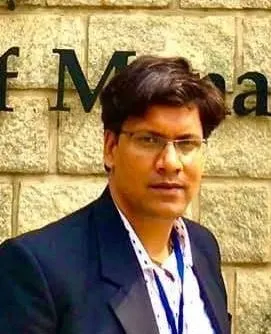
Dr. Vikram Keshari Jena is an academic, researcher, and public intellectual from Odisha. His work focuses on media, politics, development, public policy, and Indian knowledge traditions, with an emphasis on critical inquiry, social transformation, and interdisciplinary dialogue. He has authored numerous academic books and currently serves as the Founding Director of the Centre for Adivasi Research and Development (CARD), Odisha.
Reader Feedback
Was this article useful?
Stay Connected
Get the next important story before you miss it.
Subscribe to the newsletter for trusted updates, or join our WhatsApp channel for quick top-story alerts from The Eastern Times.
WhatsApp Channel
Prefer instant alerts? Join our WhatsApp channel for top stories and breaking updates.
Join on WhatsApp