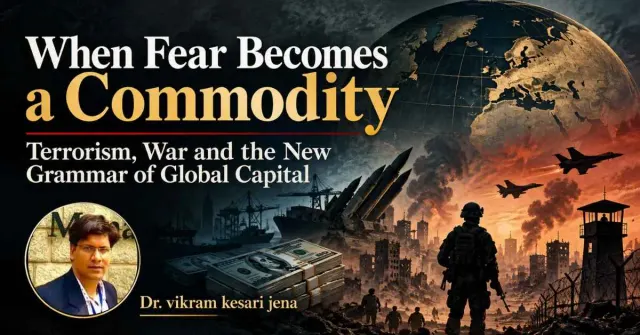
When Fear Becomes a Commodity: Terrorism, War and the Economics of Global Capital
Quick Summary
- This article examines how terrorism, war and persistent insecurity can generate economic demand for weapons, surveillance, security and reconstruction.
- It explores the political economy of fear, the unequal costs of conflict and the deeper question of who benefits when insecurity becomes a permanent market.
There is a disturbing possibility that the political economy of the twenty-first century cannot be understood merely through the language of democracy, security, terrorism and national interest. It must also be read through the language of markets.
The central question is no longer simply who produces violence, who suffers from it and who is morally responsible. The deeper question is who economically benefits when fear becomes permanent.
Terrorism is undoubtedly a political and security phenomenon, and its causes differ across regions and organisations. Yet terrorism, counterterrorism, war, militarisation and reconstruction can become parts of economic systems in which insecurity itself generates demand. The new grammar of global business may therefore be less about morality and more about money.
The Numbers Behind the Economy of Insecurity
The numbers are difficult to ignore. According to the Stockholm International Peace Research Institute, global military expenditure reached approximately $2.887 trillion in 2025, marking the eleventh consecutive year of growth. Global military spending rose by 41 percent over the decade from 2016 to 2025.
The world’s largest arms-producing and military services companies generated combined arms revenues of $679 billion in 2024, the highest figure recorded by SIPRI. These figures do not prove that arms companies create terrorism or manufacture conflicts. They demonstrate something more structural: insecurity has become an enormous economic market.
The Political Economy of Fear
This creates a political economy of fear.
A terrorist attack produces casualties, destruction and psychological trauma. But it can simultaneously produce budgets, contracts, surveillance systems, weapons procurement, border technologies, private security markets, intelligence infrastructure and military deployments.
Fear creates urgency; urgency reduces political resistance to expenditure; expenditure creates markets.
In this cycle, the economic value of insecurity does not depend upon terrorism being commercially organised by a single actor. The system can profit from the consequences of violence without having caused the violence in the first place.
Terrorism, Violence and the Global Economy
This distinction is essential. It is intellectually weak to claim that every terrorist organisation is simply an instrument of the arms industry or that every conflict is manufactured by Western powers.
Terrorist organisations have their own ideologies, political objectives, financing networks and local histories. But it is equally inadequate to imagine that violence exists outside the global economy.
Terrorist financing can involve criminal economies, illicit trade, extortion, taxation of territories and other revenue streams. At the same time, states and corporations respond to insecurity through legitimate security expenditures. These are different phenomena, but they can intersect within the larger political economy of conflict.
The Unequal Geography of Fear
The more uncomfortable question concerns the unequal geography of this economy.
Why do some societies repeatedly become laboratories of war, while others become laboratories of security technology? Why are certain populations more frequently represented as security problems rather than political communities? Why does the Global South so often experience the extraction of minerals, labour and strategic value while bearing disproportionate ecological, social and human costs?
These questions do not require a conspiracy theory. They require an examination of power.
The World Bank notes that economies affected by fragility and conflict face persistent institutional weakness and overlapping vulnerabilities, while high-intensity conflicts are typically followed by substantial long-term losses in GDP per capita.
The Political Economy of Representation
Here lies another dimension: the political economy of representation.
Propaganda does not necessarily mean inventing every fact. Modern propaganda can operate by deciding which facts receive attention, which victims become visible, which violence is called terrorism, which violence is called security, and whose suffering becomes strategically significant.
The vocabulary itself can create hierarchies.
A bombing in one part of the world may be framed as barbarism; military destruction elsewhere may be described through the language of strategic necessity. Such asymmetries deserve scrutiny because language influences public consent, and public consent influences budgets.
Colonial Hierarchies in a Modern World
The argument about white superiority must therefore be handled carefully.
Colonialism unquestionably created racial hierarchies, and European imperial power historically constructed categories of civilisation and backwardness that justified domination. But contemporary international politics cannot be reduced to a simple racial conspiracy in which all Western institutions operate according to one unified doctrine of white supremacy.
The stronger argument is structural: historical hierarchies can survive through institutions, economic relationships, knowledge systems and unequal geopolitical power even after formal colonialism ends.
When the security of powerful societies becomes a universal standard while the insecurity of poorer societies is treated as normal, an old hierarchy may acquire a new institutional language.
The Arms Economy and Continuous Demand
The arms economy is particularly revealing because it converts geopolitical anxiety into commercial demand.
SIPRI reports that the volume of major international arms transfers from 2021 to 2025 was 9.2 percent higher than during 2016–2020, while the United States accounted for 42 percent of global major arms exports during the later period. Europe sharply increased its arms imports during the same period.
The economic logic is straightforward: when states perceive greater threats, they purchase more weapons; when weapons become more sophisticated, security doctrines expand; when security doctrines expand, new threats are identified.
The market does not need a single mastermind. It needs continuous demand.
The Permanent Emergency Economy
This produces what might be called the “permanent emergency economy”.
Peace becomes economically difficult to measure because it produces fewer spectacular contracts. A missile has a price, a surveillance system has a contract, a military base has a budget and reconstruction has a procurement chain.
But the absence of war has no comparable balance sheet.
Peace creates enormous social value without necessarily creating equivalent private revenue. Consequently, capitalism can become extraordinarily efficient at monetising insecurity while remaining comparatively poor at monetising prevention.
The Opportunity Cost of Security
The consequences are particularly severe for developing countries.
Every dollar directed towards arms has an opportunity cost. It may represent a school not constructed, a hospital not equipped, a railway not extended, a tribal community not protected from displacement, or a climate adaptation programme postponed.
SIPRI’s data show that military expenditure reached 2.5 percent of global GDP in 2025.
The question is therefore not whether states require defence. They do. The question is what happens when security expenditure becomes politically easier to justify than social investment.
Who Benefits When Fear Never Ends?
The most radical question, therefore, is not “Who is the terrorist?”
It is “Who benefits economically from a world in which terrorism can never be declared finished?”
That question moves the debate beyond morality into political economy. It asks us to examine procurement systems, arms exports, private security, intelligence technologies, reconstruction contracts, resource extraction and geopolitical alliances simultaneously.
It also forces us to distinguish between those who commit violence and those who later profit from the market created by violence.
When Insecurity Becomes an Industry
Perhaps this is the most uncomfortable grammar of the new world economic order: money does not always require peace, and markets do not always require stability.
Some markets expand precisely because stability has failed.
Terrorism therefore should neither be romanticised as resistance nor reduced to an isolated pathology of particular societies. It should be studied simultaneously as political violence, ideological mobilisation, criminal economy, security problem and economic externality.
The ethical question remains indispensable, but it is not sufficient.
Behind every security doctrine there is a budget; behind every weapon there is a supply chain; behind every war there is an economic geography; and behind every prolonged emergency there are institutions capable of receiving money.
The Real Grammar of the New World Order
The ultimate danger is not that terrorism becomes a business in the narrow sense. The greater danger is that an entire global ecosystem can learn to conduct business around terrorism, war and permanent insecurity.
When fear becomes demand, demand becomes investment, investment becomes industry and industry acquires political influence, violence enters the bloodstream of the economy without requiring a single command centre.
That is why the politics of the future cannot be understood only through the language of good and evil.
We must also ask the brutally economic question: Who pays for fear, who sells security, who accumulates wealth from insecurity, and who is left to live with its ruins?
That may be the true grammar of the new world order: governed not by morality alone, nor ideology, but by money.
Author Details
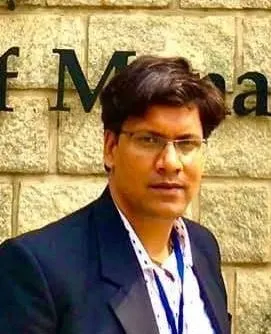
Dr. Vikram Keshari Jena is an academic, researcher, and public intellectual from Odisha. His work focuses on media, politics, development, public policy, and Indian knowledge traditions, with an emphasis on critical inquiry, social transformation, and interdisciplinary dialogue. He has authored numerous academic books and currently serves as the Founding Director of the Centre for Adivasi Research and Development (CARD), Odisha.
Reader Feedback
Was this article useful?
Stay Connected
Get the next important story before you miss it.
Subscribe to the newsletter for trusted updates, or join our WhatsApp channel for quick top-story alerts from The Eastern Times.
WhatsApp Channel
Prefer instant alerts? Join our WhatsApp channel for top stories and breaking updates.
Join on WhatsApp