War in West Asia: The US–Israel–Iran Conflict and the Risk of Global Escalation
The Middle East has once again entered one of the most dangerous phases in modern history.
The latest military confrontation involving the United States, Israel, and Iran marks not merely another regional clash but a conflict with potentially global consequences.
What began as strategic suspicion over nuclear ambitions has now transformed into open military confrontation, pushing the world closer to a broader geopolitical crisis.
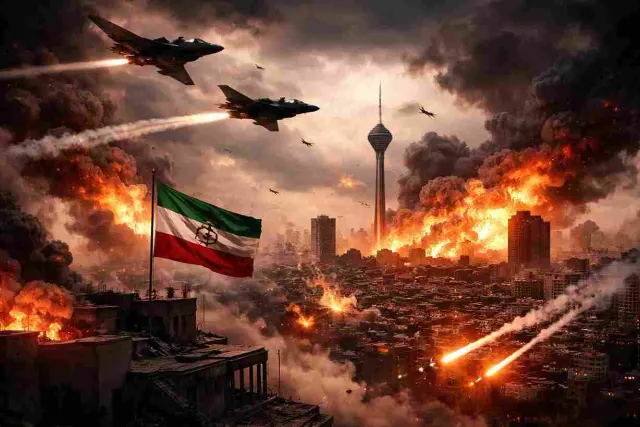
On 28 February 2026, Israel, supported militarily by the United States, launched coordinated air and missile strikes against multiple Iranian targets under an operation widely reported as Operation Lion’s Roar.
The attacks targeted military infrastructure, missile facilities, and strategic installations across Tehran and other cities.
Israeli leaders described the action as a pre-emptive strike aimed at preventing Iran from acquiring nuclear weapons capabilities.
However, the strikes immediately escalated tensions.
Iran condemned the attacks as violations of sovereignty and responded with missile and drone strikes targeting Israeli territory and American military bases across the Gulf region, including installations in Bahrain, Qatar, and Iraq.
Tehran warned that any continued aggression would invite a prolonged regional war.
From Shadow War to Direct War
For decades, Israel and Iran fought what analysts called a “shadow war”—cyber operations, proxy conflicts, assassinations, and covert sabotage.
Direct confrontation was largely avoided.
The current escalation represents a dramatic shift from indirect rivalry to overt warfare involving state militaries.
The roots of the conflict lie primarily in Iran’s nuclear programme and missile development.
Israel considers a nuclear-capable Iran an existential threat, while Iran insists its nuclear activities are peaceful.
Diplomatic negotiations between Washington and Tehran repeatedly failed to bridge disagreements over uranium enrichment and missile restrictions, creating conditions for military escalation.
American Involvement and Strategic Calculations
The direct participation of the United States fundamentally alters the nature of the conflict.
Washington justified its involvement as necessary to neutralize imminent threats and maintain regional security.
Yet American military entry risks transforming a regional war into a global confrontation.
Major powers have already reacted sharply.
Russia condemned the strikes as “armed aggression,” warning that continued escalation could destabilize the international system and trigger humanitarian and economic disasters.
The conflict therefore reflects more than Middle Eastern rivalry—it mirrors emerging global polarization among competing power blocs.
Economic Shockwaves Beyond the Battlefield
Wars in West Asia rarely remain regional events.
The Persian Gulf remains the heart of global energy supply, and instability threatens vital oil transportation routes.
Markets worldwide have reacted with fears of rising oil prices, disrupted trade routes, and inflationary pressures affecting developing economies far removed from the battlefield.
Countries like India, heavily dependent on energy imports, may face immediate economic consequences despite maintaining neutrality.
Humanitarian and Political Risks
Beyond strategy and geopolitics lies the human cost.
Civilian casualties, damaged infrastructure, and displacement risks are already being reported.
Airspace closures, emergency evacuations, and fear of retaliation have turned daily life across the region into uncertainty.
More dangerously, the conflict risks drawing regional actors and proxy groups into the war.
Fighting could expand across Lebanon, Syria, Iraq, and the Gulf states, creating a rapidly escalating multi-front conflict.
A War Without Clear Victory
History shows that wars aimed at regime change or strategic elimination rarely produce stable outcomes.
Military superiority may achieve tactical success, but long-term peace depends on political settlement—something currently absent.
The US–Israel confrontation with Iran raises a troubling question: Has diplomacy lost relevance in contemporary international politics?
The increasing reliance on pre-emptive military action suggests a world returning to power politics rather than cooperative security.
The Global Moment of Decision
The present conflict is not simply about Iran, Israel, or American security interests.
It represents a turning point in international relations where mistrust, nuclear anxiety, and geopolitical rivalry intersect.
If escalation continues, the world may witness not only a regional war but a systemic crisis affecting global peace, economic stability, and international institutions themselves.
Author Details

Dr. Susanta Kumar Parida serves as Lecturer and Head, Department of Political Science, Lokanath Mohavidyalaya, Patkura, Kendrapara. He is a columnist and panelist specializing in international relations and strategic affairs.
Reader Feedback
Was this article useful?
Stay Connected
Get the next important story before you miss it.
Subscribe to the newsletter for trusted updates, or join our WhatsApp channel for quick top-story alerts from The Eastern Times.
WhatsApp Channel
Prefer instant alerts? Join our WhatsApp channel for top stories and breaking updates.
Join on WhatsApp