
UPI Charges: Merchant Discontent and the Digital Economy
Quick Summary
- The proposed UPI charges have sparked concerns among merchants and consumers.
- The debate highlights the challenge of balancing digital payment sustainability with affordability, financial inclusion, and public trust.
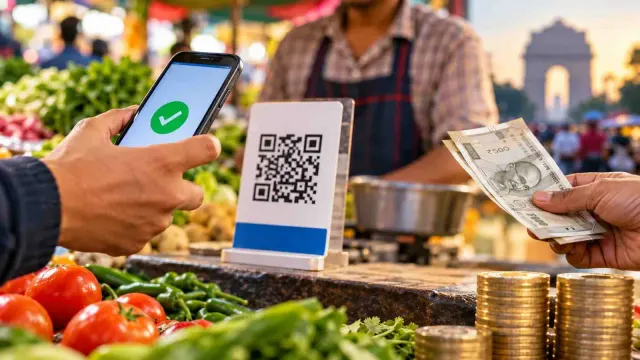
There was a time when people hesitated to leave home or visit the market without cash in their pockets. However, the arrival of the Unified Payments Interface (UPI) has transformed India's payment system, bringing significant changes to our financial habits and everyday lives. Whether it is buying a cup of tea from a roadside stall or conducting business transactions worth thousands of rupees, making a payment in India today often means simply scanning a QR code. UPI is no longer just a payment method; it has become an integral part of India's daily financial life.
Although India lags behind several countries in certain areas of the broader economy, artificial intelligence (AI), and other advanced technologies, it is at the forefront of digital payments and financial technology (fintech). India's UPI technology is no longer limited to the country but has also expanded its influence overseas. As of now, 11 countries are using UPI or Indian digital payment systems associated with it. This is not merely a success story for India's digital payment system but also a striking example of the global impact of India's Digital Public Infrastructure.
According to data from the National Payments Corporation of India (NPCI), approximately 560 million people currently use UPI, and India records an average of 817 million UPI transactions daily. In August 2026, transactions worth approximately ₹29.82 lakh crore were conducted through UPI, demonstrating the enormous scale of the system. Although UPI may appear simple and free to users, the vast infrastructure behind it cannot operate without costs. According to available information, its annual operating expenditure is approximately ₹20,700 crore, and this is expected to increase further in the coming years. This raises a major question: who will bear the enormous operating costs of UPI?
The Cost of Maintaining the UPI Ecosystem
Banking systems, servers and data centres, high-speed telecommunications networks, software maintenance, and customer service all require continuous financial investment to ensure uninterrupted operations. Moreover, the growth of UPI transactions has been accompanied by an increase in cyber fraud, making substantial investment in cybersecurity and fraud monitoring essential.
In 2020, the government introduced the Zero Merchant Discount Rate (Zero MDR) policy for UPI and RuPay transactions. This allowed small and medium-sized merchants to accept digital payments without paying transaction charges. Under the incentive scheme introduced by the government to support the institutions providing these services, ₹1,389 crore was disbursed in the financial year 2021–22, ₹2,210 crore in 2022–23, and a record ₹3,631 crore in 2023–24. Subsequently, actual disbursements amounted to ₹1,923 crore in 2024–25 and ₹2,196 crore in 2025–26, while a budget estimate of ₹2,000 crore was allocated for 2026–27.
However, compared with annual operating costs of approximately ₹21,000 crore, these subsidies are relatively insignificant, placing continued pressure on banks. To ensure the long-term sustainability of this vast system, the government has introduced a Merchant Discount Rate (MDR) mechanism. According to a notification from the Ministry of Finance, an MDR of 0.4% will apply from October 15 to business transactions exceeding ₹2,000. In addition, a fixed fee of ₹5 per transaction has been prescribed for payments exceeding ₹2,000 in sectors such as railways, telecommunications, insurance, and fuel. These measures have generated discontent among both the business community and the general public.
MDR Charges: Will Consumers Ultimately Bear the Burden?
MDR is a fee paid by merchants to banks and payment service providers for processing digital payments. According to the government's position, merchants alone will bear this charge. In practice, however, when merchants face higher costs, the burden often eventually falls on consumers. Fearing an increase in their expenses, many shopkeepers in vegetable markets and other local markets are already saying they will no longer accept UPI payments and are asking customers to bring cash instead.
Could Additional Charges Reverse India's Digital Payment Revolution?
Demonetisation, the widespread adoption of QR codes, the popularity of apps such as Paytm, Google Pay, and PhonePe, and the fear surrounding the COVID-19 pandemic collectively encouraged people to shift from cash to digital transactions. However, the introduction of additional charges could reverse this trend.
According to a survey conducted by LocalCircles across 291 districts, 84% of respondents were unwilling to pay MDR on UPI transactions exceeding ₹2,000. Furthermore, 27% explicitly stated that they would return to cash transactions if the MDR burden were passed on to consumers.
According to a 2024 EY-CII report, although 38% of people in rural and semi-urban areas used UPI, 86% of consumers still preferred visiting bank branches, while 40% stood in queues to withdraw cash. Many areas also face problems with network reliability. Issues with bank servers, payment networks, or internet connectivity often leave UPI transactions pending or cause delays. In such circumstances, cash serves as an alternative means of payment. This indicates that rural India has yet to fully embrace the digital ecosystem.
Digital Payment Infrastructure: Is India Ready for Uniform MDR?
India has approximately 1.29 billion mobile subscribers, while the number of UPI users stands at around 560 million and smartphone users at approximately 700 million. In other words, the number of UPI users is roughly half the total number of mobile subscribers.
Therefore, the question is not simply whether MDR should be introduced. The more fundamental issue is how justified a uniform MDR system would be for the entire country when the availability and reliability of digital payment infrastructure remain unequal across India. If some merchants or consumers return to cash transactions because of MDR, it could affect the digital ecosystem, financial inclusion, and the expansion of the formal economy.
Rising Inflation and the Additional Burden on Consumers
The impact of rising global oil prices has also been felt in India. Higher prices for petrol, diesel, and cooking gas have increased transportation and production costs. Consequently, prices have risen for everything from food items to various services, further contributing to inflation. Both businesses and ordinary people are suffering from this inflationary pressure.
While rising business costs are putting additional pressure on merchants and household budgets are already stretched, imposing charges on digital payments would amount to adding another burden to existing hardships. Therefore, an alternative model could be considered that encourages digital payments without placing an additional financial burden on consumers and small businesses.
An Alternative Model: Digital Payment Support Fund
First, keeping the interests of consumers and small merchants in mind, the government could establish a Digital Payment Support Fund instead of imposing MDR on UPI transactions. Under this proposal, 50% of the UPI ecosystem's costs could be borne by the government, 40% by banks, and the remaining 10% jointly by payment service providers and users.
Learning from Global Digital Payment Models
Second, instant digital payment systems such as UPI are not unique to India. Brazil's Pix, Singapore's PayNow, and Thailand's PromptPay are also important components of their respective countries' digital payment ecosystems. However, these systems differ in their transaction charges and cost-recovery models. For example, Thailand's PromptPay features a slab-based fee structure depending on the transaction amount.
India could also consider an alternative model of this kind instead of the proposed 0.4% MDR. For instance, under such a slab-based system, transactions up to ₹2,000 could remain completely free, while transactions between ₹2,001 and ₹10,000 could attract a fee of ₹2; those between ₹10,001 and ₹20,000 could incur ₹10; those between ₹20,001 and ₹50,000 could attract ₹30; and transactions exceeding ₹50,000 could be subject to a capped fee of ₹100.
Are Consumers Already Paying Fees on Digital Platforms?
Furthermore, platforms such as PhonePe, which accounts for approximately 46% of India's UPI market, Google Pay with 33%, and Paytm with 8%, are now charging platform fees ranging from ₹1 to ₹5 on mobile recharges exceeding ₹100. The fact that mobile recharges worth approximately ₹2.8 lakh crore were conducted through UPI alone in 2025 suggests that consumers are already familiar with this kind of fee structure.
Cash Transactions Also Have a Cost
On the other hand, the cash we use is not entirely free to print or manage either. In the two years following demonetisation, the government had to spend approximately ₹12,877 crore on printing new currency notes. Every year, substantial amounts are spent on printing currency, withdrawing old notes, transporting cash to banks and ATMs, and maintaining stringent security arrangements.
A Balanced Policy for a Sustainable Digital Economy
The growth of digital payments in place of cash has played a major role in the success of Digital India and the digital economy, with UPI making one of the most significant contributions. Adequate financial support is essential to keep this system sustainable, secure, and uninterrupted.
Therefore, when considering charges on UPI transactions, policymakers must prioritise not only operating costs but also the interests of ordinary citizens, small businesses, and consumer confidence in digital payments.
The long-term sustainability and security of India's digital payment ecosystem require the collective cooperation of the government, banks, UPI platforms, and consumers. Only a balanced policy can protect the interests of all stakeholders while ensuring that this system remains successful and reliable for years to come.
Author Details

Editor, writer, and columnist focused on social, economic, and key national issues, delivering insightful analysis, informed perspectives, and impactful commentary that informs public discourse and engages a wide audience.
Reader Feedback
Was this article useful?
Stay Connected
Get the next important story before you miss it.
Subscribe to the newsletter for trusted updates, or join our WhatsApp channel for quick top-story alerts from The Eastern Times.
WhatsApp Channel
Prefer instant alerts? Join our WhatsApp channel for top stories and breaking updates.
Join on WhatsApp