The Environment and the India–Europe Trade Agreement
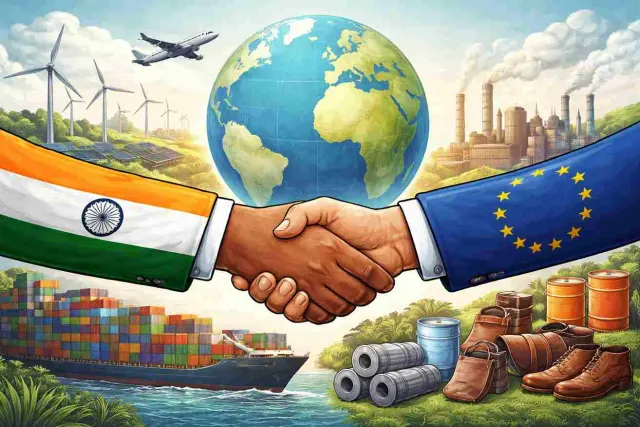
The historic Free Trade Agreement between India and Europe, signed on January 27, has finally ended nearly two decades of uncertainty. The agreement is expected to open a vast market of nearly two billion people and create new opportunities for trade and employment. It could also bring significant tax benefits to both sides.
In many ways, the agreement has the potential to influence a large share of global trade. Yet, while its economic promise is widely discussed, certain concerns remain. Among the most important is the question of industrial pollution and environmental protection.
Economic Opportunity and Environmental Costs
India exports several products to Europe, including textiles, leather and leather products, chemicals, rubber, plastics, jewellery and precious stones. Under the trade agreement, many of these goods are expected to gradually enter the zero-tariff category within five to seven years.
These industries are labour-intensive and play a key role in creating employment. However, they also raise environmental concerns. Textile production, for example, requires large amounts of water and chemicals during dyeing. Similarly, the leather industry releases liquid waste containing chromium, which can contaminate soil and groundwater.
These concerns bring attention to a broader issue: the carbon emissions produced by industrial activity.
Carbon Emissions at the Centre of the Debate
Industrial processes release significant amounts of carbon dioxide into the atmosphere, contributing to air pollution and accelerating the greenhouse effect. In response, the European Union has introduced a policy known as the Carbon Border Adjustment Mechanism, or CBAM.
CBAM is essentially a carbon-linked tax. It can be viewed both as a border tax and an environmental levy aimed at controlling carbon emissions. The mechanism forms part of the European Union’s broader climate policy, which seeks to reduce carbon emissions by at least 55 percent by the year 2030.
The central idea is that goods exported to Europe should meet emission standards similar to those followed within Europe itself.
Implementation and Scope
CBAM was introduced on a trial basis in October 2023. Its objective was to impose carbon costs on industrial production processes that are harmful to the environment. From January 2026, the mechanism has come into full effect.
During negotiations over the India–Europe trade agreement, India attempted to secure certain concessions related to CBAM. However, those efforts were not successful.
Several sectors fall within the scope of the mechanism. These include steel, aluminium, cement, fertilizers, chemicals, electricity, paper, glass production and oil refining. These industries are included because their production processes generate high levels of carbon emissions.
The Working of the Carbon Tax
The CBAM system functions through a certification process. The tax is calculated based on two main factors: the quantity of goods exported and the average carbon emissions generated during their production.
Exporting countries must purchase certificates reflecting these emissions. The pricing of these certificates is linked to the European Union Emissions Trading System, which was introduced in 2005.
Under this system, industries, power producers and aviation companies must pay according to the amount of carbon they emit. Currently, the cost of emitting one ton of carbon dioxide ranges between approximately 80 and 88 euros. The CBAM system follows a similar framework.
Implications for India
For India, the implications of this mechanism are significant. A large share of India’s exports to Europe consists of steel and aluminium. The production of these materials generates considerable carbon emissions.
Another important factor is India’s dependence on coal as a primary energy source. In the steel sector, blast furnaces are widely used in India, and these produce higher carbon emissions. In contrast, European industries increasingly rely on electric furnaces, which are considered more environmentally friendly.
Because of these differences, Indian exports may face additional carbon costs in European markets. In order to remain competitive, manufacturers may even be forced to reduce prices by around 15 to 22 percent. This could ultimately reduce profit margins for producers.
Possible Policy Responses
To address these challenges, India may need to consider several policy measures. Reducing dependence on coal and adopting a comprehensive decarbonization strategy would be an important step.
The government could also work with the European Union to bring environmentally friendly industrial technologies to India. Encouraging industries to adopt renewable energy and green technologies will also be essential.
At the same time, India’s growing global influence — highlighted by its role as the host of the G20 summit in 2023 — provides an opportunity to engage with other developing countries on this issue. A collective platform could help raise concerns about the impact of carbon taxation on emerging economies.
The Larger Debate
Despite its stated environmental objectives, the effectiveness of CBAM remains open to debate. Even with its application in Europe, the mechanism has reduced global carbon emissions by only about 0.1 percent.
At the same time, it has increased export costs for developing countries and reduced profit margins for their industries. This raises an important question: does CBAM genuinely address climate change, or does it risk becoming a barrier to free trade?
Europe has developed strong green energy systems that allow it to produce steel and other materials using cleaner energy sources, though at higher costs. India, on the other hand, still relies heavily on coal but produces steel at comparatively lower prices.
Because of this cost advantage, Indian steel can compete strongly in global markets. Some critics therefore argue that CBAM may also serve as a protective measure for European industries.
India’s Economic Survey 2024–2025 has already expressed concern about the policy. Finance Minister Nirmala Sitharaman has also warned that CBAM could significantly affect India’s steel sector.
Author Details

Dr. Raj Kishore Panda (MBBS, PGPN) is a medical professional and commentator who writes on socio-economic affairs, geopolitics, environmental challenges, and public health issues.
Reader Feedback
Was this article useful?
Stay Connected
Get the next important story before you miss it.
Subscribe to the newsletter for trusted updates, or join our WhatsApp channel for quick top-story alerts from The Eastern Times.
WhatsApp Channel
Prefer instant alerts? Join our WhatsApp channel for top stories and breaking updates.
Join on WhatsApp