
The Future of Money Is Not Universal: Why South Asia Will Defy Silicon Valley’s Predictions
Quick Summary
- South Asia’s rural population, informal economy and cultural traditions make a universal financial transformation unlikely.
- AI, digital payments, blockchain and digital currencies will reshape finance, but traditional money and institutions will remain important.
- The region is likely to develop a hybrid future where cash, digital payments and emerging financial technologies coexist
Few entrepreneurs have shaped the modern technological imagination as profoundly as Elon Musk. From electric vehicles and reusable rockets to artificial intelligence and brain-computer interfaces, Musk has repeatedly challenged conventional wisdom.
When he speaks about the future of money, financial systems, or the possibility that traditional currencies may gradually lose significance in an AI-driven world, his arguments deserve careful attention. Yet they should not be mistaken for universal truths.
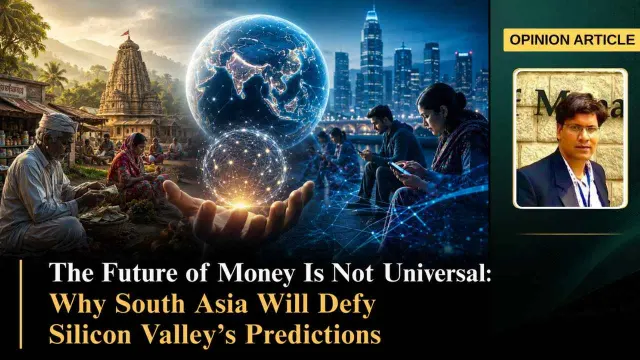
The future of finance will not be written exclusively in Silicon Valley. It will also be determined in the villages of Odisha, the markets of Dhaka, the streets of Kathmandu, the textile hubs of Pakistan, and the farming communities of Sri Lanka.
History repeatedly demonstrates that technological revolutions rarely unfold uniformly across civilizations. Every society adapts innovation through the lens of its own culture, political institutions, demographic realities, historical memory, and social structures.
South Asia, home to nearly two billion people, represents one of the clearest examples of why predictions about the disappearance or radical transformation of money cannot simply be imported from the West.
Money Is More Than a Technology
Money is far more than a technological instrument. It is a social institution built upon trust, customs, legal authority, political legitimacy, and cultural relationships.
Throughout South Asian history, economic exchange has always combined formal markets with deeply embedded informal systems. Family credit, neighbourhood lending, cooperative societies, self-help groups, religious donations, barter arrangements, rotating savings associations, and community finance continue to coexist alongside digital banking.
These multiple layers of economic interaction make South Asian societies structurally different from highly financialized Western economies.
Rural Economies Follow Their Own Rhythm
The first reason Musk’s futuristic predictions may have limited relevance lies in the demographic composition of South Asia. The region contains enormous rural populations whose economic lives remain closely connected to agriculture, small enterprises, informal labour, and family-owned businesses.
For millions of households, financial decisions are shaped less by algorithmic optimization than by seasonal income, local relationships, festivals, agricultural cycles, and community obligations.
Technology can certainly improve efficiency, but it cannot replace the social trust accumulated across generations.
The Informal Economy Cannot Be Ignored
Second, the informal economy remains one of South Asia’s defining characteristics. In India alone, a significant share of employment is generated outside the formal corporate sector.
Street vendors, artisans, transport workers, domestic workers, small manufacturers, fishermen, farmers, and countless micro-entrepreneurs operate within economic ecosystems where flexibility often matters more than technological sophistication.
Predicting the disappearance of conventional money ignores the resilience of these economic arrangements.
The Digital Divide Still Matters
Third, economic inequality presents an enormous constraint on any universal technological transition.
Artificial intelligence, blockchain-based finance, decentralized digital assets, and fully automated payment ecosystems require reliable internet connectivity, digital literacy, cybersecurity awareness, and affordable technological infrastructure.
While urban centres increasingly enjoy these facilities, large sections of South Asia continue to experience uneven access to digital resources. Financial inclusion has undoubtedly expanded through digital payment systems, but inclusion does not automatically eliminate structural inequality.
Money Is Also About Sovereignty
A fourth factor concerns political sovereignty. Every independent nation treats monetary policy as one of its most powerful instruments of governance.
Central banks regulate inflation, maintain financial stability, supervise commercial banks, manage foreign exchange reserves, and respond to economic crises.
No democratic government willingly surrenders these responsibilities to private technological platforms, regardless of how innovative they appear. National currencies embody economic sovereignty as much as financial functionality.
Culture Shapes How People Use Money
Culture further distinguishes South Asia from many futuristic projections. Economic behaviour in this region cannot be understood solely through rational market models.
Weddings, religious festivals, pilgrimage, inheritance traditions, charitable giving, temple donations, mosque contributions, community celebrations, and family ceremonies continue to involve tangible financial practices that carry emotional and symbolic significance.
Cash often represents security, privacy, and autonomy rather than technological backwardness.
One Generation Will Not Replace Another Overnight
Generational diversity also deserves attention. South Asia contains one of the world’s youngest populations, yet it simultaneously supports millions of elderly citizens whose financial habits were formed long before smartphones and digital wallets emerged.
The future, therefore, will not be a simple replacement of one monetary system by another, but an extended coexistence of multiple financial cultures operating simultaneously.
Technology Still Has to Earn Trust
Trust remains another underestimated variable. Advanced financial technologies require confidence not only in software but also in institutions that govern data privacy, cyber resilience, legal accountability, and regulatory oversight.
High-profile incidents involving financial fraud, digital theft, identity breaches, and online scams remind citizens that technological innovation introduces new vulnerabilities alongside new opportunities.
Public trust develops slowly and cannot be engineered solely through technological superiority.
South Asia Is Not a Single Financial System
South Asia also possesses remarkable institutional diversity. India, Bangladesh, Nepal, Bhutan, Pakistan, Sri Lanka, and the Maldives maintain different regulatory philosophies, banking structures, taxation systems, and political priorities.
There is little reason to assume that these governments will embrace identical financial futures. Regional diversity itself becomes a safeguard against technological uniformity.
New Technologies Rarely Erase the Old
The philosophy underlying many Silicon Valley forecasts often reflects technological determinism—the belief that innovation inevitably transforms society in predictable directions.
History offers a more complex lesson.
Printing did not eliminate oral traditions. Television did not destroy newspapers. E-books did not replace printed books. Digital classrooms have not rendered universities obsolete.
Instead, societies integrate old and new institutions into hybrid arrangements. Money is likely to follow the same evolutionary path.
AI Will Transform Finance, Not Necessarily Replace Money
Artificial intelligence will undoubtedly reshape banking, investment management, insurance, taxation, fraud detection, and financial services.
Central bank digital currencies may expand. Blockchain applications may improve transparency in supply chains and public administration. Cross-border payments may become cheaper and faster.
These developments deserve encouragement. However, none of them necessarily imply the disappearance of traditional money or the marginalization of national monetary institutions.
In a Crisis, Redundancy Becomes Strength
Another important consideration involves resilience during crises.
Natural disasters, cyberattacks, geopolitical conflicts, infrastructure failures, and electricity disruptions periodically remind societies of the importance of maintaining multiple payment systems.
Financial redundancy is not inefficiency; it is resilience.
South Asia, which frequently experiences floods, cyclones, earthquakes, and infrastructure disruptions, cannot afford complete dependence upon a single technological architecture.
Human Behaviour Changes More Slowly Than Technology
Perhaps the greatest limitation of futuristic monetary predictions is their tendency to underestimate human behaviour.
Economic systems evolve through psychology as much as technology. People save differently, spend differently, borrow differently, and invest differently according to family expectations, social norms, education, religious beliefs, and historical experience.
These behavioural foundations change gradually, not overnight.
The Questions Policymakers Should Be Asking
Rather than asking whether money will disappear, policymakers should ask more practical questions.
How can financial inclusion reach remote villages? How can digital fraud be reduced? How can women gain greater financial independence? How can small enterprises obtain affordable credit? How can agricultural markets become more transparent? How can financial technology strengthen rather than weaken democratic accountability?
These questions are particularly relevant for South Asia, where development remains inseparable from employment generation, education, healthcare, rural infrastructure, and institutional reform.
Financial innovation must serve these objectives instead of becoming an end in itself.
Technology Cannot Replace Civilizational Understanding
Elon Musk has repeatedly expanded humanity’s technological horizons, and many of his predictions have proven remarkably accurate.
Yet technological brilliance should never substitute for civilizational understanding. The future of money cannot be determined by algorithms alone because economies are ultimately communities of people, not merely networks of transactions.
South Asia’s financial future will emerge through a unique synthesis of digital innovation, democratic governance, cultural continuity, institutional trust, and social diversity.
Technology will undoubtedly transform how people earn, save, invest, and exchange value. But it will not erase the historical, cultural, and political foundations upon which monetary systems rest.
The Future Will Be Plural, Not Universal
The next several decades will therefore witness not the death of money, but its plural evolution.
Cash, digital payments, central bank currencies, community finance, cooperative institutions, and emerging technologies will coexist in different combinations across different societies.
The world will not converge toward a single financial destiny. It will continue to reflect the remarkable diversity of human civilization, and South Asia will remain one of its most compelling examples.
Author Details

Dr. Vikram Keshari Jena is an academic, researcher, and public intellectual from Odisha. His work focuses on media, politics, development, public policy, and Indian knowledge traditions, with an emphasis on critical inquiry, social transformation, and interdisciplinary dialogue. He has authored numerous academic books and currently serves as the Founding Director of the Centre for Adivasi Research and Development (CARD), Odisha.
Reader Feedback
Was this article useful?
Stay Connected
Get the next important story before you miss it.
Subscribe to the newsletter for trusted updates, or join our WhatsApp channel for quick top-story alerts from The Eastern Times.
WhatsApp Channel
Prefer instant alerts? Join our WhatsApp channel for top stories and breaking updates.
Join on WhatsApp