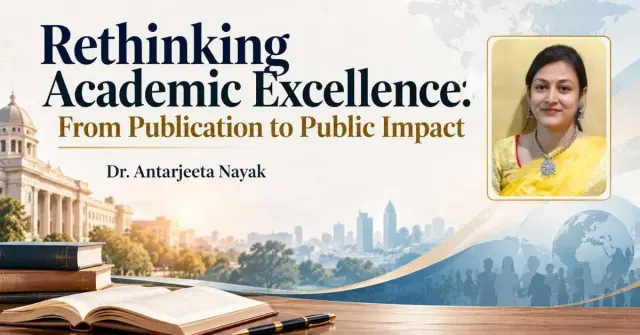
Rethinking Academic Excellence: From Publication to Public Impact
Quick Summary
- This article argues that academic excellence should go beyond publications and citation counts.
- Research achieves its greater purpose when knowledge is communicated clearly, reaches society, informs policy and practice, and contributes to meaningful human development.
"Knowledge is not created merely to be archived. It is created to be understood, questioned, applied, and transformed into human progress."
For centuries, academia has measured intellectual excellence through journals. Universities and educational institutes celebrate publications in indexed journals, governments fund research based on citation counts, and promotion committees often evaluate scholars through impact factors, h-indexes, and bibliometric indicators.
Every year, millions of scientific papers are published across thousands of journals. According to major databases such as Scopus and the Web of Science, global research output has now exceeded three million peer-reviewed articles annually, with publication rates continuing to rise rapidly. Governments collectively invest hundreds of billions of dollars each year in research and development.
Universities proudly report publication counts, citation indices, impact factors, and global rankings. Funding agencies increasingly demand measurable research productivity. These measures undoubtedly serve an important purpose: preserving scientific rigor, ensuring methodological scrutiny through peer review, and building cumulative knowledge.
Yet a profound paradox lies at the heart of modern research. Even papers that become highly cited often remain confined within disciplinary communities, circulating among specialists who already possess the technical vocabulary and methodological expertise to interpret them.
Outside these circles, their existence frequently goes unnoticed. A paper may receive dozens of citations from fellow researchers while remaining completely unknown to teachers, policymakers, journalists, entrepreneurs, farmers, healthcare workers, parents, or ordinary citizens.
The problem, therefore, is not necessarily the production of knowledge. It is the circulation of knowledge.
Conversely, an evidence-based newspaper article derived from rigorous research may influence millions of readers, inspire behavioural change, stimulate legislative debate, reshape public policy, or alter professional practice while receiving almost no academic citations and often disappearing from academic accounting.
This asymmetry reflects a deeper philosophical assumption embedded within higher education: that publication itself represents the culmination of research. Increasingly, this assumption deserves reconsideration.
This raises a fundamental question: Should popular writing become an integral component of academic work rather than remain an extracurricular activity? The answer demands neither replacing journals with newspapers nor glorifying popularity over scientific rigor.
Instead, it requires recognizing that research and communication represent two equally important stages of knowledge creation.
From Academic Writing to Public Understanding
Perhaps the greatest conceptual limitation of contemporary academic evaluation is its tendency to divide scholarly writing into two isolated categories: academic writing and popular writing. Such a distinction appears logical at first glance.
Journal articles employ technical language, statistical analysis, theoretical precision, and methodological detail. Popular articles use accessible language, narratives, examples, and contextual explanations. Because their styles differ, they are often assumed to belong to different intellectual worlds.
This assumption is misleading. Both forms of writing are not competing products; they are sequential stages within a single Knowledge Continuum.
When universities evaluate only journal publications, they effectively assess only one segment of this continuum while overlooking the equally important processes through which research acquires public meaning. Research transforms questions into evidence, peer-reviewed journals validate that evidence, and popular writing translates validated evidence into language that non-specialists can understand.
Surveys conducted by organizations such as Pew Research Center, Wellcome Trust, and Eurobarometer have repeatedly shown that public understanding of scientific issues—from vaccination and climate change to nutrition, artificial intelligence, and mental health—depends far more on newspapers, magazines, documentaries, digital media, podcasts, blogs, and social platforms than on scholarly journals.
In other words, society rarely consumes science directly. It consumes science after someone translates it. When economists explain inflation in newspapers, citizens make better financial decisions; when psychologists discuss adolescent mental health through magazines and television, families recognize symptoms earlier.
When environmental scientists publish columns on climate adaptation, communities become more resilient. When paediatricians explain sleep science to parents, children's health improves. Popular writing converts information into public action, democratizes knowledge, and, in many cases, humanizes science.
Stories often travel farther than statistics. Narratives make evidence memorable, while emotion increases retention. Communication therefore becomes an extension, not a dilution, of research.
In such an environment, the social responsibility of researchers extends beyond discovering truth. It includes ensuring that truth is communicated with clarity, accuracy, and accessibility.
When Research Remains Inside Academic Databases
This changing landscape raises a question that may become one of the defining questions of higher education in the coming decades: Can a university truly claim to have fulfilled its mission if its discoveries remain confined within academic databases while public discourse is shaped by voices less informed by evidence?
The answer cannot be found solely in citation reports or university rankings. It requires a broader understanding of what research is ultimately meant to accomplish.
For if the purpose of research is only to produce knowledge, publication is sufficient. But if the purpose of research is to improve humanity, publication is only the beginning.
"The greatest challenge of the twenty-first century is no longer producing knowledge. It is ensuring that knowledge travels from evidence to action."
The defining challenge of contemporary science is not a shortage of discoveries but an abundance of discoveries struggling to find meaningful social expression. A scientific discovery published in a prestigious journal does not instantly transform society.
It must pass through multiple stages of interpretation before reaching those capable of applying it. Popular writing therefore acts as one of the principal communication channels through which validated knowledge crosses disciplinary boundaries and enters public consciousness.
Without this intermediary stage, even excellent research risks remaining institutionally celebrated but socially underutilized. One reason popular writing often receives limited academic recognition is the widespread assumption that writing for the public necessarily involves simplifying science to the point of superficiality.
Sometimes it does. But poor communication is not an inevitable feature of popular writing. Explaining complexity accurately is often intellectually more demanding than merely describing it. The ability to write for society should therefore be regarded not as an extracurricular talent but as an advanced scholarly competency.
India’s Knowledge Society and the Communication Gap
"A nation does not become a knowledge society because its universities publish more papers. It becomes a knowledge society when its people become more knowledgeable."
India often describes itself as a knowledge economy, an innovation hub, and a nation aspiring to become a Viksit Bharat by 2047. This aspiration is reflected in ambitious investments in higher education, research funding, digital infrastructure, artificial intelligence, biotechnology, semiconductor manufacturing, and startup ecosystems.
The National Education Policy (NEP) 2020 envisions universities as centres of multidisciplinary inquiry, innovation, and societal transformation. These developments are encouraging because they acknowledge that knowledge, rather than natural resources alone, will determine the competitiveness of twenty-first-century nations.
Yet beneath this optimism lies a contradiction that remains largely unaddressed. India has made measurable progress in increasing the volume of scientific publications, but the translation of that knowledge into public understanding, policy discourse, school education, local governance, and everyday decision-making remains strikingly uneven.
The country has become increasingly successful at producing research, but considerably less systematic in ensuring that research becomes part of the intellectual life of society. This is not merely a communication deficit; it is an institutional design problem.
Young researchers quickly learn what matters for recruitment. Faculty members understand what determines promotion, universities know what influences accreditation, and departments recognize which activities receive institutional appreciation and which remain invisible.
Over time, these incentives create a predictable pattern of behaviour. Researchers naturally devote their greatest attention to activities that contribute directly to career advancement.
This is not a weakness of individual scholars. It is a characteristic of every incentive-driven system. Consequently, academic energy increasingly concentrates on publishing in indexed journals, maximizing citation counts, securing research grants, and improving bibliometric indicators.
These activities are indispensable for maintaining scientific standards and must continue to remain central to academic evaluation. However, an unintended consequence has gradually emerged.
Evidence-based newspaper columns, public policy essays, educational magazines, science communication initiatives, multilingual books, and community-oriented publications frequently become invisible within institutional appraisal systems, regardless of their societal influence.
The result is a paradox: the more researchers seek academic success, the less institutional incentive they often have to communicate with the very society whose problems they investigate.
Redefining Academic Excellence
Perhaps the time has come to redefine the very meaning of academic excellence. Academic excellence should no longer be understood merely as the ability to produce rigorous research.
It should also include the ability to ensure that rigorous research becomes public knowledge, informed policy, improved practice, and measurable human development. The university is not simply a producer of publications; it is a trustee of civilization's knowledge.
Its responsibility extends beyond discovery to dissemination, beyond dissemination to understanding, and beyond understanding to transformation. Only then does research complete its journey from the laboratory to society.
From Research to Human Development
The twenty-first century, however, increasingly defines itself as a knowledge society—a world in which ideas, innovation, research, and intellectual capital have become the principal drivers of economic growth and social development.
But research, however rigorous, is not development unless it ultimately transforms the conditions of human life. The true measure of civilization, therefore, is not the volume of knowledge it generates but the extent to which that knowledge improves the lives of its people.
It is this distinction that demands a fundamental rethinking of academic excellence. If universities genuinely aspire to become engines of national development, their evaluation systems must reflect the complete journey of research.
The future researcher should be recognized not only for publishing influential journal articles but also for demonstrating excellence in responsible science communication, multilingual dissemination, policy engagement, educational outreach, and measurable societal contribution. This does not imply lowering scientific standards. On the contrary, it raises expectations.
The researcher of tomorrow will be expected not only to discover knowledge but also to ensure that knowledge survives outside the laboratory—from the university to the village, from data to dialogue, and from evidence to everyday life. In the end, research achieves its highest purpose not when it is merely published, but when it becomes part of the way humanity thinks, decides, and lives.
Author Details

Dr. Antarjeeta Nayak is a researcher and columnist with a Ph.D. in Economics from NIT Rourkela and a recipient of ICSSR Doctoral and Post-Doctoral Fellowships. Her research focuses on poverty and tribal development.
Reader Feedback
Was this article useful?
Stay Connected
Get the next important story before you miss it.
Subscribe to the newsletter for trusted updates, or join our WhatsApp channel for quick top-story alerts from The Eastern Times.
WhatsApp Channel
Prefer instant alerts? Join our WhatsApp channel for top stories and breaking updates.
Join on WhatsApp