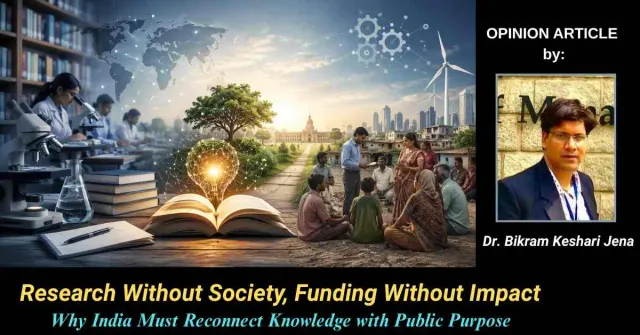
Research Without Society, Funding Without Impact: Why India Must Reconnect Knowledge with Public Purpose
Quick Summary
- Publicly funded research should create real societal impact by informing policy, solving public problems, and benefiting citizens—not just producing reports and conferences.
- India needs stronger accountability, transparency, and collaboration between researchers, governments, and legislatures to ensure research leads to measurable outcomes.
- Research must return to its original purpose: generating knowledge that strengthens democracy, improves governance, and builds a better society.
civilization is ultimately judged not by the wealth it accumulates but by the wisdom it produces. Roads, buildings, industries, and technologies are visible markers of progress, yet the true strength of a nation lies in its ability to generate ideas that help society understand itself and solve its problems.
Research institutions exist for this purpose. They are funded not merely to publish papers or organize seminars but to deepen public understanding, shape policy, preserve memory, and guide the future.
When Research Loses Its Connection with Society
This is why an uncomfortable question deserves serious attention today: What happens when research becomes disconnected from society?
The question acquires particular significance in the context of institutions entrusted with promoting social science research in India. Every year, public funds are allocated for conferences, seminars, workshops, fellowships, surveys, publications, and research projects. The stated objective is noble. Research is expected to contribute to policy formulation, social development, cultural preservation, and national advancement.
Yet many citizens increasingly wonder whether the outcomes justify the investment.
Beyond Publications: The Real Purpose of Public Research
The concern is not that researchers are not working. Thousands of scholars across India devote years of effort to studying society, history, culture, economics, governance, and public policy.
The concern is whether the knowledge produced reaches the people, influences governance, or contributes meaningfully to public life.
Historic Commemorations Should Inspire Scholarship
This concern becomes sharper when viewed against the backdrop of major historical commemorations receiving national attention.
The celebration of the 150th birth anniversary of the great tribal freedom fighter Birsa Munda, the anniversaries of distinguished national figures, the centenary of important organizations and movements, the hundred years of the martyrdom of Baji Rout, and the 125th birth anniversary of Dr. Harekrushna Mahatab are not merely ceremonial occasions.
They are opportunities for intellectual engagement. They invite fresh research, new interpretations, archival recovery, policy discussions, and public education.
Yet one is compelled to ask whether these occasions have generated the scale of scholarly mobilization they deserve. How many long-term research programmes have emerged? How many district-level studies have been undertaken? How many policy reports have been prepared? How many findings have entered public debate? Most importantly, how many recommendations have shaped government action?
Bridging the Gap Between Knowledge and Governance
A democracy requires a continuous conversation between knowledge and power. Research should not remain confined within libraries, conference halls, or academic journals.
The ultimate destination of publicly funded research should be society itself.
Unfortunately, a structural gap has emerged in many parts of the academic ecosystem. A project is sanctioned. Funds are released. Fieldwork is conducted. Reports are submitted. Publications appear. Administrative procedures are completed.
Yet the social life of the research often ends there. The knowledge remains buried in institutional archives, inaccessible to policymakers, legislators, journalists, civil society organizations, and citizens.
This is not merely an administrative failure. It is a philosophical failure.
Also Read: G7 Summit 2026 Highlights: Key Outcomes and Why It Matters for India
Knowledge Must Serve the Public Good
The ancient Indian conception of knowledge never separated learning from public purpose. Knowledge was valued because it contributed to social harmony, ethical reflection, and collective well-being. The scholar was not merely a collector of information but a guide to society. Wisdom carried responsibility.
Modern research institutions were created with a similar aspiration. They were expected to produce evidence that would improve governance and strengthen democracy. The purpose of research was not accumulation alone but transformation.
Accountability Must Accompany Public Funding
Yet transformation requires accountability.
Every publicly funded research project should answer a simple question: What problem did it help solve?
If a study examined tribal development, what policy improvements emerged from it? If research was conducted on education, what recommendations were implemented? If a project investigated rural distress, what administrative actions followed? If a conference discussed cultural preservation, what institutions were created afterward?
Without such questions, research risks becoming an exercise in procedural compliance rather than social contribution.
Odisha's Research Potential and Policy Challenges
Odisha provides an important context for this discussion. The state possesses enormous intellectual potential. Its universities, colleges, research centres, and independent scholars have produced valuable work across disciplines.
Yet many of Odisha's most pressing challenges continue to demand deeper engagement.
Issues of tribal welfare, migration, environmental sustainability, linguistic preservation, regional inequality, youth employment, public health, climate vulnerability, and resource governance require sustained research attention.
More importantly, they require mechanisms through which research findings can directly inform policy decisions. The challenge, therefore, is not a shortage of studies but a shortage of institutional pathways connecting research to governance.
Also Read: Are Parents Failing Their Children? The Paradox of Modern Parenting
Creating Stronger Links Between Research and Government
Legislative bodies should regularly review major publicly funded research findings. State Assemblies and Parliament should create structured opportunities for discussing significant studies relevant to public policy.
Government departments should be required to respond to research recommendations and explain whether they have been accepted, modified, or rejected.
Equally important is public accessibility. Taxpayer-funded research should be publicly accessible. Every completed project should be placed in a searchable digital repository. Executive summaries should be translated into regional languages.
Citizens should know what research was funded, what conclusions were reached, and what impact was achieved.
Transparency would strengthen both scholarship and public trust.
From Conference Culture to Lasting Impact
The future agenda must also move beyond conference culture. Conferences have value, but they cannot become ends in themselves.
Too often, intellectual energy is concentrated on organizing events rather than generating lasting outcomes.
A successful conference should lead to policy papers, institutional collaborations, public engagement initiatives, and measurable follow-up actions.
Measuring Success by Social Impact
Research institutions must embrace a culture of impact assessment. Success should not be measured solely by the number of projects completed or publications produced. It should be measured by the extent to which knowledge influences public understanding and improves social conditions.
The coming decades present India with extraordinary opportunities and challenges. Technological transformation, demographic change, environmental pressures, urbanization, cultural transitions, and geopolitical shifts will reshape society in profound ways.
Meeting these challenges requires a vibrant research ecosystem capable of generating actionable knowledge.
Turning National Milestones into Opportunities for Renewal
This is particularly important as India enters an era marked by significant historical commemorations.
Such anniversaries should not become occasions merely for remembrance. They should become opportunities for renewal. They should inspire new research, new institutions, new public conversations, and new visions for the future.
The fundamental question is not how much money is spent on research. The fundamental question is whether society becomes wiser because of it.
Transforming Research into Results
Publicly funded research is a sacred trust between citizens and scholars. It represents society's belief that knowledge can illuminate problems and improve collective life.
When that trust produces meaningful outcomes, democracy becomes stronger. When it produces reports that remain unread and recommendations that remain unimplemented, the promise of research remains unfulfilled.
The future, therefore, demands a new compact: research must return to society, policy must engage with evidence, and institutions must be evaluated not only by what they study but by what they help transform.
Only then will knowledge regain its highest purpose—not as an archive of information, but as an instrument of national and human advancement.
Author Details
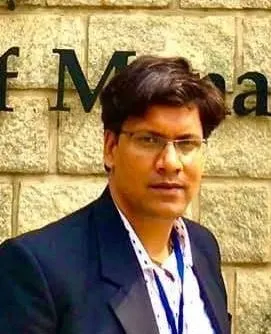
Dr. Vikram Keshari Jena is an academic, researcher, and public intellectual from Odisha. His work focuses on media, politics, development, public policy, and Indian knowledge traditions, with an emphasis on critical inquiry, social transformation, and interdisciplinary dialogue. He has authored numerous academic books and currently serves as the Founding Director of the Centre for Adivasi Research and Development (CARD), Odisha.
Reader Feedback
Was this article useful?
Stay Connected
Get the next important story before you miss it.
Subscribe to the newsletter for trusted updates, or join our WhatsApp channel for quick top-story alerts from The Eastern Times.
WhatsApp Channel
Prefer instant alerts? Join our WhatsApp channel for top stories and breaking updates.
Join on WhatsApp