
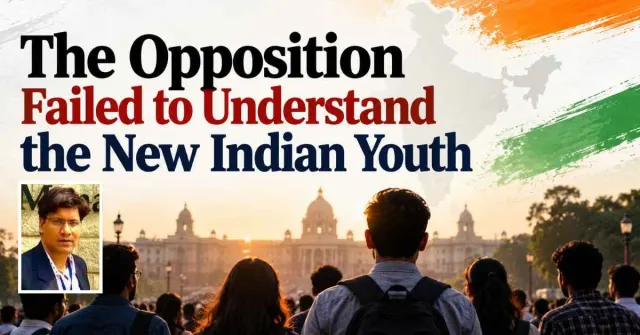
The Opposition Failed to Understand the New Indian Youth
Quick Summary
- Why India’s opposition is struggling to understand the aspirations, politics and changing expectations of the country’s new generation of young voters.
Indian politics is witnessing a generational transformation that much of the opposition has failed to understand. Its problem is no longer merely electoral defeat; it is an intellectual failure to understand the India emerging. The new Indian youth is not the political citizen of the previous century. This generation has grown up with smartphones, digital payments, social media, artificial intelligence, entrepreneurship and global information. It sees India not simply as a poor country seeking development but as an ambitious civilisation seeking global influence. The opposition has often mistaken this complexity for political ignorance. That mistake could become historically expensive.
Voters Want an Alternative
For decades, opposition politics operated on a simple assumption: if the government performs badly, voters will naturally turn towards the opposition. That assumption is now obsolete. Citizens do not vote merely against something; increasingly, they want to vote for something. Criticism of government is not an alternative government. Blaming every defeat on money, media control, polarisation or manipulation may satisfy party workers, but it does not explain why millions repeatedly make different choices. The opposition must accept an uncomfortable possibility: voters are not always confused or manipulated. Sometimes they simply do not find the opposition convincing. Democracy becomes intellectually dangerous when an opposition begins believing that the electorate is wrong whenever it rejects them.
The Failure to Offer a Future
The greatest weakness of the opposition is its inability to articulate a compelling future. It speaks extensively about what it opposes but insufficiently about what it would construct. Young Indians want answers to practical questions. Where will jobs come from? How will universities become globally competitive? How will artificial intelligence transform employment without creating permanent insecurity? How will villages become economically productive? How will cities become cleaner and safer? How will India become richer without allowing inequality to become explosive? These are questions of everyday life. The movement that answers them will shape the future. The opposition cannot expect yesterday’s slogans to answer tomorrow’s anxieties.
Nationalism and Citizenship
The opposition has also failed to understand the new relationship between nationalism and citizenship. It sometimes behaves as though national pride belongs exclusively to the ruling establishment and approaches nationalism defensively. This is strategically foolish. A young Indian can demand constitutional rights, oppose government policy, defend democratic freedoms and still possess intense national pride. The choice between nationalism and democracy is false. India needs both. It should define patriotism through constitutional citizenship, scientific achievement, social justice, economic opportunity, institutional integrity and national confidence. A politics embarrassed by India’s aspirations will lose ground to one that speaks confidently about India. National pride should not be surrendered simply because another political force has successfully claimed its vocabulary.
The Digital Communication Gap
There is also a profound technological gap between political organisations and the generation they seek to represent. Political parties still behave as though communication begins with a press conference and ends with television debate. Young citizens live elsewhere. Politics arrives through short videos, podcasts, digital creators, independent commentators and online communities. The opposition needs more than better social media management. It needs a different communication culture: explain policy simply, debate without permanent outrage and communicate directly with citizens who have little patience for traditional political vocabulary. The political party that refuses to understand the information habits of young India will increasingly become an institution speaking to a generation that has already moved beyond it.
The Need for Political Renewal
A party cannot demand political renewal from the country while refusing renewal within its organisation. It needs younger leadership, research institutions, policy professionals, economists, scientists, technologists and administrators capable of converting slogans into governing programmes. A modern opposition should function as a government in waiting, not merely as a protest movement. Without internal renewal, alliances will remain temporary rather than durable alternatives. Political inheritance may preserve a party, but it cannot automatically preserve political relevance.
Constructive Opposition
India does not need an opposition that simply obstructs everything the government does. It needs an opposition capable of distinguishing good policy from bad policy. If an infrastructure project is beneficial, support it while demanding safeguards. If a welfare programme helps citizens, improve it rather than automatically reject it. If economic reform creates opportunity but also social costs, propose corrections. Political maturity begins when disagreement is based on principles rather than reflex. Saying yes to good policy does not make an opposition a government supporter. Sometimes the strongest opposition is constructive criticism, because democracy needs competition as well as responsibility. A party that opposes everything eventually teaches voters to ignore its opposition.
Understanding the New Indian Youth
The opposition must stop treating young Indians merely as an electoral category. Youth is not simply an age group; it is a political condition created by rapid social transformation. Young Indians are creating businesses, migrating between cities, studying abroad, returning to villages, experimenting with technology and constructing new identities. They form opinions independently and change them quickly. Political organisations dependent upon inherited loyalties will struggle. The new voter wants competence, authenticity and evidence. Politicians who speak about poverty while displaying privilege, or democracy while suppressing internal disagreement, will face a credibility crisis. The youth demands seriousness, not perfection. It must learn to respect voters before asking voters to respect its political promises and independent democratic judgement.
The Need for Intellectual Reconstruction
The opposition therefore needs something more difficult than another alliance, slogan or campaign strategy. It needs intellectual reconstruction. It must develop a political philosophy for twenty-first-century India combining economic growth with social justice, technological ambition with human dignity, national confidence with constitutional liberty, infrastructure with ecological responsibility and global ambition with civilisational self-respect.
Imagining India’s Future
India’s young generation is already moving into the future. The opposition has two choices. It can continue explaining why the government is wrong and hope anger becomes votes. Or it can understand that history rewards movements that understand their moment and offer a credible future. The new Indian youth does not need to be instructed how to think. It needs political leaders capable of thinking alongside it. The opposition’s crisis is therefore not simply electoral. It is generational. Unless it understands the aspirations, anxieties and contradictions of young India, it may continue contesting elections while losing the larger argument about India’s future. The question is no longer whether the opposition can criticise power. The question is whether it can imagine the India that young citizens are already building.
Author Details
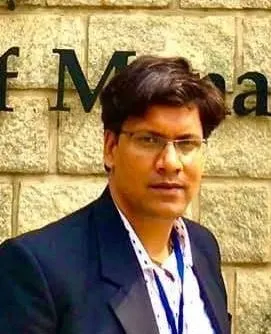
Dr. Vikram Keshari Jena is an academic, researcher, and public intellectual from Odisha. His work focuses on media, politics, development, public policy, and Indian knowledge traditions, with an emphasis on critical inquiry, social transformation, and interdisciplinary dialogue. He has authored numerous academic books and currently serves as the Founding Director of the Centre for Adivasi Research and Development (CARD), Odisha.
Reader Feedback
Was this article useful?
Stay Connected
Get the next important story before you miss it.
Subscribe to the newsletter for trusted updates, or join our WhatsApp channel for quick top-story alerts from The Eastern Times.
WhatsApp Channel
Prefer instant alerts? Join our WhatsApp channel for top stories and breaking updates.
Join on WhatsApp