
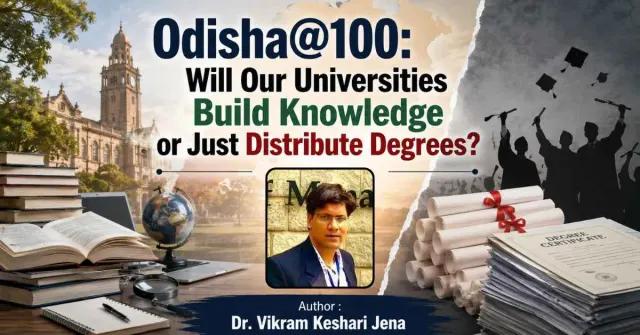
Odisha@100: Will Our Universities Build Knowledge or Just Distribute Degrees?
Quick Summary
- Odisha’s universities must move beyond teaching and certificate distribution to become serious centres of research and knowledge creation.
- University Vision 2036 can align higher education with Odisha’s social, economic, ecological, cultural and technological challenges.
- The state needs an Odisha Knowledge Mission that turns universities into institutions shaping policy, innovation and the future of Odisha.
The recent high-level meeting of Vice-Chancellors, Registrars and PG Council Chairpersons of State Government Universities, under the chairmanship of Higher Education Minister Shri Suryabanshi Suraj, has once again placed Odisha’s higher education system at an important crossroads.
The priorities discussed, including filling vacant posts, strengthening startup ecosystems, promoting research, expanding internships, developing artificial intelligence skills, integrating Indian Knowledge Systems and establishing Centres of Excellence, are unquestionably necessary.
Yet, beneath these familiar policy formulations lies a much deeper and uncomfortable question: what exactly are Odisha’s universities producing for society beyond degrees and certificates?
Odisha@100 Needs an Intellectual Blueprint
This question must be asked without hesitation, particularly when Odisha is preparing to celebrate the historic centenary of its linguistic statehood in 2036.
We are approaching that milestone with considerable pride, but where is the intellectual blueprint for Odisha@100? Where are the university-level research missions that will define what Odisha should become by 2036? Where are the institutional visions connecting our universities with the state’s enormous social, economic, ecological, cultural and technological challenges?
The problem is not simply a shortage of money, buildings, laboratories or classrooms. Odisha possesses universities with talented teachers, substantial physical infrastructure and generations of intellectual experience.
Indeed, a large majority of teachers are highly capable classroom educators. They teach well, guide students and perform their academic responsibilities with dedication.
But teaching and research are different intellectual practices. The ability to deliver a good lecture does not automatically translate into the ability to formulate a research question, construct a methodology, gather evidence, engage with communities, publish meaningful scholarship or convert research into public policy.
How Many Teachers Are Being Prepared to Become Researchers?
This is perhaps one of the most neglected questions in Odisha’s higher education discourse: how many of our universities have systematically trained their teachers to become researchers?
The problem is compounded by the relatively small research community capable of undertaking serious, sustained and interdisciplinary research on Odisha.
If only a limited proportion of academics are actively producing original research, that intellectual capacity is nowhere near sufficient for a state as complex as Odisha.
The state has vast research requirements involving Adivasi societies, mining, industrialisation, displacement, migration, agriculture, climate change, coastal vulnerability, forests, tribal knowledge, public health, education, urbanisation, linguistic diversity, heritage, technology, entrepreneurship and regional inequality.
These issues cannot be adequately understood through occasional seminars, conventional dissertations or routine government-commissioned reports. They require long-term field research, interdisciplinary collaboration, community engagement, archival investigation, data collection and sustained intellectual investment.
Universities Must Ask Questions Governments Have Not Yet Asked
Unfortunately, many policymakers and political leaders themselves may not fully appreciate the scale of this research requirement.
Universities therefore have a responsibility not merely to respond to government agendas but to identify questions that governments have not yet recognised.
A genuine university should function as the intellectual conscience and knowledge laboratory of society. It should discover problems before they become crises and generate evidence before policies are formulated.
Instead, Odisha’s universities are increasingly perceived as certificate distribution centres. This is a harsh description, but it deserves serious reflection.
If the primary institutional achievement is the annual production of graduates, postgraduate degrees and certificates, while the university contributes relatively little original knowledge to the community surrounding it, then its social purpose remains incomplete.
A University’s Legitimacy Must Come From Knowledge
A university cannot justify its existence merely through buildings, convocations, examinations and administrative structures.
Its legitimacy must also come from the knowledge it produces.
Where is the university that has adopted a twenty-year research mission for Odisha?
Where is the university that has mapped every major Adivasi knowledge system in its region?
Where is the university that maintains a comprehensive database on displacement caused by development?
Where is the university researching Odisha’s mining economy from the perspectives of communities, ecology, labour and global capital simultaneously?
Where is the university developing an intellectual framework for a climate-resilient Odisha?
Where is the institution preparing a comprehensive knowledge architecture for Odisha in 2036?
These are not rhetorical luxuries. They are questions of institutional purpose.
AI Should Serve Odisha, Not Become Another Slogan
The proposed emphasis on Artificial Intelligence is welcome, but AI should not become another fashionable slogan.
Odisha’s universities must ask what AI can do for local knowledge, agriculture, disaster management, tribal languages, public administration, healthcare, education and environmental monitoring.
Similarly, Indian Knowledge Systems should not be reduced to ceremonial lectures or token curriculum additions.
Odisha possesses extraordinary intellectual traditions, indigenous ecological knowledge, maritime histories, linguistic traditions, cultural practices and community institutions.
These must become subjects of rigorous research rather than merely objects of cultural celebration.
Centres of Excellence Must Produce Excellence
The creation of Centres of Excellence will also be meaningful only if they are genuinely centres of knowledge production.
A Centre of Excellence without sustained researchers, international collaboration, competitive grants, field laboratories, doctoral programmes, data infrastructure and measurable research outcomes risks becoming another institutional signboard.
The real measure of such centres should therefore be the knowledge they produce, the problems they solve and the impact they create—not simply their establishment or formal designation.
University Vision 2036
The forthcoming centenary of Odisha in 2036 should therefore become an intellectual deadline.
Every university, old and new, should prepare a University Vision 2036.
It should identify ten or twenty major research questions relevant to its geographical and disciplinary responsibilities.
Each institution should create long-term research programmes, interdisciplinary laboratories, community knowledge partnerships, digital archives and measurable targets for publications, patents, policy interventions and socially useful innovations.
Such a vision would help universities move beyond short-term academic cycles and develop a sustained intellectual relationship with the future of Odisha.
Teachers Must Be Given a Research Pathway
Universities must also rethink the career structure of teachers.
Research cannot remain an activity performed by a small minority after teaching and administration are completed.
Faculty development should include serious training in research methodology, grant writing, data science, ethnography, archival research, interdisciplinary approaches and publication ethics.
Young teachers should be mentored by established researchers, while universities should reward research that demonstrates genuine social impact.
The objective should not be to force every teacher into publishing for the sake of numbers. It should be to create an academic environment in which meaningful research becomes a genuine institutional responsibility.
Odisha Has Talent. What It Lacks Is Institutional Ambition.
Odisha does not suffer from a complete absence of intellectual talent.
It suffers from insufficient institutional ambition.
That distinction matters.
Our universities have people. They have students. They have buildings. They have libraries and laboratories. They have public money and social legitimacy.
What they often lack is a compelling mission that connects all these resources to the future of Odisha.
The challenge, therefore, is not simply to create more institutions. It is to make existing institutions more intellectually ambitious and socially consequential.
From Odisha@100 to an Odisha Knowledge Mission
The 2036 centenary should therefore not merely be an occasion for commemorative conferences, cultural programmes and publications.
It should become the beginning of an Odisha Knowledge Mission.
Every university should be asked:
What knowledge will you create for Odisha by 2036?
Which communities will benefit from it?
Which unresolved problems will you address?
What will remain as your intellectual contribution after the certificates have been distributed?
These questions can provide universities with a clear sense of purpose while connecting academic work directly with the state’s long-term development.
A Plea for Reinvention
This is not an attack on universities.
It is a plea for their reinvention.
If Odisha wants to build an inclusive, innovative and knowledge-driven society, its universities must move beyond the examination hall and enter the real world of communities, forests, villages, industries, cities, laboratories and public policy.
They must become institutions that do not merely teach what is already known, but also discover what is not yet known.
Otherwise, we may celebrate Odisha at 100 with magnificent ceremonies, while discovering that our universities prepared no intellectual blueprint for the century they were supposed to help build.
That would be the saddest irony of Odisha’s centenary.
Author Details
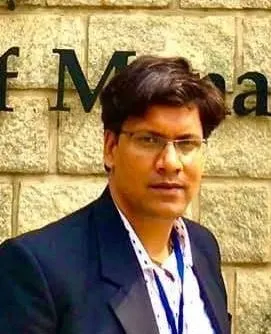
Dr. Vikram Keshari Jena is an academic, researcher, and public intellectual from Odisha. His work focuses on media, politics, development, public policy, and Indian knowledge traditions, with an emphasis on critical inquiry, social transformation, and interdisciplinary dialogue. He has authored numerous academic books and currently serves as the Founding Director of the Centre for Adivasi Research and Development (CARD), Odisha.
Reader Feedback
Was this article useful?
Stay Connected
Get the next important story before you miss it.
Subscribe to the newsletter for trusted updates, or join our WhatsApp channel for quick top-story alerts from The Eastern Times.
WhatsApp Channel
Prefer instant alerts? Join our WhatsApp channel for top stories and breaking updates.
Join on WhatsApp