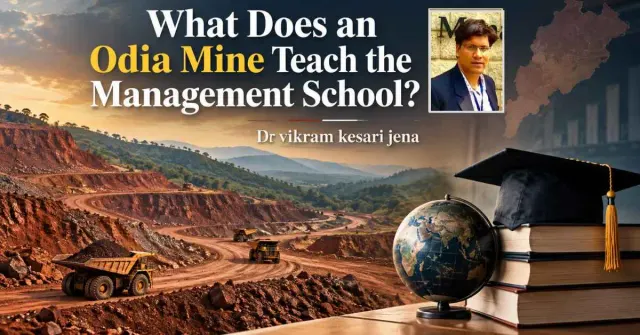
What Does an Odia Mine Teach the Management School?
Quick Summary
- Samarendra Das’s doctoral research traces India’s iron-ore economy and its connection to global extractive capital.
- The article questions whether management education adequately considers the social, ecological and historical costs of resource extraction.
- It argues for a more grounded approach to knowledge that connects business, communities, environment, politics and society.
There is something profoundly unsettling about a doctoral thesis that begins not in a boardroom, a stock exchange or a management classroom, but by following the trails of iron ore across India. “Following the Iron Ore Trails of India for a Global Epistemology of Extractive Capital,” by Samarendra Das, is listed by the University of Southampton as a 2026 doctoral thesis. Its significance, however, is larger than the title of a doctoral dissertation. It raises an uncomfortable question for India’s business schools, economists, historians, sociologists and development theorists: what exactly have our institutions of knowledge been teaching us about development, capital and natural resources?
For decades, India has built an impressive architecture of management education. The Indian Institutes of Management and numerous other business schools have produced generations of managers, consultants, economists and corporate leaders. They have mastered the languages of markets, strategy, competitiveness, efficiency, supply chains, valuation, corporate governance and globalisation. Yet, somewhere between the balance sheet and the mine pit, something essential has frequently disappeared: the public, ecological, historical and human meaning of the resource itself.
Iron ore is not merely a commodity. A forest is not merely an asset. A mountain is not simply an inventory of minerals waiting to be converted into capital. And a community living on that mountain is not an externality.
This is precisely where Das’s intellectual journey becomes important. His doctoral research attempts to understand the realities surrounding India’s iron-ore economy by following the “iron trails” from the sites of extraction and connecting them to a broader understanding of extractive capital. His wider research has examined mining, displacement, environmental destruction and the contradictions between corporate claims of sustainable development and the experiences of communities living in mining regions.
The question, therefore, is not whether business schools teach capitalism. They obviously do. The question is whether they sufficiently teach where capitalism comes from.
Every global commodity has a geography. Every supply chain has a beginning. Every mineral entering a factory has passed through a landscape. Before iron ore becomes steel, before steel becomes infrastructure, before infrastructure becomes economic growth, there is a mountain, a forest, a river, a village and a political decision about who owns the right to transform nature into capital.
Yet mainstream management education often begins much later in the chain. It begins with the firm. Das asks us to begin with the mine. That reversal is intellectually powerful because it forces us to see global capitalism from the point of extraction rather than merely from the point of consumption, investment or corporate management.
The Missing Question in the Boardroom
Indian management education has become extraordinarily sophisticated in explaining how companies create value. But perhaps it has been insufficiently curious about who pays for that value creation.
If a corporation extracts a resource from a region, who bears the environmental cost? Who loses access to land? Who loses forests, water or cultural landscapes? Who carries the social cost of displacement? Who benefits from appreciation in commodity prices? Where does the extracted value ultimately accumulate? How does local resource extraction become part of global capital?
These are not peripheral questions. They are questions of political economy, and they belong inside the management classroom.
The conventional vocabulary of business can make extraction appear deceptively neutral. “Resource utilisation” sounds technical. “Investment” sounds beneficial. “Infrastructure” sounds universally progressive. “Economic growth” sounds socially inclusive.
But development becomes morally and politically complicated when one asks: development for whom, at whose cost and under whose definition?
This is where economists, historians and sociologists must also look inward. Economists can construct elegant models from datasets. Historians can reconstruct institutional trajectories from archives. Sociologists can produce sophisticated accounts of social transformation.
But knowledge becomes dangerously incomplete when the researcher moves faster than the evidence, when theory precedes listening, or when communities become merely “cases” illustrating an argument already constructed elsewhere.
The problem is not that theory is unnecessary. The problem is theory without sufficiently grounded knowledge.
The Mine as a Classroom
An iron-ore mine can teach more about globalisation than a PowerPoint presentation on global markets. Stand beside an extraction site and globalisation becomes physical.
A geological formation becomes a commodity. A commodity becomes revenue. Revenue becomes investment. Investment creates infrastructure. Infrastructure creates new markets. Markets alter political relationships. Political decisions determine access to land. Communities resist. Governments negotiate. Corporations adapt. International capital watches.
Suddenly, economics, political science, history, sociology, anthropology, environmental studies and management are no longer separate departments. They become one question: how does a natural resource become global capital, and what happens to the society from which that resource is extracted?
This is why Das’s work deserves serious attention beyond the conventional boundaries of disciplinary scholarship. The University of Southampton record identifies his thesis within its 2026 doctoral output, while his wider research trajectory connects mining, materiality, political economy and the lived realities surrounding extraction.
An Odia researcher following iron ore is consequently doing something more important than documenting a regional problem. He is asking whether the Global South can produce concepts rather than merely provide data.
That distinction matters enormously. Too often, the intellectual geography of knowledge runs in one direction. The South supplies minerals, labour, environmental sacrifice and empirical cases; the North supplies the conceptual vocabulary through which these realities are interpreted.
Das’s project challenges that hierarchy. The iron-ore trails of India can become a route to theorising global capitalism itself.
What Should Our Faculties Learn?
Perhaps the first lesson is humility.
Management faculties need to learn that markets do not exist independently of history, geography and politics. Economists need to relearn that a resource has a social life before it becomes a price. Historians need to remember that the archive is not the only repository of historical knowledge; landscapes and communities also carry memory. Sociologists need to resist the temptation to produce conclusions faster than they produce knowledge. And business schools need to ask whether the managers they educate understand the difference between creating value and merely appropriating value.
These are not attacks on disciplines. They are invitations to deepen them.
The second lesson is methodological.
Go to the field. Follow the commodity. Talk to the people who live beside the mine. Read the government files. Study corporate documents. Trace ownership. Understand infrastructure. Examine the geology. Follow the money. Listen to memories. Only then return to the classroom.
That may be the beginning of a genuinely Indian management epistemology. Knowledge should not merely be extracted from communities in the same way that minerals are extracted from the earth. Research itself must be ethically grounded, empirically rigorous and accountable to the people whose lives become the subject of scholarship.
Beyond the MBA Imagination
India cannot become a developed economy merely by producing more MBAs, more start-ups and more unicorns. Development requires an intellectual capacity to understand the consequences of the economic model itself.
The central challenge before Indian business education is therefore not whether it can teach students how to compete in global markets. It is whether it can teach them how those markets are materially produced.
The iron-ore trail begins in the soil of India but does not end there. It travels through steel plants, ports, infrastructure, financial markets, corporations and international commodity networks. It connects an apparently remote mining village to the architecture of global capital.
That is precisely why Samarendra Das’s thesis matters. An Odia researcher has followed a mineral trail from the ground upward and, in doing so, has turned the direction of knowledge upside down.
Perhaps our business schools should follow him, not because every conclusion must be accepted uncritically, but because serious scholarship should make established institutions uncomfortable enough to ask new questions.
What does a management school know about the land from which its economic models begin? What does an economist know about the community behind a commodity price? What does a historian know when living memory is absent from the archive? What does a sociologist know when the field is treated merely as data?
The greatest failure of education is not ignorance. It is the illusion that we already know.
Samarendra Das’s work offers a valuable opportunity for India’s intellectual institutions to pause, look beyond the balance sheet and reconsider the relationship between knowledge, capital and society.
The most important lesson from the iron-ore trails of India may therefore be simple but profound: before teaching the world how to manage resources, we must first learn how to understand what a resource means to the people who live upon it.
Only then can management become more than management. It can become knowledge in the service of society.
Author Details
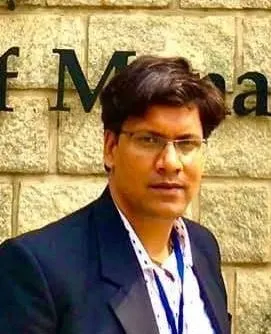
Dr. Vikram Keshari Jena is an academic, researcher, and public intellectual from Odisha. His work focuses on media, politics, development, public policy, and Indian knowledge traditions, with an emphasis on critical inquiry, social transformation, and interdisciplinary dialogue. He has authored numerous academic books and currently serves as the Founding Director of the Centre for Adivasi Research and Development (CARD), Odisha.
Reader Feedback
Was this article useful?
Stay Connected
Get the next important story before you miss it.
Subscribe to the newsletter for trusted updates, or join our WhatsApp channel for quick top-story alerts from The Eastern Times.
WhatsApp Channel
Prefer instant alerts? Join our WhatsApp channel for top stories and breaking updates.
Join on WhatsApp