Marks vs Real Learning: The Hidden Crisis Behind India’s Surging 99% Board Exam Scores
Quick Summary
- India’s rising 99% scores create an illusion of excellence, while real understanding and learning may be declining.
- A rigid stream hierarchy (science > commerce > arts) pushes students into choices based on marks, not interest or ability.
- Education needs to move beyond marks and focus on critical thinking, interdisciplinary learning, and real-life preparedness.
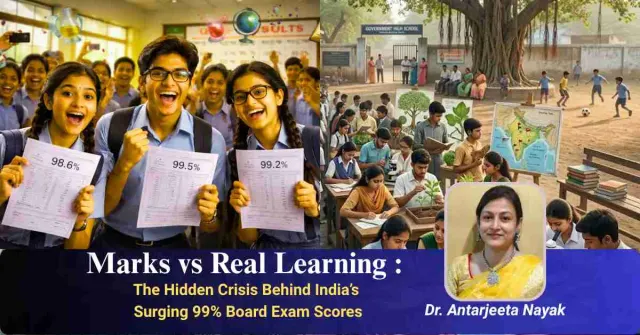
The board exam results have become an annual spectacle in India, marked by surreal percentages that defy not only belief but also the very purpose of education.
Students scoring 99.9%—a figure that once seemed an unattainable pinnacle of academic excellence—has now become surprisingly frequent.
The celebration of these scores, however, masks a deeper crisis: an educational system trapped in the illusion of numerical excellence while ignoring the hollowness that often lies beneath.
This raises some often unasked questions. How believable and practical are these numbers? What does it mean when thousands of students secure 99–99.9%?
Has our schooling system become so efficient that it produces near-perfect minds, or have our evaluation systems become so mechanical that they no longer measure the true depth of understanding?
More than marks, we must ask—what are children doing with these marks?
Why Do Marks Decide Who You Become?
While marks continue to skyrocket, the collective mindset remains stuck in an old, hierarchical perception of disciplines.
The familiar pattern unfolds like clockwork—those scoring above 90% gravitate toward science, convinced (or coerced) that it is the passport to prestige and prosperity.
The so-called “average” students, ranging between 70–85%, are nudged toward commerce, while those who secure below 70%, often viewed as “leftovers” or who “couldn’t do better,” are left with arts or humanities as their “last option.”
Why do students with high marks automatically choose science?
This pseudo-meritocratic structure is based on a deeply flawed social hierarchy of disciplines—one that considers science as aspirational, commerce as practical, and humanities as dispensable.
Parents and schools, chasing perceived prestige and job security, impose streams on children as if they were predestined roles in a caste system of intellect.


The Silent Push No One Talks About
Coaching empires don't just prepare students—they manufacture aspirants.
No student dreams of becoming a sociologist, economist, educationist, linguist, or psychologist when every street corner is dominated by billboards of NEET and JEE toppers grinning like demigods, flaunting their AIR and near-perfect scores.
When the front pages of newspapers are filled with coaching advertisements and elite institutes promoting “science prodigies,” the voices of the social sciences are drowned in the noise of rank, prestige, and percentile.
Why Is Choosing Arts Still Seen as a Risk?
A 95% scorer taking arts is seen as someone squandering divine grace.
It’s like giving a Ferrari to someone who just wants to go to the vegetable market, and society reacts with disbelief:
“Itna accha number laake arts padhega?”
Meanwhile, if you’re in arts, your introduction in society sounds like an apology:
“She’s doing arts… but planning for civil services.”
Yet the same subjects are rediscovered when engineers, doctors, and IITians prepare for the Civil Services.
Arts becomes a fallback.
Otherwise, why would someone read Kabir when one can study Kinematics?
What a paradox.
What Are We Missing in All This?
We dismiss social science during schooling, underestimate arts as a stream, only to embrace it later at the highest levels of achievement.
This reveals a deep disconnection between what we teach, what we value, and what we actually need.
This is not just a curriculum issue—it is a crisis of imagination.
In a world facing climate change, inequality, mental health challenges, and social conflict, the need for thinkers, historians, economists, psychologists, and sociologists is more urgent than ever.
Can Science Alone Solve Real-World Problems?
What good are high marks in Physics or Mathematics if we cannot build inclusive and sustainable societies?
What is the real value of cracking NEET or JEE if one remains unaware of how poverty, mental health, and environmental issues shape people’s lives?
The future is interdisciplinary.
The digital economy needs ethical thinkers.
Climate change needs both scientists and economists.
AI needs not just engineers but also ethicists.
Social science provides the context and conscience that science alone cannot.
What Should Education Really Aim For?
We need to rethink our educational goals.
Instead of asking how much a child scores, we should ask how well a child thinks.
The goal should not be to produce marks-machines, but curious and capable individuals.
Social sciences must be seen not as backup options, but as essential ways of understanding the world.
Exams should test reasoning, creativity, and ethical thinking—not just memory.
Parents too need to move beyond rigid definitions of success.
When High Scores Stop Meaning Anything
The normalization of extremely high marks has weakened the credibility of assessments.
It has also created a dangerous illusion—that academic success equals life preparedness.
When almost everyone scores above 90%, marks stop differentiating and start creating pressure.
Students are pushed into a mechanical race for perfection.
The Questions That Actually Matter
It is time to move beyond percentage-based worth.
Are students emotionally resilient?
Are they socially aware?
Can they think critically?
Can they deal with complexity and uncertainty?
These questions matter far more than marks.
Education is not a competition—it is preparation for life.
Rethinking Success, Rethinking Streams
We need to move away from rigid stream selection.
We need doctors who understand society, engineers who think ethically, and leaders who listen and learn.
The future demands interdisciplinary thinking, not narrow excellence.
Beyond Marks, Towards Meaning
Let us not celebrate marks that are disconnected from reality.
Let us build systems that value emotional intelligence, social awareness, and critical thinking.
Let us aim to create not just toppers, but thinkers—not just performers, but reformers.
Author Details
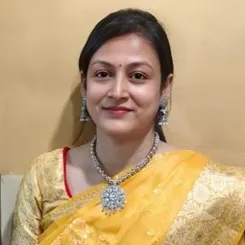
Dr. Antarjeeta Nayak is a researcher and columnist with a Ph.D. in Economics from NIT Rourkela and a recipient of ICSSR Doctoral and Post-Doctoral Fellowships. Her research focuses on poverty and tribal development.
Reader Feedback
Was this article useful?
Stay Connected
Get the next important story before you miss it.
Subscribe to the newsletter for trusted updates, or join our WhatsApp channel for quick top-story alerts from The Eastern Times.
WhatsApp Channel
Prefer instant alerts? Join our WhatsApp channel for top stories and breaking updates.
Join on WhatsApp