
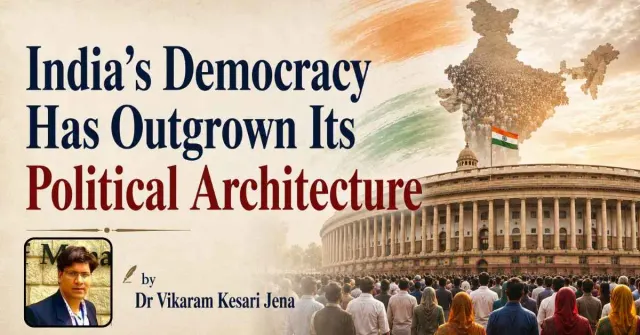
India’s Democracy Has Outgrown Its Political Architecture
Quick Summary
- Representation: India’s 543 Lok Sabha seats may no longer adequately represent a population exceeding 140 crore.
- Inclusion: The debate should address women’s representation, education and stronger citizen-representative connections.
- Reform: Delimitation should become a broader national exercise to modernise India’s political architecture while protecting federal balance.
India is approaching another great constitutional moment, and the debate over delimitation should not be reduced to a quarrel between northern and southern states. At its heart lies a much larger question: Can a democracy designed for a population of roughly 36 crore at Independence adequately represent a country of more than 140 crore people? The answer cannot simply be yes.
India’s population, economy, urbanisation, social complexity, and political consciousness have transformed dramatically, while the architecture of representation has remained remarkably constrained. The Election Commission records that the Lok Sabha currently has 543 parliamentary constituencies, while the present constitutional arrangement postpones the readjustment of the allocation of seats until the first Census conducted after 2026 is published.
From 36 Crore to More Than 140 Crore
The historical starting point matters. India’s population in the 1951 Census was approximately 36.1 crore, not 40 crore. Yet even that distinction strengthens the argument.
The first Lok Sabha election had 489 constituencies, and the number subsequently expanded as delimitation took place. The present 543-seat structure is therefore not some eternal constitutional number handed down by the founding generation. It evolved through successive constitutional and delimitation exercises.
The real question today is why a parliamentary structure created for a vastly smaller India should continue to carry almost the same representational burden after seven and a half decades.
The 543-Seat Myth
There is another misconception that needs correction. It would be historically inaccurate to say that the present 543 seats were “decided by the British”. The British did not design today’s 543-member Lok Sabha. The constitutional framework was created by Indians after Independence, and subsequent Indian Parliaments altered the size and distribution of representation.
But there is a legitimate political argument behind the sentiment: India inherited and retained a representative architecture whose scale has not expanded in proportion to its demographic transformation.
The Election Commission itself records that the number of parliamentary constituencies has remained at 543, even though the electorate has become enormous. In the 2024 election, India had approximately 98 crore registered electors.
Is 543 Seats Enough for India?
This is where the delimitation debate must become intellectually more ambitious. Instead of asking whether India should preserve 543 seats, Parliament should ask whether 543 is remotely sufficient for a population exceeding 140 crore.
One MP today represents an extraordinarily large constituency. The representative is expected to understand villages, cities, tribal communities, farmers, industrial workers, entrepreneurs, students, women, migrants, minorities, environmental conflicts, and rapidly changing local economies.
This is not a reasonable workload for one elected representative.
Why Should India Fear a Larger Parliament?
Why should India be frightened of having a larger Parliament? A serious democracy should not measure representation merely by the number of chairs inside the chamber. It should measure the quality and accessibility of representation outside it.
A Parliament of perhaps 1,000, 1,500, or even 2,000 members, after a careful constitutional and administrative study, could make representation considerably more granular. The exact number should be determined by an independent constitutional commission using population, geography, administrative capacity, diversity, and international comparative standards rather than political convenience.
The same principle should apply to state legislatures. Many Indian MLAs represent populations larger than those of entire countries. If democracy means proximity between citizen and representative, gigantic constituencies are a democratic weakness, not an achievement.
Representation Must Also Include Women
But representation cannot be discussed without confronting the gender question. India’s women constitute roughly half the population, yet political representation has historically remained far below that proportion.
The current debate over women’s reservation is therefore too cautious. The Constitution has already moved toward 33 percent reservation for women through the 106th Constitutional Amendment. The political question now should be whether 33 percent is a ceiling or merely a beginning. A target of 40 percent representation for women in the Lok Sabha, Rajya Sabha, and state legislatures deserves serious national debate.
Political parties that claim to represent women cannot simultaneously treat women’s representation as a threat to their political arithmetic. Women are not a special-interest constituency. They are citizens who constitute approximately half of India.
The 2024 electoral data itself demonstrates how close the electorate has become to gender parity, with female electors numbering about 47.6 crore against 50.3 crore male electors. The democratic argument for greater representation is therefore not charity. It is representation catching up with citizenship.
Education Without Creating an Elite Democracy
The same seriousness is necessary regarding the educational preparedness of elected representatives. Here, however, India must avoid an elitist mistake.
A compulsory graduate degree for every MP or MLA may sound attractive, but democracy cannot become a competition restricted to degree holders. Education is valuable, but formal educational qualifications do not automatically produce constitutional morality, administrative competence, or integrity.
Instead, India should consider a National Public Representation Certification System. Every candidate, regardless of whether they belong to the Scheduled Castes, Scheduled Tribes, Other Backward Classes, or the general category, could be required to demonstrate basic competency in the Constitution, fundamental rights, parliamentary procedure, public finance, law, governance, and the functioning of government.
A minimum threshold equivalent to secondary education could be considered, alongside publicly funded constitutional and governance training. Candidates without formal educational opportunities should not be excluded merely because they were denied education.
More Representatives, Not Simply More Ministers
There is also a case for rethinking the size and functioning of government itself. But expanding the Council of Ministers to more than 200 should not become an automatic solution.
The Constitution currently limits the size of the Union Council of Ministers to 15 percent of the Lok Sabha’s strength. If Parliament becomes significantly larger, the ministry ceiling could be reconsidered, but governance should not become a system of distributing ministerial offices.
India needs more representatives, stronger parliamentary committees, professional legislative research, and accountable ministers, not simply a larger political executive.
A Second Representation Commission for the Republic
The deeper issue is that India has become too large for a political system that still thinks in the institutional dimensions of an earlier republic.
Delimitation should therefore not be treated as a North versus South confrontation. It should be treated as the Second Representation Commission of the Republic: a national exercise to redesign the relationship between population, territory, gender, social diversity, and political power.
The political parties are understandably worried because delimitation changes power. But constitutional democracy cannot freeze representation forever merely because political arithmetic has become comfortable.
At the same time, states that successfully controlled population growth should not be punished mechanically. The solution is not to freeze democracy, nor to impose population-based redistribution without safeguards. India needs a sophisticated formula combining population with federal balance, demographic performance, geography, development, and equal citizenship.
The Republic of 2026 Is Not the Republic of 1950
The republic of 2026 is not the republic of 1950. Its citizens are more numerous, more politically conscious, more connected, and more demanding.
If the size of India has changed but the scale of representation has barely changed, then the problem is not the people. The problem is that the political architecture has failed to grow with the republic.
India should therefore stop asking, “How can we protect 543 seats?” The more courageous question is: “How many representatives does the world’s largest democracy actually need to represent its people properly?”
That is the question Parliament must answer before the next delimitation. And the answer should be determined not by the convenience of political parties, but by the constitutional promise of equal representation.
India did not become the world’s largest democracy merely by having the largest electorate. It became one by believing that every citizen deserves a political voice. The next stage of the republic must ensure that voice is not merely counted at election time, but heard continuously in the institutions of power.
Author Details
Dr. Vikram Keshari Jena is an academic, researcher, and public intellectual from Odisha. His work focuses on media, politics, development, public policy, and Indian knowledge traditions, with an emphasis on critical inquiry, social transformation, and interdisciplinary dialogue. He has authored numerous academic books and currently serves as the Founding Director of the Centre for Adivasi Research and Development (CARD), Odisha.
Reader Feedback
Was this article useful?
Stay Connected
Get the next important story before you miss it.
Subscribe to the newsletter for trusted updates, or join our WhatsApp channel for quick top-story alerts from The Eastern Times.
WhatsApp Channel
Prefer instant alerts? Join our WhatsApp channel for top stories and breaking updates.
Join on WhatsApp