
Vision 2047: India Needs Intellectual Power, Not Just Electoral Power
Quick Summary
- Economic growth alone cannot define India’s success by 2047.
- India needs stronger universities, research institutions and intellectual freedom.
- A truly developed India must shape global ideas, not just build global influence.
Every generation inherits two responsibilities from history. The first is to preserve the civilisation it receives. The second is to enlarge its intellectual horizons for those yet to come.
Nations that succeed accomplish both. They protect their cultural foundations while continuously expanding the frontiers of knowledge. Those that neglect either eventually discover that political strength without intellectual vitality is rarely sustainable.
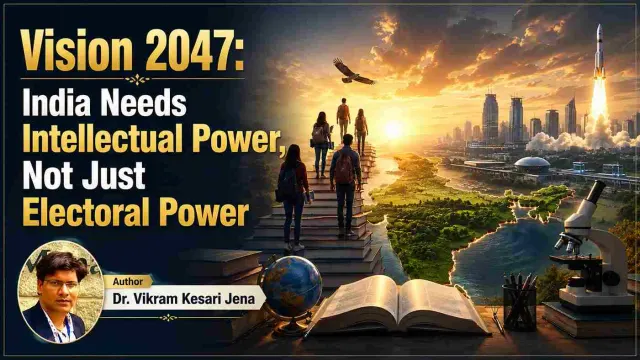
India today stands at one of the most consequential moments in its modern history. The aspiration of becoming a developed nation by 2047 has inspired ambitious discussions on economic growth, infrastructure, manufacturing, technology and global influence. These aspirations deserve appreciation. Yet a profound question remains insufficiently examined: what kind of intellectual civilisation will accompany this economic transformation?
History's Enduring Lesson: Ideas Outlive Empires
History offers a consistent lesson. Enduring powers are not remembered only for their armies, markets or governments. They are remembered for the ideas they contributed to humanity.
Ancient India produced philosophical schools that debated ethics, consciousness, logic and metaphysics. Nalanda and Takshashila attracted scholars from across Asia because they cultivated inquiry rather than mere instruction. The Renaissance transformed Europe not simply because of political change, but because universities, artists, scientists and philosophers reshaped the way societies understood knowledge itself.
Ideas have always outlived empires.
The future of India, therefore, cannot depend only on economic indicators or electoral success. A nation may build highways, airports and industrial corridors, but unless it simultaneously builds universities that encourage discovery, think tanks that challenge conventional wisdom, laboratories that pursue original research and cultural institutions that preserve critical reflection, development risks becoming materially impressive yet intellectually fragile.
Information Is Everywhere. Wisdom Still Needs Institutions.
The distinction between information and wisdom is increasingly important. Information can be transmitted instantly through digital networks. Wisdom requires institutions that cultivate disciplined thinking, historical understanding and ethical judgment.
Universities are not merely degree-granting centres; they are laboratories where societies imagine their future. Libraries are not warehouses of books; they are repositories of civilisation. Research is not an administrative requirement; it is the process through which nations prepare for challenges that have not yet emerged.
This is why intellectual infrastructure deserves the same seriousness as physical infrastructure. Roads, ports, airports and industrial corridors create the foundations for economic activity. Universities, laboratories, libraries and research institutions create the foundations for a nation's capacity to think, innovate and adapt.
Political Success Alone Cannot Build an Intellectual Tradition
Political movements naturally seek electoral legitimacy. Democracies require elections, public participation and effective governance. Yet history also demonstrates that political success alone cannot generate enduring intellectual traditions.
Every governing philosophy, regardless of ideology, must engage with scholars, scientists, historians, economists, artists and independent thinkers. It must welcome questions, not fear them. It must recognise that criticism, when offered honestly, often strengthens institutions rather than weakens them.
Civilisations stagnate when they become intellectually self-satisfied. Confidence is valuable; complacency is dangerous. The greatest thinkers in history questioned their own assumptions before questioning others.
Socrates transformed philosophy by asking uncomfortable questions. The Buddha encouraged inquiry rather than unquestioning acceptance. Rabindranath Tagore argued that education should liberate the mind from fear. Dr. B. R. Ambedkar insisted that constitutional democracy required constitutional morality sustained through education and reason.
Their enduring influence came not from political authority, but from intellectual courage.
What Should India Measure on the Road to 2047?
India's aspiration for 2047 should, therefore, be measured by more than economic rankings.
It should ask whether Indian universities rank among the world's finest, not merely in numbers but in originality. It should ask whether Indian scholars shape global debates in philosophy, economics, environmental studies, artificial intelligence, public health and international relations. It should ask whether young researchers find institutions that reward curiosity rather than conformity.
The challenge extends beyond higher education. Schools must encourage analytical thinking alongside foundational knowledge. Public discourse should reward evidence, civility and intellectual honesty.
Research funding should support both scientific innovation and the humanities, recognising that technological advancement without ethical reflection often produces unintended consequences. Languages, literature, history and philosophy are not luxuries; they help societies understand who they are and what they value.
Tradition and Innovation Must Grow Together
Equally important is the relationship between tradition and innovation. India possesses one of the world's richest civilisational inheritances. Respecting that inheritance does not require rejecting modern science, nor does scientific progress require abandoning cultural memory.
The strongest societies integrate both. They preserve ancient wisdom while embracing contemporary discovery. They understand that heritage provides roots, while research provides wings.
An intellectually confident nation also values diversity of thought. Agreement can produce stability, but disagreement often produces discovery. Universities, journals, public forums and research institutes should remain spaces where ideas compete through evidence and reason.
Innovation flourishes where questions are welcomed. Intellectual confidence is demonstrated not by suppressing debate, but by engaging with it.
Vision 2047 Should Become an Intellectual Renaissance
Vision 2047 must, therefore, become more than an economic roadmap. It should become an intellectual renaissance.
India needs globally respected research universities, vibrant independent scholarship, interdisciplinary collaboration, stronger public libraries, sustained investment in fundamental science and renewed attention to philosophy, history, languages and the arts.
These institutions shape the imagination of a nation long before they shape its statistics.
Ultimately, every civilisation is judged by the quality of its ideas. Political victories are temporary. Governments change. Policies evolve. Economic cycles rise and fall. Yet the books a nation writes, the discoveries it makes, the institutions it builds and the questions it dares to ask become its lasting contribution to humanity.
The Road to 2047 Must Be Built With Ideas
If India truly seeks to emerge as a leading nation by 2047, it must invest as deeply in intellectual capital as it does in physical infrastructure.
Roads connect cities; ideas connect generations. Bridges carry commerce; universities carry civilisation. Technology transforms economies; philosophy shapes purpose. The future belongs not only to societies that build faster, but to those that think deeper.
The greatest national achievement will not be that India becomes wealthier, stronger or more influential, important though those goals are. It will be that India becomes a civilisation whose intellectual confidence inspires the world, whose institutions cultivate fearless inquiry and whose ideas illuminate the path for future generations.
Only then will the vision of 2047 become not merely a destination on a calendar, but a genuine milestone in the continuing journey of one of humanity's oldest and most remarkable civilisations.
Author Details
Dr. Vikram Keshari Jena is an academic, researcher, and public intellectual from Odisha. His work focuses on media, politics, development, public policy, and Indian knowledge traditions, with an emphasis on critical inquiry, social transformation, and interdisciplinary dialogue. He has authored numerous academic books and currently serves as the Founding Director of the Centre for Adivasi Research and Development (CARD), Odisha.
Reader Feedback
Was this article useful?
Stay Connected
Get the next important story before you miss it.
Subscribe to the newsletter for trusted updates, or join our WhatsApp channel for quick top-story alerts from The Eastern Times.
WhatsApp Channel
Prefer instant alerts? Join our WhatsApp channel for top stories and breaking updates.
Join on WhatsApp