
Dhiman Chakma Case: Governance Must Choose Transparency Over Silence
Quick Summary
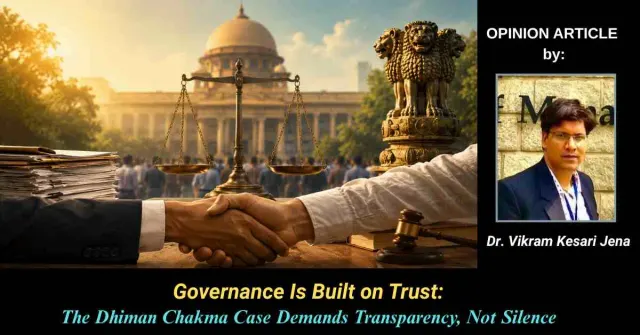
- The Dhiman Chakma case has become a broader test of democratic accountability, with the editorial arguing that the Odisha government should publicly explain the legal and administrative basis of its decision to maintain public trust.
- While affirming the principles of due process and the presumption of innocence, the editorial emphasizes that transparency, ethical governance, and clear institutional communication are essential to preserving confidence in public institutions.
The strength of a democracy is not measured merely by the laws it enacts or the institutions it creates. It is measured by the confidence citizens place in those institutions. Every administrative decision, particularly one involving allegations of corruption against a senior public official, carries consequences far beyond a single government file. It shapes public faith in justice, bureaucracy, and constitutional governance.
Recent developments relating to Dhiman Chakma have generated widespread public debate in Odisha and beyond. Reports that he returned to an important administrative assignment after vigilance action have naturally raised questions among citizens. Whether every step taken by the government is legally justified is a matter that deserves transparent explanation rather than speculation. In a constitutional democracy, clarity is never a burden; it is a responsibility.
The first obligation rests with the Government of Odisha. The Chief Minister and the Chief Secretary should issue a comprehensive public clarification explaining the legal and administrative basis of the decision. Which provisions of the applicable service rules were relied upon? Was the decision based on statutory procedure, judicial directions, disciplinary regulations, or another lawful administrative mechanism? If the action complies fully with the law, there should be no hesitation in placing the relevant rules before the public.
This is not about conducting a trial in the media. Every public servant enjoys the constitutional right to due process and the presumption of innocence unless guilt is established through lawful proceedings. These protections are essential to the rule of law. At the same time, governments have an equally important duty to preserve public confidence in the integrity of public administration. Legality and public accountability must move together.
The Odisha IAS Association also has an opportunity to strengthen public confidence. Associations representing civil servants exist to protect professional standards and institutional independence. Those objectives should also include an unwavering commitment to ethical governance. A clear statement supporting transparency, impartial investigation, and adherence to service rules would reinforce, rather than diminish, the dignity of the civil service.
The matter also has national significance. The Indian IAS Association represents one of India's most respected public institutions. The credibility of the All India Services depends not only on administrative competence but also on the public perception that integrity remains non-negotiable. A reaffirmation of the principles of ethical administration would reassure citizens across the country that accountability applies equally to everyone.
The larger question is one of institutional philosophy. What message reaches a young IAS officer entering public service with honesty and idealism? What encouragement does an upright officer receive if public perception suggests that allegations carry little practical consequence? Conversely, what confidence do ordinary citizens retain if anti-corruption investigations appear disconnected from subsequent administrative decisions?
History teaches that corruption alone does not weaken nations. The greater danger is when citizens begin to believe that accountability itself has become uncertain. Institutions lose legitimacy not because they make difficult decisions, but because they fail to explain them. Silence often creates more damage than controversy.
Also Read: What Is the Real Proof of Indian Citizenship? India's Growing Identity Debate Explained
Equally important is the distinction between legal innocence and administrative prudence. An officer may be entitled to every legal protection available under the Constitution. That principle must never be compromised. Yet governments are also expected to consider the broader implications of appointments to positions carrying significant public responsibility while disciplinary or legal questions remain unresolved. Public administration is sustained as much by credibility as by procedure.
It would be inappropriate to conclude, without evidence, that any reinstatement resulted from conspiracy or undue influence. Such assertions require proof and should not be casually made. However, unexplained decisions inevitably invite speculation. The surest way to prevent misinformation is complete transparency, supported by official documentation.
The people of Odisha are not asking for political theatre. They are asking for institutional clarity. They want to know whether existing service rules permit such administrative action and, if so, under what circumstances. If the decision followed established legal norms, the government should say so openly. If extraordinary considerations were involved, those too should be explained within the limits permitted by law.
Also Read: When the Right to Privacy Does Not Apply in India - What the Court's latest ruling said
India's administrative system has earned global respect because of generations of civil servants who upheld integrity despite enormous pressures. That legacy should never be weakened by avoidable opacity. Every controversy is also an opportunity to reaffirm constitutional values. Governments strengthen themselves not by avoiding questions, but by answering them with facts, law, and transparency.
The Dhiman Chakma matter has, therefore, become larger than one officer or one department. It is now a test of institutional communication and democratic accountability. The Chief Minister, the Chief Secretary, the Odisha IAS Association, and the Indian IAS Association all have an opportunity to reinforce public trust through openness and reasoned explanation.
Democracy does not ask governments to be infallible. It asks them to be accountable. Trust is not preserved through silence. It is earned through transparency, protected through fairness, and sustained by the unwavering belief that no public institution is above public scrutiny. That is the standard expected in Odisha. That is the standard India deserves.
Author Details
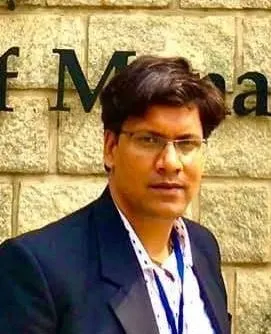
Dr. Vikram Keshari Jena is an academic, researcher, and public intellectual from Odisha. His work focuses on media, politics, development, public policy, and Indian knowledge traditions, with an emphasis on critical inquiry, social transformation, and interdisciplinary dialogue. He has authored numerous academic books and currently serves as the Founding Director of the Centre for Adivasi Research and Development (CARD), Odisha.
Reader Feedback
Was this article useful?
Stay Connected
Get the next important story before you miss it.
Subscribe to the newsletter for trusted updates, or join our WhatsApp channel for quick top-story alerts from The Eastern Times.
WhatsApp Channel
Prefer instant alerts? Join our WhatsApp channel for top stories and breaking updates.
Join on WhatsApp