
From Mann Ki Baat to Jan Ki Baat: Why India Needs Two-Way Communication
Quick Summary
- Mann Ki Baat has transformed political communication by connecting the Prime Minister with millions of citizens across India.
- Democracy, however, works best when communication goes both ways—when leaders not only speak but also listen.
- Jan Ki Baat could serve as a structured national platform for citizens to share their experiences, concerns, ideas, and aspirations directly with political leadership.
- Such an initiative could strengthen public participation, improve policymaking, build trust, and deepen democratic governance in India.
Few political leaders in contemporary India have mastered the art of public communication as effectively as Prime Minister Narendra Modi.
His monthly radio programme, Mann Ki Baat, has evolved into more than a broadcast. It has become a national institution, reaching millions of citizens across geographical, linguistic, and social boundaries.
The programme has celebrated unsung heroes, encouraged behavioural change, promoted social campaigns, highlighted innovation, and strengthened emotional bonds between citizens and the nation. It demonstrates the remarkable ability of a leader to communicate consistently and inspire collective action.
Yet communication, as understood in political science, sociology, public administration, and communication theory, is not merely the transmission of messages. It is a process.
A complete communication cycle consists of a sender, a message, a receiver, feedback, and a response. Without meaningful feedback, communication risks becoming incomplete.
Democratic governance, therefore, requires not only a leader's voice but also the people's voice.
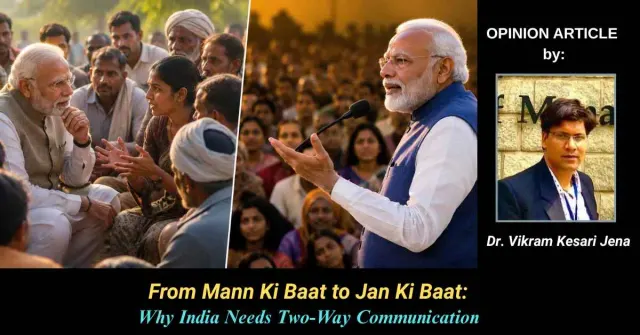
India may now be approaching a stage where Mann Ki Baat could be complemented by another democratic initiative, Jan Ki Baat, a structured platform dedicated primarily to listening rather than speaking.
This is not a criticism of an existing programme. Rather, it is an evolution of democratic communication. Great institutions remain relevant because they adapt to changing societal expectations.
As India becomes increasingly educated, digitally connected, aspirational, and politically aware, citizens seek not only inspiration from leadership but also opportunities to participate directly in shaping governance.
Communication Must Go Both Ways
Modern communication theory consistently distinguishes between one-way communication and two-way communication.
One-way communication is efficient for disseminating information, motivating citizens, and creating awareness. Governments around the world use it during emergencies, national campaigns, and public announcements.
However, democratic governance increasingly depends upon two-way communication, where citizens respond, question, suggest, critique, and participate in policy formation.
This principle is equally recognised in contemporary public administration. Governments today are judged not merely by how effectively they govern but by how effectively they listen.
Public trust grows when citizens believe that their experiences influence policymaking.
India presents an extraordinary governance challenge. It is home to more than a billion people representing thousands of communities, languages, occupations, ecological regions, and social realities.
The concerns of a farmer in Odisha differ from those of an entrepreneur in Bengaluru. A tribal family in central India faces challenges very different from those experienced by professionals in metropolitan cities.
Coastal communities confront climate vulnerability, while Himalayan regions struggle with fragile ecosystems. A single narrative cannot fully capture such diversity.
No bureaucracy, however efficient, can entirely replace direct listening by political leadership.
Also Read: Odisha Govt to Develop Model Villages on Smart City Lines
Why Listening Matters
History demonstrates that many of the world's most respected leaders possessed not only the ability to speak persuasively but also the willingness to listen patiently.
Listening often produces better governance than speaking because it reveals invisible problems before they become visible crises.
Public policy scholars frequently argue that governments fail not because they lack resources but because they misunderstand ground realities.
Policies designed in capital cities sometimes overlook the lived experiences of ordinary citizens.
Administrative reports, statistical indicators, and official presentations are valuable, but they cannot always communicate emotions, frustrations, aspirations, or local innovations.
This is where a structured Jan Ki Baat could become transformative.
What Jan Ki Baat Could Look Like
Imagine a national listening platform where farmers, teachers, scientists, tribal leaders, students, entrepreneurs, nurses, sanitation workers, artisans, soldiers' families, women's self-help groups, persons with disabilities, and young innovators engage directly with the Prime Minister on selected national themes.
Such conversations could occur physically, digitally, and through regional consultations. Rather than replacing existing institutions, they would strengthen participatory democracy.
Listening itself is a form of governance.
Political philosopher Hannah Arendt observed that politics exists wherever people come together to deliberate about their common world.
Similarly, deliberative democratic theory emphasises that legitimate governance arises through dialogue rather than unilateral communication. Citizens are not merely recipients of policy; they are partners in nation-building.
India's constitutional vision supports this philosophy. Democracy is not simply periodic elections. It is continuous engagement between institutions and citizens.
Elections determine who governs. Communication determines how governance evolves.
Prime Minister Modi is widely recognised as one of India's most effective communicators. His speeches often combine cultural symbolism, developmental aspirations, and emotional connection with citizens.
This ability has significantly shaped political discourse over the past decade. Precisely because communication has become one of his greatest strengths, expanding it into a structured listening exercise could further deepen democratic legitimacy.
Leadership is ultimately measured not only by the capacity to persuade but also by the humility to hear.
Also Read: Why India Still Struggles to Become an Economic Superpower Despite 35 Years of Reforms
Bringing Leadership Closer to Citizens
Every leader operates within institutional ecosystems comprising bureaucrats, advisers, experts, and political colleagues.
These intermediaries perform essential functions by synthesising information and providing policy advice. However, no advisory structure can fully substitute for direct engagement with citizens.
Information often changes as it moves upward through administrative layers. Ground realities are sometimes softened, filtered, delayed, or interpreted through institutional perspectives.
Direct listening helps reduce this democratic distance.
Across India, citizens increasingly use social media to express concerns. While these platforms amplify voices, they also generate noise, misinformation, polarisation, and algorithmic distortions.
Governance cannot rely exclusively upon digital trends to understand public opinion. A carefully designed Jan Ki Baat would provide structured, representative, and meaningful public engagement beyond the volatility of online debates.
Such an initiative could also improve policymaking.
Every ministry could identify recurring citizen concerns emerging from these interactions.
Artificial intelligence could categorise feedback into themes such as employment, agriculture, healthcare, education, urban infrastructure, environmental sustainability, women's empowerment, tribal development, and digital governance.
Annual policy reports could explain how citizen feedback influenced governmental decisions. This would strengthen transparency and accountability while demonstrating that participation produces measurable outcomes.
When Citizens Feel Heard
Listening also strengthens national unity.
Citizens who feel heard are more likely to trust institutions, cooperate with reforms, and contribute constructively to national development.
Even when governments cannot immediately resolve every problem, sincere listening itself builds democratic legitimacy. People often accept difficult decisions when they believe their voices were genuinely considered.
India's demographic transformation makes this particularly important.
Young citizens aspire not merely to receive government schemes but to shape public policy. They seek dialogue, participation, innovation, and recognition.
A democracy that creates institutional spaces for listening will harness this immense intellectual and social capital.
Critics may argue that numerous grievance redressal systems, parliamentary mechanisms, public consultations, and digital complaint portals already exist. These mechanisms indeed perform valuable functions.
However, symbolic leadership also matters. When the highest elected office visibly prioritises listening, it sends a powerful message throughout the administrative hierarchy.
Bureaucracies often emulate the governance culture demonstrated by political leadership.
A national listening initiative could therefore inspire ministries, state governments, district administrations, universities, and local governments to institutionalise similar practices.
The essence of democratic leadership lies in recognising that wisdom is distributed throughout society.
Policymakers possess expertise. Administrators possess experience. Scholars possess analysis.
Yet citizens possess lived realities, and lived realities often reveal truths unavailable in official reports.
Completing the Conversation
As India advances towards becoming a developed nation, governance must evolve from consultation to collaboration and from information dissemination to meaningful participation.
Perhaps the future of democratic communication does not lie in choosing between Mann Ki Baat and Jan Ki Baat.
Instead, it lies in integrating both into a continuous cycle of speaking, listening, learning, and responding.
The strength of a democracy is not measured only by the power of its leaders' voices. It is equally measured by the seriousness with which leaders hear the voices of ordinary citizens.
Communication achieves its highest purpose not when one side speaks eloquently but when both sides understand one another.
In the decades ahead, India will require not only visionary leadership but also institutionalised listening.
The journey from Mann Ki Baat to Jan Ki Baat would not diminish leadership. It would elevate it.
It would transform communication into participation, participation into trust, and trust into stronger democratic governance.
For a nation as vast and diverse as India, perhaps the next great innovation in governance is not finding a louder voice.
It is cultivating a deeper ear.
Author Details
Dr. Vikram Keshari Jena is an academic, researcher, and public intellectual from Odisha. His work focuses on media, politics, development, public policy, and Indian knowledge traditions, with an emphasis on critical inquiry, social transformation, and interdisciplinary dialogue. He has authored numerous academic books and currently serves as the Founding Director of the Centre for Adivasi Research and Development (CARD), Odisha.
Reader Feedback
Was this article useful?
Stay Connected
Get the next important story before you miss it.
Subscribe to the newsletter for trusted updates, or join our WhatsApp channel for quick top-story alerts from The Eastern Times.
WhatsApp Channel
Prefer instant alerts? Join our WhatsApp channel for top stories and breaking updates.
Join on WhatsApp