FOOD LITERACY
Quick Summary
- Food literacy goes beyond nutrition—it helps children understand where food comes from and how it reaches the plate.
- Advertising and convenience are shaping children's choices, often making packaged brands more familiar than traditional foods.
- Schools can bridge the gap through nutrition gardens, local food experiences, technology, and practical food education.
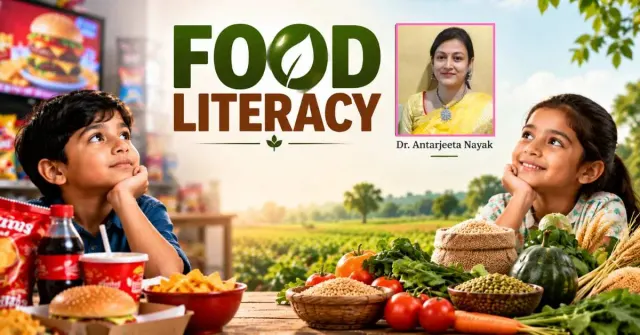
Ask a child to identify a packet of chips, a soft drink, or an instant-noodle brand, and the answer may come almost instinctively. The colours, mascots, slogans, and even the jingles have become part of childhood. Now ask the same child to identify different varieties of millets, explain where pulses come from, describe the journey of rice from a paddy field to the dining table, or name vegetables that grow naturally in a particular season. The response may be far less certain.
This is not merely a matter of general knowledge. It points to a deeper transformation in India's relationship with food. The modern child is increasingly becoming a consumer of food without necessarily becoming a learner of food. The journey from soil to seed, farm to market, and kitchen to plate is being replaced by another journey—from advertisement to screen, screen to desire, and desire to purchase.
The concern arises when the brand becomes more familiar than the food itself. India remains fundamentally connected to agriculture. Yet, paradoxically, many of its children are growing increasingly disconnected from the origins of what they eat.
In such a situation, the question of nutrition cannot remain confined to calories, proteins, vitamins, and minerals. It must also include another important dimension: food literacy. Food literacy means much more than knowing which food is “healthy” and which is “unhealthy”. It involves understanding where food comes from, how it is grown, processed, and marketed; what it contains; how advertising influences choices; and how food is connected with agriculture, culture, the environment, income, and public health.
In other words, it is the ability to see the entire journey behind the plate.
How Children Once Learned About Food
For much of India's history, food knowledge was acquired informally. A child growing up in a village often saw crops being cultivated, harvested, dried, and stored. Seasonal changes were reflected in the kitchen. Local markets displayed the agricultural diversity of the region. Grandparents passed down recipes, preservation techniques, and knowledge about particular grains, leaves, roots, and vegetables.
Even urban children, though perhaps more distant from farms, often grew up in households where food was prepared from basic ingredients and where the kitchen itself was a site of learning. A child could watch wheat being kneaded into dough, pulses being cleaned, spices being ground, or vegetables being prepared according to the season.
But this relationship with food is changing rapidly. Urbanisation, migration, changing family structures, rising incomes, time constraints, and the expansion of organised food markets have altered not only what Indians eat but also how they encounter food.
The scale of this transformation is reflected in India's changing consumption patterns. According to the Household Consumption Expenditure Survey 2023–24, expenditure on beverages, refreshments, and processed food constituted the largest component among the food expenditure groups in both rural and urban India. The growth of these products is closely linked to changes in lifestyle, retail expansion, aggressive marketing, and the increasing availability of ready-to-eat and ready-to-consume foods.
For busy families, convenience is often not a luxury but a necessity. A working parent returning home late may not have the time to prepare elaborate traditional meals. Students juggling school, tuition, and other activities may prefer something quick. Therefore, the rise of packaged and processed food cannot simply be explained as individual irresponsibility. It is also a consequence of the changing economics of time.
Children Are Choosing More Than Food
This is where the issue becomes more complex than the familiar advice to “eat healthy”. Children do not make food choices in isolation. Their preferences are shaped by what is available, affordable, convenient, and socially desirable.
Advertising plays a significant role in this process. Research on food marketing has repeatedly demonstrated that advertisements aimed at children often associate products with fun, excitement, friendship, energy, happiness, and popularity rather than with their nutritional qualities. The child is not merely being sold a biscuit, beverage, or snack. The child is being sold an experience and an identity.
A packet of chips, therefore, has an enormous advantage over a millet. It has colour, packaging, a logo, advertising campaigns, and sometimes celebrity endorsements. It appears repeatedly on television and increasingly on digital platforms. A millet, on the other hand, has centuries of agricultural and nutritional history but rarely the same commercial storytelling machinery.
The Strange Journey of India’s Millets
The irony is striking. A grain that may have travelled through generations of Indian food culture can become unfamiliar to the very generation for whom it is now being rediscovered as a “superfood”.
Yet, over time, dietary transitions, agricultural policies, changing aspirations, and market structures contributed to the declining visibility of several traditional grains in everyday diets. Today, there is a renewed effort to bring millets back into the national nutritional conversation.
Government initiatives and other nutrition and food programmes have emphasised dietary diversity, traditional food systems, and the inclusion of locally appropriate foods. The promotion of millets has received particular attention in recent years.
However, simply reintroducing a grain into the market or a meal programme is not enough to rebuild a relationship with it. A child should not encounter ragi only as an ingredient in a school meal or see millet only during Poshan Maah. A millet cookie may become fashionable in an urban supermarket while the child consuming it remains unaware of what millet is, where it grows, or why it was traditionally important.
This is why India's nutrition challenge must move from merely encouraging food consumption to promoting food understanding.
Nutrition Education Needs a Bigger Meaning
India needs to expand the meaning of nutrition education. At present, nutrition is often reduced to lists: proteins, carbohydrates, vitamins, minerals, calories, and healthy versus unhealthy foods. These are important. But they are not enough.
A truly food-literate child should be able to understand the entire food ecosystem. They should know that rice does not originate in a supermarket aisle. That milk does not begin in a tetra pack.
This is where food literacy must become interdisciplinary literacy.
Turn the School Garden into a Living Classroom
The government's emphasis on School Nutrition Gardens offers an important opportunity in this direction. A school garden should not merely be a symbolic patch of land where a few vegetables are grown for ceremonial purposes. Properly integrated, it can become a living laboratory.
Children can sow seeds, observe germination, understand the role of soil and water, record plant growth, and learn about seasonality. They can compare what grows in their school garden with what is available in the local market. They can calculate the price difference between farm produce and retail prices. They can study how a vegetable travels from a farmer to a consumer.
Such experiences can fundamentally change a child's relationship with food.
A student who has watched a seed germinate may think differently before wasting vegetables on a plate. A child who has spoken to a farmer may understand that food does not simply “appear” in a supermarket. A student who compares the ingredients of a packaged snack with a traditional food may become a more informed consumer.
From “Eat Healthy” to “Think About Food”
This is particularly important because India today faces what may be called a nutritional paradox. The country continues to struggle with undernutrition and micronutrient deficiencies while simultaneously witnessing growing concerns about overweight and obesity.
Therefore, India's battle against malnutrition cannot be reduced to ensuring that the stomach is full. The objective must be to ensure that the diet is diverse, balanced, and appropriate to the child's stage of growth.
But even this objective will remain incomplete if children are not equipped to understand the food environment around them. Nutrition education has traditionally focused on telling children what they should eat. The next stage must involve teaching them how to think about what they eat.
What is this product made of? How much processing has it undergone?
These are not trivial questions. They are questions of consumer literacy.
Use Technology to Reconnect Children With Food
In the twenty-first century, children are growing up in an environment where algorithms increasingly influence attention and preferences. Children can use digital tools to map local foods, interview farmers, document traditional recipes, identify crops grown in their districts, or create short videos explaining the journey of food from farm to plate.
The challenge is not to take children away from technology but to use technology to reconnect them with the real world.
Imagine, for example, a “Know Your Food” initiative in every school. Students could be asked to identify five grains grown in their state, trace the origin of the food in their lunchbox, or interview grandparents about foods that were commonly eaten during their childhood.
A class could visit a local haat or agricultural market and study the diversity of grains, pulses, and vegetables available there. Students could compare the price, ingredients, and advertising strategies of packaged snacks with locally available alternatives.
Such exercises would achieve something that a conventional lecture on nutrition may not. They would transform the child from a passive consumer into an informed participant in the food system.
Let Modern Education Keep One Foot in the Farm
A truly modern education system should not treat traditional knowledge and contemporary knowledge as opposites. A child can learn coding and also learn cropping seasons. They can understand artificial intelligence and still know how a seed germinates. They can use a smartphone to document biodiversity in a school garden.
The choice need not be between technology and tradition.
The real goal should be to ensure that technology does not sever the child's connection with the ecological and agricultural foundations of life. This is where food literacy plays a much larger role.
The Future of Nutrition Begins in the Mind
India's nutritional future, therefore, depends not only on what reaches the child's plate but also on what reaches the child's mind.
Let children recognise bajra, jowar, ragi, and the many grains, pulses, and vegetables that form India's extraordinary food diversity. Let them understand the information printed on the packet, but also understand the labour that produced the food outside it. Let them know the convenience of the market without losing their connection with the farm.
Because a well-nourished India will not be built merely by filling plates. It will be built by creating a generation that understands the plate.
Author Details

Dr. Antarjeeta Nayak is a researcher and columnist with a Ph.D. in Economics from NIT Rourkela and a recipient of ICSSR Doctoral and Post-Doctoral Fellowships. Her research focuses on poverty and tribal development.
Reader Feedback
Was this article useful?
Stay Connected
Get the next important story before you miss it.
Subscribe to the newsletter for trusted updates, or join our WhatsApp channel for quick top-story alerts from The Eastern Times.
WhatsApp Channel
Prefer instant alerts? Join our WhatsApp channel for top stories and breaking updates.
Join on WhatsApp