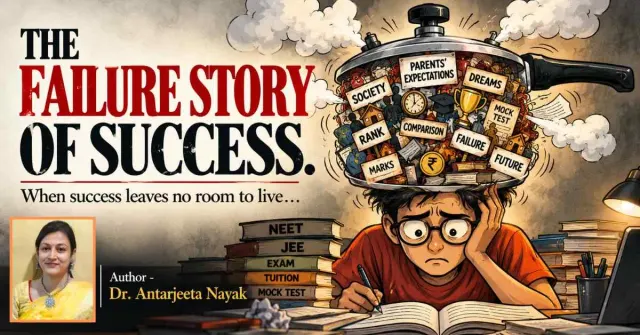
The Failure Story of Success
When success leaves no room to live….
Quick Summary
- Parental expectations, comparison and coaching culture can turn education into a relentless race for marks and ranks.
- The article questions an examination system that measures performance rather than practical understanding, judgement and resilience.
- True education must teach children how to handle failure and recognise that their worth extends far beyond academic success.
Have you ever seen a pressure cooker burst?
A cooker does not explode merely because it has been placed on a stove. An explosion occurs when pressure keeps building, the vessel is overfilled, the vent becomes blocked, the safety valve fails, and the pressure exceeds the limit the cooker can withstand.
Could something similar be happening to our children?
When a cooker bursts, we reflexively blame the cooker. But what about the hand that filled it, lit the fire and ignored the warning hiss? Examined honestly, these questions turn our attention closer to home: towards parents, families and households.
Parents may bristle at the suggestion. “Are we our children's enemies?” Of course not. Most parents love their children fiercely. Yet somewhere along the way, childhood has slipped out of children's lives and, ironically, parents have slipped out of it too.
What remains is a grim litany of school, tuition, competitive examinations, tests and yet more tests.
The Race That Never Ends
When marks dip, the first question is seldom, “What went wrong?” It is more likely to be, “If that child could do it, why couldn't you?”
When a child returns exhausted from school and tuition and says, “I'm tired,” the response is often, “Everyone else is studying. Why can't you?”
And when a child confesses, “I don't want to become an engineer or a doctor,” the retort comes sharpened: “Then what will you become? Will you take up farming in the village? Are you such a fool?”
By this point, the child is no longer wrestling with a syllabus alone. The rivals are classmates, neighbours' children and, worst of all, the phantom “ideal child” conjured by the family: a paragon who never tires, never makes mistakes and is always one step ahead.
The child who scores 95 is miserable because someone else has scored 98. The child with 98 cannot rest because someone has scored 99. The race has no finish line.
Gradually, children learn a dangerous lesson: good marks bring smiles at home, high ranks bring praise, and failure invites interrogation. Slowly, the child begins to believe that his or her worth is nothing more than a number printed on a mark sheet.
When Education Becomes a Business
The story of pressure does not end within the family or the living room. Once parents tie a child's destiny to ranks and entrance examinations, a vast marketplace stands ready to monetise their anxiety: the coaching centre.
There is nothing inherently sinister about tuition. For many children, additional academic support can be useful. The trouble begins when coaching ceases to support education and starts replacing it, when examinations become life itself and learning becomes a business.
Children are now pushed towards IIT and medical entrance coaching as early as Class VI, before they can fully understand what engineering or medicine entails. Before a child has discovered what he or she loves, parents and coaching factories have already decided what that child must become.
The child is pushed into the oven, expected to emerge as a “perfect loaf”.
Some heat is indispensable. A measure of pressure can teach diligence, perseverance and the determination to rise after failure. But we have drifted towards a peculiar belief: the more pressure a child endures, the stronger that child becomes.
And what of the child who bears it all in silence? We praise such a child as “strong”. We mistake obedience for resilience, fear for discipline and exhaustion for hard work. Rarely do we pause to ask what the child is experiencing within.
Where Is the Safety Valve for Our Children?
Even a pressure cooker comes with a safety valve. But where is the safety valve for our children?
When a child is drained, who will say, “Stop for a moment”? Before a child breaks, who will say, “You are worth more than your marks and your rank”?
When a student dies by suicide, attention shifts towards academic pressure, institutional accountability and mental health. Television studios and social media go hunting for a villain. For a few days, everyone insists that “something must be done”. Then we move on. The recent death of a student at IIT Bombay provoked intense debate. Fixing responsibility is important. But a more fundamental question lies beneath the immediate controversy: why does a young person reach such a point at all?
We are adept at apportioning blame but far less adept at examining the forces that manufacture such pressure and confronting them steadily over the long term.
Examinations Should Measure Learning, Not a Child's Worth
The problem is not examinations themselves. It begins when an examination stops measuring learning and starts measuring the child. What did the child learn throughout the year? How did the child think? What did the child understand? Where did the child make mistakes? How did the child learn from those mistakes? Instead of exploring these questions, we often prefer to measure an entire year's learning through a single three-hour examination.
But when a child enters an examination hall, it is not merely academic knowledge that enters with them. Anxiety walks in too, along with fear and the circumstances of home. Then the child walks out, and all that intricate humanity is flattened into a few digits: 95, 85, 72…
Artificial intelligence makes this question even more pressing. Machines can now solve equations, write code and compose fluent essays, yet we continue to design examinations that pit children against machines in essentially the same contest: who can produce the correct answer? Examinations need not disappear because AI has arrived. They must evolve.
Give an engineering student a malfunctioning machine and ask how they would diagnose and repair it. Present an economics student with an unfamiliar, real-world problem and ask them to unravel it. Let examinations move beyond “What do you know?” towards “How will you use what you know?”
Such abilities may sit awkwardly on a rank list. That may be precisely why they matter. The true divide between humans and machines lies not in who can reproduce an answer faster, but in who can question an assumption, exercise judgement and choose a course of action when no answer is waiting in a textbook.
We Have Taught Them to Win, Not to Lose
We often assume that pressure is fiercest in the country's most prestigious institutions. But perhaps an institution is sometimes merely the place where an old, overfilled pressure cooker finally bursts. The cooker may burst in one place even though the pressure has been building elsewhere for years.
A child who has spent years hearing that a high rank and a famous campus are the ultimate measures of success may arrive there only to discover that everyone around them is exceptional. The child who was once extraordinary becomes one among hundreds, and the fear of being ordinary takes root.
Here lies another lesson we have failed to teach: how to lose.
We have not given children enough opportunities to experience what it means to fall behind, nor have we taught them how to live with uncertainty and failure. Yet we expect them to possess problem-solving skills, self-discipline and the courage to recognise their own worth.
We ask them to solve difficult problems without teaching them how to deal with the possibility that they may not always succeed. The consequences of this contradiction are becoming impossible to ignore.
According to official records, 13,044 students died by suicide in India in 2022. It would be wrong to conclude that examinations alone caused these deaths. Suicide is complex, and individual, psychological, familial and social factors can all play a part. Nevertheless, the number compels us to ask whether we are thinking seriously enough about the environment in which we raise our children.
A Mark Sheet Is Not a Measure of a Life
Ranks are eventually forgotten. Mark sheets end up in cupboards, gathering dust. The examination that once seemed to determine an entire future becomes a single page in a much longer story. What endures is the human being. Perhaps that human being is the most important outcome of education.
The real question, then, is not whether we should put out the flame, but whether we have forgotten how to regulate it. It is not whether children should face pressure, but whether we have begun to mistake pressure for education.
It is not whether examinations should exist, but whether an examination should determine a child's worth. And above all, it is whether we will heed the warning hiss before the pressure cooker bursts.
Author Details

Dr. Antarjeeta Nayak is a researcher and columnist with a Ph.D. in Economics from NIT Rourkela and a recipient of ICSSR Doctoral and Post-Doctoral Fellowships. Her research focuses on poverty and tribal development.
Reader Feedback
Was this article useful?
Stay Connected
Get the next important story before you miss it.
Subscribe to the newsletter for trusted updates, or join our WhatsApp channel for quick top-story alerts from The Eastern Times.
WhatsApp Channel
Prefer instant alerts? Join our WhatsApp channel for top stories and breaking updates.
Join on WhatsApp