
End the VIP Culture Before It Ends the Meaning of Democracy
Democracy demands equal respect for citizens, not privileges that place public officials above them.
Quick Summary
- The persistence of VIP vehicle culture exposes a gap between India's democratic ideals and everyday governance.
- While essential security is justified, unnecessary convoys, traffic disruptions and official privileges waste public resources and reinforce social distance.
- Transparent rules, proportionate security and administrative restraint can help restore public trust and strengthen democratic equality.
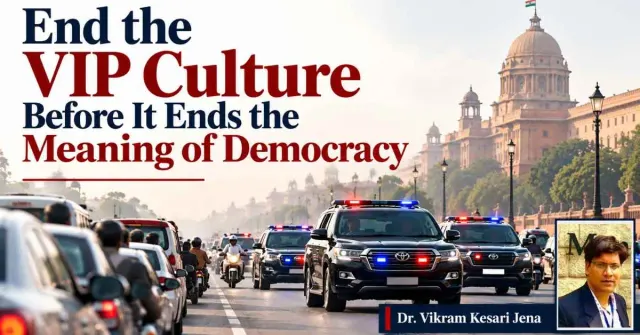
Democracy begins with a simple moral principle: no citizen is inherently more important than another. Public office carries responsibility, authority and constitutional dignity, but it does not create a superior class of human beings. Yet across India, the distance between citizens and the state is often measured not by law, but by the number of vehicles accompanying an official car. The flashing beacon may have disappeared from many vehicles, but the culture behind it has not. Convoys, escort vehicles, pilot cars, traffic stoppages, barricades and elaborate security arrangements continue to send a message that democracy should never convey: some people are entitled to the road, while others are expected to wait.
There is something deeply troubling about a government convoy passing through a crowded road while ordinary citizens stand helplessly at traffic signals. A patient may be rushing to a hospital. A student may be trying to reach an examination centre. A worker may be running late for work, or a parent may be carrying a sick child. Yet traffic can suddenly come to a standstill because a public official is passing through. For a moment, the convenience of the state takes precedence over the needs of society.
This is more than a traffic inconvenience. It is a visible demonstration of power. Democracy is weakened whenever citizens are repeatedly reminded that those who exercise authority enjoy privileges that ordinary people must accommodate.
The argument is often made that protocol is necessary for security, dignity and administrative convenience. Security must certainly be ensured wherever a genuine threat exists. Constitutional offices require appropriate protection, and no responsible democracy can ignore the legitimate security needs of public representatives. But security and VIP culture are not synonymous. Safe movement does not require unnecessary spectacle. The dignity of public office does not depend on a procession of vehicles, nor does administrative efficiency require roads to be cleared for every official journey.
The question, therefore, is not whether security should be provided. It is whether public resources are being used proportionately, rationally and transparently.
The financial cost of this culture deserves equal scrutiny. Every government vehicle consumes fuel and requires maintenance. Every additional vehicle needs a driver, while every unnecessary security deployment diverts personnel from other responsibilities. Convoys also involve logistical and operational expenditure. Although individual costs may appear modest, their cumulative burden can be significant.
At a time when governments emphasise fiscal discipline, welfare spending, infrastructure development, public health, school facilities and employment, maintaining unnecessary official privileges raises legitimate questions about public priorities. Taxpayers' money should be allocated according to public need, not official status.
The deeper problem, however, is not merely the expenditure on fuel or vehicles. It is the mentality that sustains this system. VIP culture is fundamentally a culture of distance. It creates a psychological and institutional divide between those who govern and those who are governed.
When officials become accustomed to convoys, exclusive entrances, cleared roads, preferential seating and layers of protocol, there is a risk that ordinary citizens gradually disappear from their understanding of public service. Those in authority begin to experience the state differently from the people they serve. Democracy then risks becoming an exercise performed during elections rather than a principle practised in everyday life.
India has spent decades seeking to overcome the psychological legacy of colonial rule. Yet VIP culture can reproduce aspects of that legacy in a modern form. The colonial state visibly surrounded itself with authority, while ordinary Indians were expected to move aside. Independence changed the rulers, but it did not eliminate every inherited habit of power.
A democratic republic cannot consider its transformation complete merely because those occupying positions of authority have been elected or appointed under the Constitution. The real test of democratic culture is whether public officials recognise, even while travelling through the streets, that the people whose movement they interrupt are the very citizens whose taxes sustain the state.
There is also an environmental dimension to consider. Governments increasingly ask citizens to conserve fuel, reduce pollution, embrace cleaner mobility and respond to climate change. Unnecessary fleets of official vehicles send a contradictory message. Government institutions should lead by example rather than exempt themselves from the principles they expect citizens to follow.
Where an official journey can be conducted safely with fewer vehicles, more efficient planning and better traffic management, oversized convoys should not be maintained merely because tradition demands them. Administrative practices must be assessed according to their present public value. What was once considered necessary may no longer be justified.
Reform does not require dramatic gestures. It requires administrative discipline and clear accountability.
Every department should periodically review its vehicle deployment and protocol expenditure. The number of vehicles assigned to officials should be assessed against actual requirements. Pilot vehicles and escorts should be deployed according to documented security needs, not simply the rank of the person being escorted. Traffic disruptions should be minimised, and alternative arrangements should be considered wherever public safety permits. Official vehicles can be pooled where practical, while unnecessary journeys can be reduced through digital meetings.
Governments should also establish and publish clear norms governing official transport, security deployment and protocol expenditure. Such rules must distinguish between essential protection and ceremonial privilege. Above all, senior officials should lead by example by voluntarily giving up privileges that are not necessary for discharging their constitutional responsibilities.
These reforms could deliver something more valuable than financial savings: public trust.
Imagine a senior public official travelling with minimal disruption, stopping at an ordinary traffic signal when security conditions permit, entering a public institution without an unnecessary procession and meeting citizens without layers of avoidable protocol. Such conduct would carry considerable symbolic value. Citizens would see not a ruler passing through their midst, but a public servant sharing the same republic.
Political equality cannot be sustained by constitutional text alone. It must also be visible in everyday conduct. When citizens encounter a state that respects their time, mobility and dignity, democratic institutions become more credible.
Political parties should therefore compete not by demanding more privileges for their leaders, but by demonstrating a willingness to reduce them. Governments should not wait for public anger before reviewing official protocol. Opposition parties must not condemn VIP culture while out of power only to reproduce it when they enter government. Civil servants should have the professional courage to distinguish genuine security requirements from ceremonial habits, while legislatures should demand transparency in public expenditure.
Citizens, journalists and civil society also have a role to play. Whenever an elaborate convoy disrupts public life, a reasonable question deserves to be asked: which parts of this arrangement are genuinely necessary for public service, and which exist merely to display authority?
The republic does not need bigger convoys. It needs a smaller distance between government and the people. It does not need more vehicles surrounding authority. It needs stronger accountability over the exercise of power.
The prestige of public office should arise from the quality of service delivered, not from the number of vehicles accompanying its holder. A minister travelling with ten vehicles is not necessarily more effective than one travelling with two. An officer surrounded by layers of protocol is not necessarily more efficient than one who travels simply. The true measure of public office is not the procession that accompanies an official, but the public good that follows from the work performed.
India aspires to become a developed nation and a confident global power. Achieving that ambition requires more than highways, digital infrastructure, economic growth and technological advancement. It also requires a democratic culture mature enough to reject inherited symbols of privilege. The Indian state of the future must be efficient, accessible, frugal and citizen-centred. Public money must be directed towards the needs of citizens rather than the demands of official prestige.
It is time to bring unnecessary VIP vehicle culture to an end, through practical and constitutionally sound reforms. Essential security must remain, but unnecessary spectacle must go. The road belongs to everyone. The treasury belongs to everyone. The state belongs to everyone.
When an elected representative or public official moves through society, citizens should not feel that democracy has temporarily been pushed aside. Democracy must remain on the road with them.
Author Details
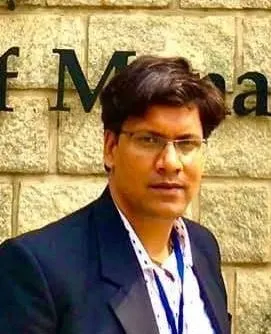
Dr. Vikram Keshari Jena is an academic, researcher, and public intellectual from Odisha. His work focuses on media, politics, development, public policy, and Indian knowledge traditions, with an emphasis on critical inquiry, social transformation, and interdisciplinary dialogue. He has authored numerous academic books and currently serves as the Founding Director of the Centre for Adivasi Research and Development (CARD), Odisha.
Reader Feedback
Was this article useful?
Stay Connected
Get the next important story before you miss it.
Subscribe to the newsletter for trusted updates, or join our WhatsApp channel for quick top-story alerts from The Eastern Times.
WhatsApp Channel
Prefer instant alerts? Join our WhatsApp channel for top stories and breaking updates.
Join on WhatsApp