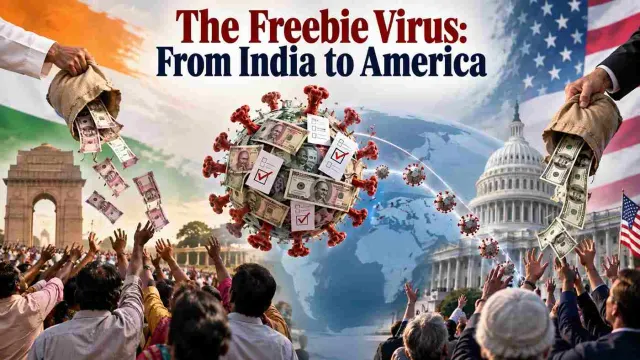
The Freebie Virus: From India to America
Quick Summary
- Freebies and direct financial benefits are becoming an increasingly important part of electoral politics.
- India and the US face different economic realities but share questions over welfare and electoral incentives.
- The growing use of public money for political promises raises concerns about fiscal sustainability and transactional democracy.
A democracy was once built on promises of a better tomorrow. Today, increasingly, it is being tested by promises of money today.
The ballot box was meant to be the place where citizens judged leaders on their ideas, performance and vision. But across democracies, another question is quietly becoming more important: “What will I get if I vote for you?”
From direct cash transfers and free electricity to subsidised goods and election-time financial promises, the line between welfare and political inducement is becoming increasingly difficult to define. What begins as assistance for the vulnerable can, under the pressure of electoral competition, evolve into a race in which political parties compete to offer more and voters are encouraged to think in terms of immediate financial returns.
India has been debating this phenomenon for years. Now, similar questions are emerging in the United States.
The issue is bigger than any single political party, leader or election. It goes to the heart of democracy itself: Can a system designed to give citizens political power remain healthy when public money increasingly becomes a tool for winning their loyalty?
That is the uncomfortable question behind the growing global debate over freebies.
From Cash-for-Votes to the Freebie Culture
Buying votes with money—“cash for votes”—is no longer merely a covert practice in India. What was once condemned as an underhand electoral tactic is increasingly being discussed and announced openly on public platforms. The Election Commission of India has also faced criticism over the growing normalisation of such electoral practices.
The political landscape has reached a stage where parties that refuse to distribute money or promise direct financial benefits may find it increasingly difficult to compete in elections. At times, such strategies can also influence voter behaviour and make electoral outcomes less predictable.
The “cash-for-votes” culture, which has gradually become deeply embedded in Indian electoral politics, now appears to have found echoes in the United States—the world’s oldest continuous modern democracy.
The ‘Trump Dividend’ and a New Debate
A few days ago, the real significance of US President Donald Trump’s praise for India’s Election Commission was not immediately clear. But the debate has taken a new turn with Trump’s reported proposal for what has been described as a “Trump Dividend” ahead of the US midterm elections.
At an election rally in Texas, Trump announced that if Republicans retain control of both chambers of Congress, senior citizens could receive a one-time payment of $5,000 each—equivalent to roughly ₹4.5 lakh.
The proposal has triggered a wider debate: when direct financial benefits are offered during an election cycle, where does welfare policy end and electoral inducement begin?
Money Has Always Been Part of American Politics
The influence of money on American elections is not a new phenomenon. Campaign financing, political donations and spending by wealthy individuals and organisations have long played an important role in US politics.
Following the last presidential election, commentators also debated the role of money and political spending in the contest. Billionaire Elon Musk’s financial support for Trump and his involvement in the campaign attracted considerable attention.
However, campaign spending and direct payments to voters are not the same thing. The distinction is important. Political donations and campaign expenditure operate within a legal framework, whereas offering voters direct personal financial benefits in exchange for electoral support raises a fundamentally different question.
Freebies: Welfare or Electoral Politics?
This debate is not limited to the United States. India has been engaged in a similar argument for years.
There is a legitimate case for targeted welfare programmes in a developing country. Millions of economically vulnerable citizens may require direct assistance to meet basic needs. Schemes aimed at women’s economic empowerment, social security, food security or poverty reduction can serve important public-policy objectives.
Odisha’s Subhadra scheme, for instance, has been presented as an initiative aimed at providing financial support and promoting women’s economic empowerment.
But the criticism of freebies is equally straightforward: when welfare announcements are closely tied to elections, critics question whether such programmes are primarily designed as long-term public policy or as instruments of electoral mobilisation.
The distinction between welfare and electoral inducement therefore becomes crucial.
The Economic Cost of Freebies
The larger concern is not simply whether citizens receive money, but how governments finance such commitments.
Every rupee spent by a government ultimately comes from public resources—through taxation, borrowing, natural-resource revenues or other sources. If expenditure rises without a corresponding increase in productive capacity or revenue, governments may face greater fiscal pressure.
Critics of India’s growing freebies culture argue that substantial resources are being diverted towards recurring transfers instead of infrastructure, education, healthcare, employment generation and other productive investments.
The key question is therefore not whether governments should provide assistance to citizens, but whether public expenditure is creating long-term economic capacity or merely providing short-term political benefits.
India’s Freebie Debate
India's debate over freebies has become particularly intense since 2024, with large financial commitments being made by governments at both the Centre and state levels.
The combined fiscal burden of such schemes has been estimated at several lakh crore rupees annually, while the debt burden of Indian states has also continued to rise.
But the relationship between welfare spending and public debt needs to be examined carefully. Not every welfare programme is economically unproductive, just as not every infrastructure project automatically generates sufficient economic returns.
The real issue is the quality, targeting, sustainability and financing of public expenditure.
When Welfare Becomes a Political Currency
The most serious danger emerges when citizens begin to view elections primarily as opportunities to receive immediate financial benefits.
Once voters begin asking, “What will I get?” rather than “What policies will improve my future?”, political competition can gradually shift from governance to distribution.
Parties may then feel compelled to outbid one another with increasingly expensive promises. A cycle can emerge:
More promises → higher expenditure → greater fiscal pressure → more borrowing → reduced fiscal space for productive investment.
Such a cycle can eventually constrain the government's ability to respond to genuine economic crises.
The Social Cost of Free Money
The consequences may extend beyond government finances.
When financial benefits become politically competitive, they can sometimes create conflicts within communities and even families over eligibility, distribution and access. Recent incidents surrounding welfare payments in Odisha have drawn attention to the possibility that financial incentives can have unintended social consequences.
Such incidents should not, however, be used to dismiss welfare programmes as a whole. They instead underline the importance of transparent delivery systems, proper verification and safeguards against misuse.
America and India: Similar Symptoms, Different Systems
India and the United States have very different political systems, economic structures and social-security frameworks. Therefore, the two countries cannot simply be compared on the basis of a single financial proposal.
Yet there is a broader similarity worth examining.
In both democracies, political competition increasingly involves questions about who will receive what, how much, and when.
The danger arises when short-term financial benefits become more politically attractive than long-term reforms.
Can Democracy Become a Transaction?
Democracy is fundamentally based on the idea that citizens choose their representatives according to their interests, values and assessment of public policy.
If elections increasingly become transactional—where political support is exchanged for immediate financial benefits—the nature of democratic participation could gradually change.
The voter becomes a beneficiary.
The political party becomes a distributor.
The election becomes a marketplace.
That is where the deeper concern lies.
From Welfare State to ‘Freebie State’
There is an important difference between a welfare state and a freebie state.
A welfare state invests in citizens' long-term capabilities through education, healthcare, nutrition, social security and employment opportunities. A freebie-driven political system, by contrast, can become increasingly dependent on short-term transfers to maintain political support.
The challenge for democracies is therefore not to eliminate welfare, but to ensure that welfare policy remains fiscally sustainable, economically productive and institutionally independent of electoral manipulation.
The Democratic Warning
India has already witnessed an expanding debate over freebies. If similar political incentives increasingly appear in wealthy democracies such as the United States, the issue deserves broader global attention.
The concern is not that governments should never give citizens financial assistance. Nor is every welfare programme an electoral bribe.
The real concern is what happens when public money becomes the currency of political competition.
If democracies begin competing not over better institutions, stronger economies and better public services, but over increasingly expensive promises of immediate financial benefits, the long-term consequences could be serious.
Democracy may not disappear overnight. But its character can change gradually—one promise, one payment and one election at a time.
Author Details
The Eastern Times Desk is the editorial team of The Eastern Times, responsible for delivering accurate, balanced, and timely news coverage. The desk curates reports from trusted sources, correspondents, and news agencies, ensuring verified information and high journalistic standards.
Reader Feedback
Was this article useful?
Stay Connected
Get the next important story before you miss it.
Subscribe to the newsletter for trusted updates, or join our WhatsApp channel for quick top-story alerts from The Eastern Times.
WhatsApp Channel
Prefer instant alerts? Join our WhatsApp channel for top stories and breaking updates.
Join on WhatsApp