
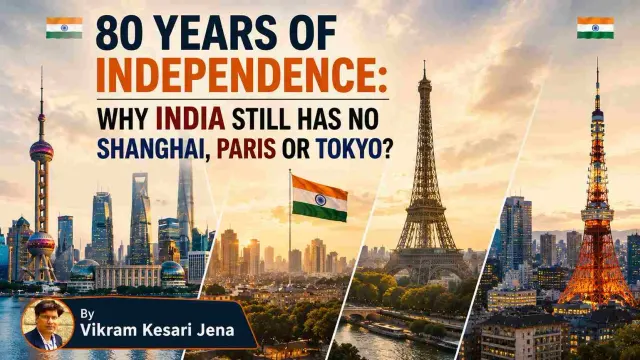
80 Years of Independence: Why India Still Has No Shanghai, Paris or Tokyo?
Quick Summary
- India has achieved major progress, but development remains uneven and fragmented.
- Weak urban planning, institutional gaps, political short-termism and education challenges limit transformation.
- India needs long-term planning, stronger cities, better institutions and greater citizen participation to define its own development model.
India has completed nearly eight decades of independence, yet a difficult question continues to confront us: why has a country of our scale, intelligence, resources, civilisational depth and democratic experience failed to create cities and institutions that can stand confidently alongside Shanghai, Paris or Tokyo? This is not a question of copying another country. It is a question of understanding why our development ambitions repeatedly become trapped between political promises and institutional reality.
India Has Achieved a Lot
The problem is not that India has achieved nothing. India has built globally respected institutions, expanded infrastructure, created a powerful digital economy, developed scientific capabilities, produced world-class entrepreneurs and become an important geopolitical power. Yet our achievements remain uneven, fragmented and insufficiently transformative. We have islands of excellence surrounded by large territories of underdevelopment. We celebrate individual success while struggling to create systems capable of reproducing excellence at scale.
The Problem of Implementation
The deeper failure lies in the distance between vision and execution.
Since independence, India has produced countless plans, commissions, missions, five-year strategies, economic reforms and development programmes. Governments change, slogans change and priorities change, but the fundamental question remains: where is the long-term national imagination that survives electoral cycles?
Shanghai did not become Shanghai because somebody merely announced a vision. Tokyo did not emerge from a speech. Paris was not built through disconnected schemes. Great cities are products of institutional continuity, urban planning, infrastructure, education, economic productivity, cultural confidence and decades of disciplined execution.
India frequently begins with ambition but loses momentum in implementation.
Politics and Long-Term Development
Our political system often rewards what is immediately visible rather than what is historically transformative. A road inaugurated today receives political attention; improving primary education over twenty years does not. A new building creates a photograph; strengthening an institution requires patience. Subsidies can generate immediate political goodwill, while judicial reform, municipal reform, research investment and administrative restructuring rarely produce instant electoral dividends.
This is where political will becomes detached from developmental reality.
The greatest danger is not political competition itself. Democracy requires competition. The danger emerges when competition becomes disconnected from the larger national project. Development then becomes a sequence of announcements rather than a coherent process of institution building.
India Needs Stronger States and Cities
India also suffers from an extraordinary centralisation of imagination. Delhi frequently decides what India needs, while the realities of Odisha, Kerala, Assam, Rajasthan, Maharashtra or the Northeast may be fundamentally different. A truly developed India cannot be constructed through one template. It requires empowered cities, capable states, accountable local governments and citizens who participate meaningfully in determining their own futures.
Our Urban Problem
Our urban failure illustrates the problem particularly clearly.
India has metropolitan regions with enormous economic potential, yet many remain congested, polluted and administratively fragmented. We speak about smart cities while millions still struggle with basic mobility, drainage, affordable housing, public spaces and reliable civic services. The question should not be whether a city has a smart application. The question should be whether its citizens experience a smart state.
Education and Talent
Similarly, our educational crisis is not primarily a shortage of buildings. It is a crisis of imagination, quality and institutional accountability. We produce millions of graduates, but too many young people remain disconnected from productive employment, research and innovation. India exports intellectual talent while struggling to create enough institutions where that talent wants to remain.
This is perhaps one of our greatest paradoxes: a country celebrated for its brains frequently behaves as though human intelligence were an unlimited resource rather than its most valuable national asset.
Citizens Also Have a Role
We must also examine ourselves as citizens.
Democracy is not merely the right to vote every five years. Democracy is the right and responsibility to question, investigate, dissent, organise, participate and demand accountability. A society that asks every question of government but rarely questions itself cannot achieve deep development.
Why do we tolerate poor public services? Why do we accept corruption as normal? Why do we celebrate political personalities more than functioning institutions? Why do we demand government jobs but hesitate to demand better schools, universities, courts, municipalities and research laboratories? Why do we measure national greatness through slogans rather than human development?
These questions are uncomfortable, but development begins precisely where collective self-examination begins.
What Should an Indian City Look Like?
India should stop asking when it will become another Shanghai, Paris or Tokyo. We should ask something more ambitious: what should an Indian city of the twenty-first century actually look like?
It should combine technological sophistication with social justice, economic dynamism with environmental responsibility, heritage with innovation and individual freedom with collective responsibility. It should be globally competitive without becoming culturally hollow. It should create wealth without destroying communities. It should attract capital without surrendering public interest.
A New Developmental Compact
Such a transformation requires a new developmental compact.
First, India needs twenty-five- to fifty-year national and regional development frameworks insulated, as far as possible, from short electoral cycles. Governments should compete over how to achieve long-term goals, not repeatedly abandon them.
Second, cities must receive genuine financial and administrative autonomy. Municipal governments cannot build world-class cities if they remain dependent on fragmented permissions and inadequate revenue.
Third, education and research must become the central infrastructure of development. India cannot become a knowledge power merely by producing degrees. Universities must become centres of discovery, criticism, innovation and public reasoning.
Fourth, citizens must be treated as participants rather than consumers of development. Public policy should be transparent, measurable and continuously evaluated. Every major programme should answer a simple question: what changed in people’s lives?
Finally, we need a culture of institutional integrity. Development without justice creates inequality; growth without accountability creates oligarchy; technology without ethics creates new forms of exclusion; democracy without informed citizens becomes vulnerable to manipulation.
The Next Eighty Years
Eighty years is not too late. But eighty years is long enough to recognise that repeating the same methods will not produce a different future.
India does not lack resources. It does not lack talent. It does not lack ambition. What it lacks is sustained institutional discipline, long-term political consistency and a civic culture courageous enough to question both government and itself.
The next chapter of India cannot be written merely through bigger highways, taller buildings or larger markets. It must be written through better institutions, stronger cities, deeper democracy, fearless citizens, excellent universities, productive enterprises and justice accessible to everyone.
The real challenge is therefore not whether India can catch up with Shanghai, Paris or Tokyo. The challenge is whether India can finally discover the confidence to define its own developmental civilisation.
We have already waited eighty years.
We should not spend the next eighty merely explaining why we are still behind.
Author Details
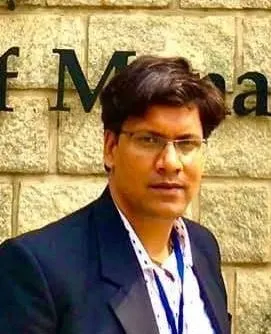
Dr. Vikram Keshari Jena is an academic, researcher, and public intellectual from Odisha. His work focuses on media, politics, development, public policy, and Indian knowledge traditions, with an emphasis on critical inquiry, social transformation, and interdisciplinary dialogue. He has authored numerous academic books and currently serves as the Founding Director of the Centre for Adivasi Research and Development (CARD), Odisha.
Reader Feedback
Was this article useful?
Stay Connected
Get the next important story before you miss it.
Subscribe to the newsletter for trusted updates, or join our WhatsApp channel for quick top-story alerts from The Eastern Times.
WhatsApp Channel
Prefer instant alerts? Join our WhatsApp channel for top stories and breaking updates.
Join on WhatsApp