
Is the Deputy Chief Minister’s Post Unconstitutional?
 The Eastern Times
 Quick Summary
- Odisha PIL: The Orissa High Court is examining a PIL challenging the appointment of two Deputy Chief Ministers.
- Constitutional position: The Constitution does not create a separate office of Deputy Chief Minister;
- the person remains a Minister under Article 164.
- Supreme Court ruling: In 2024, the Supreme Court held that the designation “Deputy Chief Minister” does not violate the Constitution.
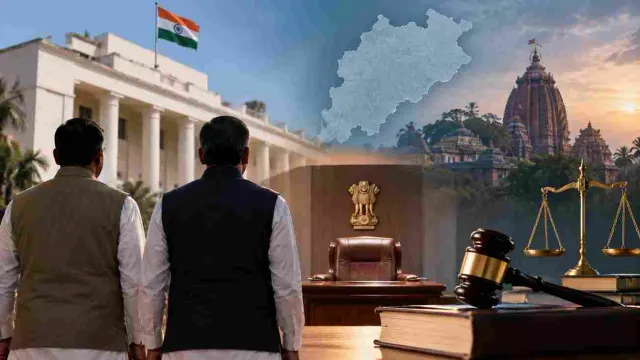
The constitutional validity of the Deputy Chief Minister’s position is being examined by the Orissa High Court following a Public Interest Litigation challenging the appointment of Kanak Vardhan Singh Deo and Pravati Parida as Deputy Chief Ministers of Odisha.
The PIL questions the constitutional basis of the designation on the ground that the Constitution does not expressly recognise a separate office of Deputy Chief Minister. The State, however, has relied on the constitutional framework governing Ministers and the Supreme Court’s 2024 ruling on the issue. The Orissa High Court has reserved its judgment.
What Does the Constitution Say?
The Constitution does not expressly mention the office of Deputy Chief Minister. However, this does not automatically make the position unconstitutional. The relevant provisions are primarily Articles 163 and 164.
Article 163 — Council of Ministers
Article 163 provides for a Council of Ministers with the Chief Minister at its head to aid and advise the Governor, except in matters where the Constitution requires the Governor to exercise discretion.
The Constitution therefore establishes the Council of Ministers and places the Chief Minister at its head.
Article 164 — Appointment of Ministers
Under Article 164:
-
The Chief Minister is appointed by the Governor.
-
Other Ministers are appointed by the Governor on the advice of the Chief Minister.
-
The Council of Ministers is collectively responsible to the Legislative Assembly.
-
The total number of Ministers, including the Chief Minister, cannot exceed 15% of the total strength of the Legislative Assembly, subject to a minimum of 12 Ministers.
Importantly, Article 164 does not create a separate constitutional category called Deputy Chief Minister.
A Deputy Chief Minister is therefore appointed as a Minister under Article 164 and is subsequently given the political designation of Deputy Chief Minister.
What Did the Supreme Court Decide in 2024?
The issue came directly before the Supreme Court in Public Political Party v. Union of India in February 2024. A petition challenged the appointment of Deputy Chief Ministers on the ground that the Constitution does not provide for such an office.
A three-judge Bench comprising then Chief Justice D.Y. Chandrachud, Justice J.B. Pardiwala and Justice Manoj Misra dismissed the petition.
The Supreme Court explained the position in simple terms:
“A Deputy Chief Minister is, first and foremost, a Minister in the Government of the State.”
The Court held that merely using the designation “Deputy Chief Minister” does not violate the constitutional scheme relating to Ministers.
Therefore, the fact that the words “Deputy Chief Minister” do not appear in the Constitution does not, by itself, make the designation unconstitutional.
Constitutional Position vs Political Practice
This distinction is important for understanding India’s parliamentary system.
The Constitution establishes the formal structure of government, while political practice can develop additional conventions and designations.
A Chief Minister may allocate important portfolios to particular Ministers or designate a Minister as Deputy Chief Minister for political or administrative reasons.
Such a designation does not, however, change the constitutional structure of the government.
The constitutional framework remains:
Governor → Chief Minister → Council of Ministers
The Deputy Chief Minister remains a member of the Council of Ministers headed by the Chief Minister.
Therefore, the Deputy Chief Minister does not have an independent constitutional status comparable to that of the Chief Minister.
What Follows From This?
A Deputy Chief Minister:
-
is appointed as a Minister;
-
remains part of the Council of Ministers;
-
functions within the constitutional framework headed by the Chief Minister;
-
does not automatically acquire powers superior to other Ministers merely because of the designation;
-
does not automatically succeed the Chief Minister; and
-
does not have a separate constitutional relationship with the Governor.
The title is therefore primarily a political designation, rather than a separately created constitutional office.
What About Salary, Privileges and Protocol?
This is an important distinction when examining challenges involving Deputy Chief Ministers.
The Supreme Court’s 2024 ruling dealt with the constitutional validity of the designation.
Questions relating to additional salary, allowances, facilities, privileges or protocol can involve separate legal issues.
Under Article 164(5), the salaries and allowances of Ministers are determined by the State Legislature by law.
Therefore, the designation “Deputy Chief Minister” by itself does not automatically create an entitlement to additional constitutional privileges or financial benefits.
The legality of any such benefits would have to be examined separately under the relevant law.
Deputy Chief Minister and the Order of Precedence
The question of whether a Deputy Chief Minister is senior to other Cabinet Ministers becomes more nuanced when the Union Table of Precedence is considered.
The Table of Precedence issued by the Ministry of Home Affairs primarily deals with ceremonial and state occasions. It does not determine the constitutional powers or administrative authority of Ministers.
Where Does the Deputy Chief Minister Stand?
Under the Union Table of Precedence, the Chief Minister of a State, when within the State, is placed at Article 7.
The Deputy Chief Minister of a State is placed at Article 10, alongside other dignitaries specified under that category.
Within Article 10, Deputy Chief Ministers are listed after the Deputy Chairman of the Rajya Sabha, Deputy Speaker of the Lok Sabha and Union Ministers of State.
State Cabinet Ministers, however, are not separately listed as a category in the Union Table of Precedence.
Does This Make the Deputy CM Senior to Cabinet Ministers?
Not constitutionally.
Ceremonial precedence should not be confused with constitutional seniority.
A Deputy Chief Minister may be politically regarded as senior to other Ministers, and the State government may accord the position greater protocol importance. However, the designation itself does not create a higher constitutional rank.
Thus:
Ceremonial precedence ≠ Constitutional seniority ≠ Administrative authority
A Deputy Chief Minister may enjoy greater political prominence without becoming constitutionally superior to other Ministers.
Constitutional Convention and Constitutional Limitation
The controversy also illustrates a broader feature of India’s constitutional system. The Constitution establishes the basic structure of government, while parliamentary politics inevitably produces conventions, practices and political designations that are not individually listed in the constitutional text.
The absence of a particular term from the Constitution is therefore not, by itself, sufficient to establish unconstitutionality. At the same time, political convention cannot override constitutional limitations.
The executive cannot acquire additional constitutional powers merely by giving a person a different title. Similarly, a political designation cannot automatically create financial benefits or privileges without legal authority.
This is where the distinction between constitutional office, political designation and statutory entitlement becomes important.
The Supreme Court’s 2024 ruling addresses the first part of the debate: the designation of a Minister as Deputy Chief Minister is not, by itself, unconstitutional.
Reader Feedback
Was this article useful?
Stay Connected
Get the next important story before you miss it.
Subscribe to the newsletter for trusted updates, or join our WhatsApp channel for quick top-story alerts from The Eastern Times.
WhatsApp Channel
Prefer instant alerts? Join our WhatsApp channel for top stories and breaking updates.
Join on WhatsApp