
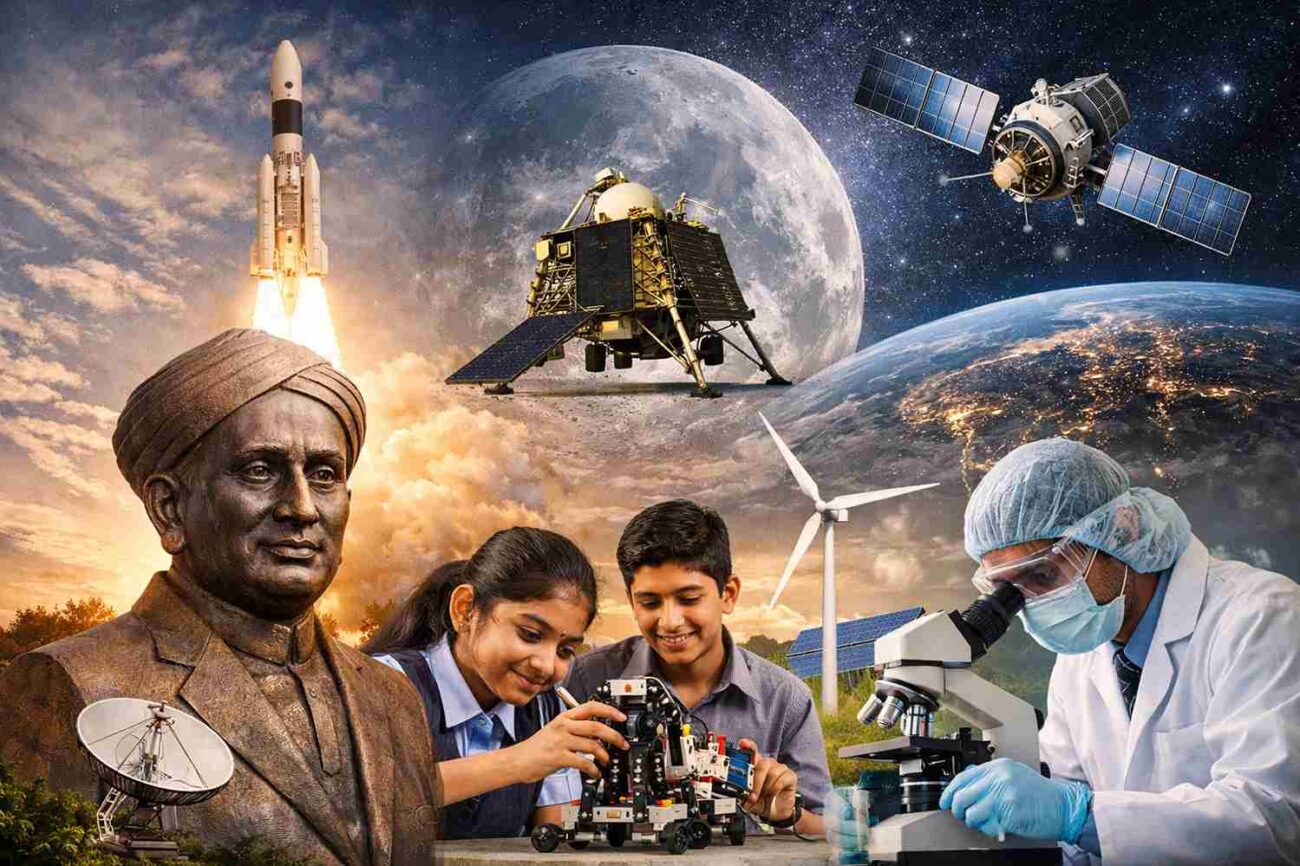
Every year on 28 February, India celebrates National Science Day to mark the discovery of the Raman Effect by the eminent physicist C. V. Raman in 1928. This pathbreaking scientific breakthrough later earned him the Nobel Prize in Physics in 1930, placing India firmly on the global scientific map. The occasion honours not only his achievement but also the enduring impact of science on society.
Science is a cornerstone of national progress. It shapes everyday life in countless ways — from farming and healthcare to education, communication, transport, and industry. National Science Day highlights the importance of scientific knowledge in solving practical problems and improving living standards. It encourages citizens to think logically, question intelligently, and rely on evidence.
Throughout the country, educational institutions and research centers organise exhibitions, workshops, lectures, debates, and science fairs to commemorate the day. Students actively participate by presenting creative models and experiments, nurturing curiosity and innovation. These activities help instill a rational outlook and inspire young minds to explore the world through inquiry and experimentation.
In recent years, India has witnessed impressive advancements in science and technology. Achievements in space exploration, including landmark lunar and planetary missions, have earned global appreciation. The country is also making rapid strides in digital innovation, biotechnology, healthcare research, renewable energy, and artificial intelligence — strengthening both national growth and international collaboration.

India’s present scientific approach emphasizes innovation, self-reliance, and sustainable development. Through policy support, research funding, and startup initiatives, the government and scientific institutions are empowering young researchers and promoting indigenous technologies. Partnerships between academia, industry, and global research communities are helping address key issues such as climate change, energy security, and public health.
The central aim of National Science Day is to foster scientific temper, promote research, and spread awareness about the value of science among the general public. It motivates students to pursue careers in scientific fields and encourages society to embrace fact-based reasoning.
In today’s fast-changing technological landscape, science must be applied responsibly for the greater good of humanity. National Science Day reminds us that when guided by ethics and sustainability, scientific advancement can pave the way for a stronger and more progressive India.
Author Bio:

Pradyumna Kishor Mishra, Indigo H.S. School of Science and Commerce, Cuttack. He writes on social issues, education, ethics, and contemporary challenges affecting society, with a focus on values and character development.

click on icons to connect with us through official social media channels






You May Be Bathing the Wrong Way: Know the Correct Ayurvedic Way
