
Why India Slipped to 6th-Largest Economy?
 The Eastern Times
 Quick Summary
- Rupee depreciation reduced India’s GDP value when converted into US dollars.
- GDP revisions changed the estimated size of India’s nominal economy.
- Stronger yen and pound helped Japan and the UK move ahead of India in the dollar-based ranking.
India’s economy continues to grow rapidly, but its position in the global economic rankings has taken an unexpected turn.
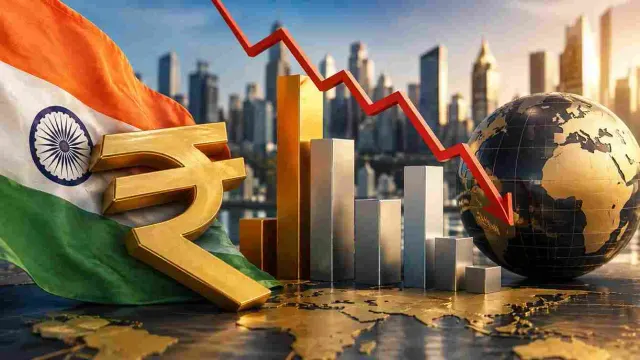
According to the IMF’s latest estimates, India is now the world’s sixth-largest economy in nominal US-dollar terms, behind the United States, China, Germany, Japan and the United Kingdom.
The change has raised an obvious question: If India is still one of the fastest-growing major economies, why has it slipped from fourth to sixth?
The answer lies largely in exchange rates, GDP revisions and the way global rankings are calculated.
Why Did India Slip From 4th to 6th?
1. The rupee depreciated
This is the biggest reason.
Global GDP rankings compare economies in US dollars. India's GDP is generated in rupees and then converted into dollars.
When the rupee weakens against the dollar, India's economy becomes smaller in dollar terms, even if the economy continues to grow in rupees.
For example:
| Exchange rate | ₹400 lakh crore in dollar terms |
|---|---|
| ₹80 = $1 | $5 trillion |
| ₹100 = $1 | $4 trillion |
The economy in rupee terms remains exactly the same. Only its dollar value falls.
India's rupee weakened considerably during the period, reducing the country's GDP when converted into US dollars.
2. India revised its GDP estimates
India introduced a new GDP series with 2022–23 as the base year, replacing the earlier 2011–12 base year.
The revision changed the estimated size of India's nominal GDP.
For FY2025–26, the earlier estimate of around ₹357 lakh crore was revised to approximately ₹345 lakh crore in the new series.
This was a statistical revision, not a sudden destruction of economic output.
However, because the international ranking is based on nominal GDP, the revision affected India's position in the global table.
3. Japan's yen strengthened
Japan benefited from movements in its currency.
A stronger yen increases the dollar value of Japan's GDP when its economy is converted from yen into US dollars.
As a result, Japan moved ahead of India in the nominal GDP ranking.
4. The British pound strengthened
The UK also benefited from currency movements.
A relatively stronger pound increased the UK's GDP when measured in US dollars, helping Britain move ahead of India.
This does not necessarily mean that the UK suddenly became a faster-growing economy than India.
5. India's real growth and dollar GDP are different things
This is an important distinction.
India can grow at 6–7% in real terms while its GDP in US dollars grows more slowly because of currency depreciation.
In other words:
Strong domestic growth + weaker rupee ≠ equally strong dollar GDP growth.
That is why India can remain one of the fastest-growing major economies while simultaneously slipping in a nominal-dollar ranking.
6. The gap between India, Japan and the UK is relatively small
India, Japan and the UK are now clustered around the $4 trillion-plus level.
That means relatively small changes in exchange rates or GDP estimates can change their positions.
The ranking is therefore more volatile than it would be if there were a huge gap between the economies.
7. Other countries' performance also matters
India's ranking is not determined by India's growth alone.
The IMF's nominal GDP ranking is influenced by:
-
Economic growth
-
Exchange rates
-
Inflation and price levels
-
GDP revisions
-
Economic performance of other countries
Therefore, India can move down the ranking even while its own economy continues to expand.
The Current Ranking
The IMF's 2026 estimates put the major economies roughly in this order:
| Rank | Country | Nominal GDP, 2026 |
|---|---|---|
| 1 | United States | $32.38 trillion |
| 2 | China | $20.85 trillion |
| 3 | Germany | Around $5.3 trillion |
| 4 | Japan | $4.38 trillion |
| 5 | United Kingdom | $4.27 trillion |
| 6 | India | $4.15 trillion |
The numbers show how close the race has become between Japan, the UK and India.
A relatively small change in exchange rates can therefore alter the ranking.
India Is Still Growing Fast
The sixth-place ranking should not be interpreted as an economic collapse.
The IMF continues to expect strong growth from India. Its 2026 projection is around 6.4% real GDP growth, keeping India among the world's fastest-growing major economies.
This highlights the difference between two measurements:
Real GDP growth tells us how quickly an economy is actually expanding.
Nominal GDP in US dollars tells us how large that economy appears after converting its output into dollars.
They are related—but they are not the same thing.
India Could Regain 4th Place
The current setback may not last long.
IMF projections cited in economic analyses indicate that India could regain fourth place in 2027 and potentially become the world's third-largest economy around 2031, depending on future growth and exchange-rate movements.
That means the current sixth-place position should be viewed as a snapshot rather than a permanent change in India's economic standing.
Government's Growth Strategy
The Indian government has highlighted several measures to strengthen long-term economic growth, including:
-
Production Linked Incentive (PLI) schemes to promote manufacturing
-
PM Gati Shakti for integrated infrastructure development
-
National Logistics Policy to improve logistics efficiency
-
Support for MSMEs
-
Greater FDI liberalisation
-
Direct and indirect tax reforms
-
Continued public capital expenditure
-
Measures to improve agricultural productivity
The objective is to increase India's productive capacity, investment, manufacturing and competitiveness.
Banking Sector: An Older Snapshot
The Sambad report also highlighted banking-sector data from the government's parliamentary response.
It reported:
| Indicator | Figure | Date |
|---|---|---|
| Public-sector bank gross NPAs | ₹1,45,314 crore | March 2022 |
| Unclaimed deposits in RBI's DEA Fund | ₹3,916.01 crore | June 30, 2022 |
| Funds returned from DEA Fund to banks | ₹1,714.71 crore | As reported |
These figures are from 2022, so they should not be interpreted as the current state of India's banking sector in 2026.
The Bigger Picture
India's move from fourth to sixth place is certainly worth watching, but the ranking needs context.
The country did not suddenly become poorer or stop growing.
The main factors were:
Rupee depreciation + GDP revisions + stronger yen and pound + changes in relative economic performance.
The episode nevertheless highlights an important challenge for India.
To become a durable economic superpower, India needs not only high GDP growth but also higher productivity, stronger exports, greater manufacturing capacity, productive employment, investment and a stable macroeconomic environment.
The ranking may have slipped.
India's economic growth story has not.
Reader Feedback
Was this article useful?
Stay Connected
Get the next important story before you miss it.
Subscribe to the newsletter for trusted updates, or join our WhatsApp channel for quick top-story alerts from The Eastern Times.
WhatsApp Channel
Prefer instant alerts? Join our WhatsApp channel for top stories and breaking updates.
Join on WhatsApp