
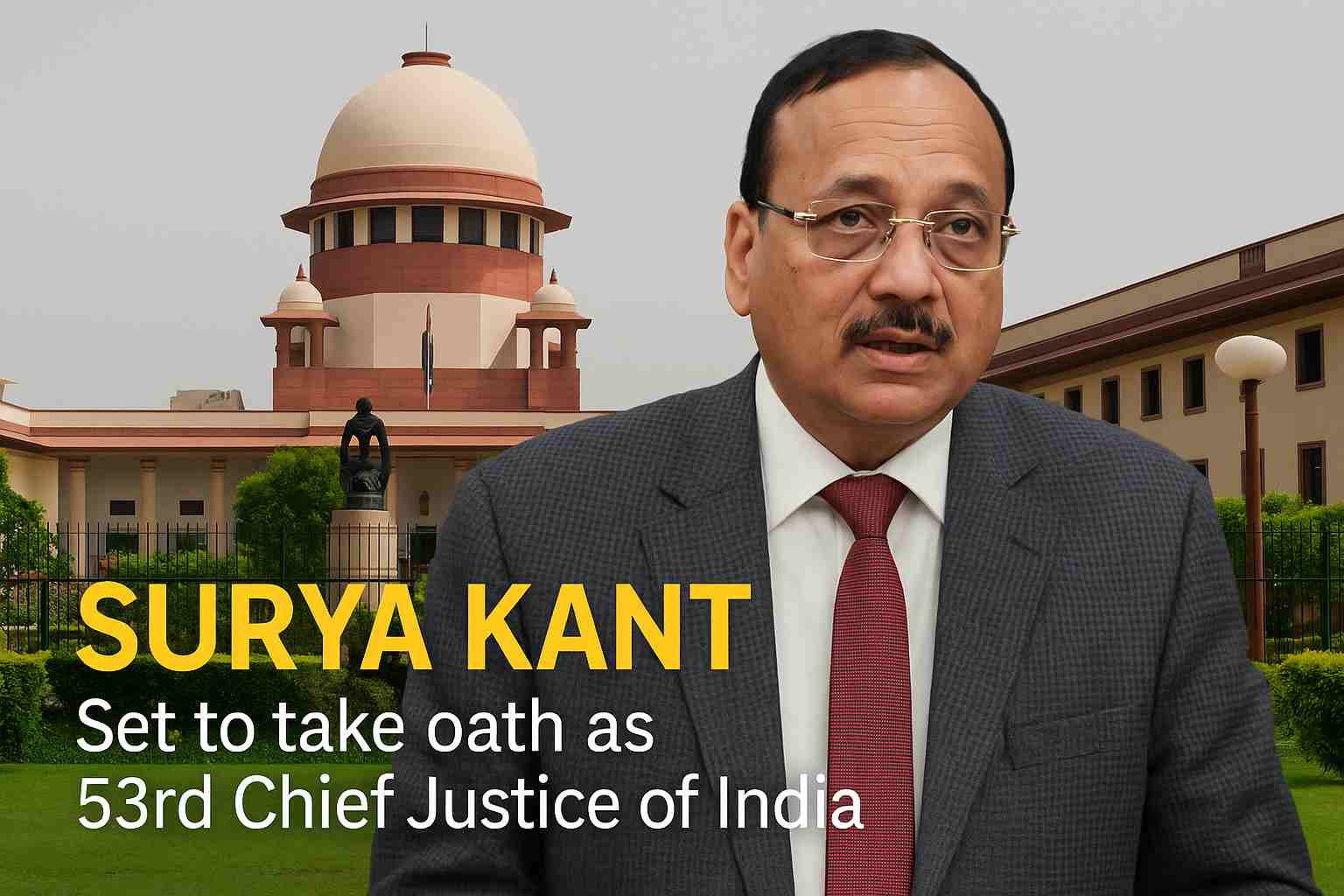
Justice Surya Kant Takes Charge as India’s 53rd Chief Justice
Justice Surya Kant, one of the Supreme Court’s most influential judges with a strong constitutional background, assumes office as the 53rd Chief Justice of India (CJI) on Monday. He will serve until 9 February 2027, marking a tenure expected to shape multiple national debates.
Early Life: From Hisar to the Supreme Court
Born on 10 February 1962 in Hisar, Haryana, Justice Kant’s rise reflects a career defined by academic merit and consistent judicial work.
Completed his LLM from Kurukshetra University with First Class First distinction.
Built a reputation early for sharp legal reasoning and administrative clarity.
Career Before the Supreme Court
Punjab & Haryana High Court
As a judge, he authored several widely cited rulings involving civil liberties, state powers, and governance reforms.
Chief Justice of Himachal Pradesh High Court (2018–2019)
He introduced administrative improvements, sped up case disposal, and delivered key judgments on land, environment, and service matters.

Major Supreme Court Judgments
Article 370 Case
Part of the bench examining challenges related to the abrogation of Jammu & Kashmir’s special status.
Sedition Law Review
Played a decisive role in putting the colonial-era sedition provision on hold, stating no new FIRs should be filed until the Union completes its review.
Electoral Roll Transparency
Directed the Election Commission to explain the exclusion of 65 lakh voters in Bihar, ensuring transparency before polls.
Free Speech & Citizenship
Delivered opinions that reinforced constitutional freedoms and procedural safeguards.
Interventions With National Impact
Justice Kant has handled matters that directly influence India’s federal structure and democratic processes, including the pending presidential reference on the powers of Governors and the President regarding state legislation.
Gender Justice
He led the bench that reinstated an unlawfully removed woman sarpanch, highlighting procedural bias and discrimination.
Women’s Representation in the Bar
Ordered that one-third seats in bar associations — including the Supreme Court Bar Association — be reserved for women.
Committees, National Security & Administrative Oversight
Co-authored the order forming a five-member committee to probe the 2022 security breach during PM Modi’s Punjab visit.
Upheld the One Rank-One Pension (OROP) scheme.
Oversaw cases on gender parity in permanent commission for women in the armed forces.
High-Profile Hearings: Pegasus & AMU Status
Pegasus Spyware Case
A member of the bench that ordered an independent probe, stressing that “national security” cannot be used to block judicial scrutiny.
AMU Minority Status
Part of the seven-judge bench that overturned the 1967 ruling, enabling a fresh decision on Aligarh Muslim University’s minority status.
What Justice Surya Kant’s Tenure Means for India
With 15 months ahead as CJI, his court is expected to steer:
Major constitutional cases (federal powers, sedition overhaul, electoral reforms)
Judicial transparency and administrative reform
Cases with long-term national implications, including data, surveillance, and gender parity
His tenure is expected to focus strongly on constitutional clarity, individual rights, and institutional accountability.
Connect with us through social media
Facebook:
 https://www.facebook.com/profile.php?id=61577015427068
X (Twitter):
 https://x.com/tet_editor
Instagram:
 https://www.instagram.com/the_eastern_times_/?next=%2F&hl=en
Mail (Email):
 contact.theeasterntimes@gmail.com