
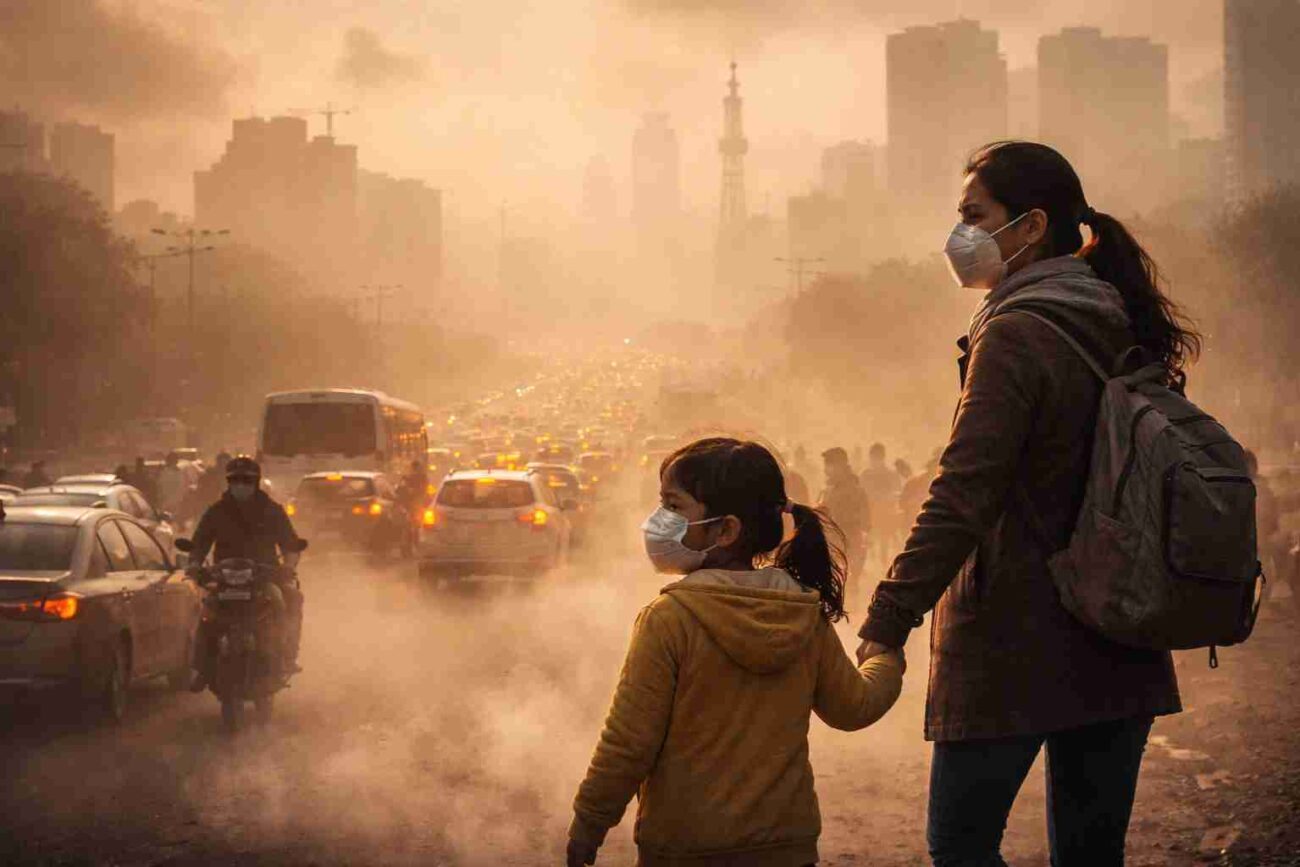
Air pollution in India is no longer a seasonal inconvenience confined to winter months or northern states. It has silently evolved into a nationwide public health emergency. Every region, every community, and nearly every organ of the human body is now under its shadow. Yet, despite its devastating consequences, it remains an “invisible pandemic” — one we continue to breathe every day.
In rapidly expanding urban centers, the concentration of particulate matter (PM) has reached alarming levels. These microscopic particles — a toxic mix of dust, smoke from vehicles and industries, and chemical pollutants — are now embedded in the air we inhale. Based on size, particulate matter is categorized mainly into PM10 and PM2.5. The latter, due to its extremely small size, poses the gravest threat. PM2.5 easily penetrates the lungs, enters the bloodstream, and bypasses the body’s natural defense mechanisms.

The Air Quality Index (AQI), used to measure pollution levels, considers values above 500 as severely hazardous. Yet recent surveys have recorded AQI levels crossing 600 in certain cities. Byrnihat in Assam and the national capital Delhi have emerged among the most polluted urban centers. In practical terms, breathing such air has been equated to smoking multiple cigarettes daily — a stark reminder of the toxic reality millions face.
The consequences are not theoretical. According to research from the Energy Policy Institute at Chicago, nearly 85 percent of Indians live in polluted regions, and their life expectancy is shrinking. In Delhi alone, the average lifespan has reportedly reduced by eight years. In 2022, pollution-related diseases claimed 1.7 million lives in India. More recent figures suggest that the annual toll has crossed two million. Since 2010, deaths linked to air pollution have increased by over 40 percent.
Also Read: Mental Pollution: The Hidden Threat to Society
The health implications are profound and far-reaching.
PM2.5 particles, once in the bloodstream, contribute to high blood pressure, atherosclerosis, heart attacks, arrhythmias, and strokes. Areas with higher pollution levels often record higher cardiovascular mortality rates.
The lungs bear the most immediate impact. Children struggle with breathing difficulties; nearly 10 percent of Indian children suffer from asthma linked to polluted air. Even a modest rise in particulate concentration significantly increases emergency hospital admissions. Among adults and the elderly, chronic obstructive pulmonary disease (COPD), bronchitis, and recurrent lung infections are becoming increasingly common.
More alarming, however, is the effect on the brain. Scientific evidence indicates that PM2.5 can cross the Blood-Brain Barrier — the body’s critical protective shield. In children, this may manifest as reduced memory, impaired cognitive ability, and poor academic performance. In older adults, prolonged exposure raises the risk of neurodegenerative conditions such as dementia.
Pregnant women are also vulnerable. Exposure to polluted air has been associated with premature births, low birth weight, and higher infant mortality.
Air pollution also reflects a deeper social inequality. The poor often reside near industrial belts, highways, and construction zones — the epicenters of toxic emissions. With limited access to healthcare and inadequate living conditions, they suffer disproportionately. Yet public discourse frequently narrows the debate to seasonal issues like firecrackers during Diwali or stubble burning. While these factors aggravate pollution, they are not its root causes.
The primary contributors remain unchecked vehicular emissions, industrial smoke, coal-based energy, unregulated construction dust, and biomass burning in rural regions.
Addressing this crisis demands more than symbolic measures. A decentralized and sustained strategy is essential. Large-scale electrification of public and private transport must accelerate. Industries must transition away from coal and adopt cleaner technologies. Construction regulations should strictly control dust emissions. Regular health screening programs in high-risk zones are equally vital.
However, responsibility cannot rest solely on the government. Clean air is as fundamental as food, water, shelter, and education. It is a shared civic duty.
If we continue to ignore this invisible pandemic, the cost will be measured not only in hospital bills and lost productivity, but in shortened lives and diminished futures. Small, collective, and sustained actions — by policymakers, industries, and citizens alike — can still alter the course.
The question is not whether the crisis is real. The question is whether we are prepared to confront it before it silently claims millions more.
Author Bio:

Dr. Raj Kishore Panda (MBBS, PGPN) is a medical professional and commentator who writes on socio-economic affairs, geopolitics, environmental challenges, and public health issues.

click on icons to connect with us through official social media channels






Russia Completely Bans WhatsApp Over Law Violations
You May Be Bathing the Wrong Way: Know the Correct Ayurvedic Way
