
Why Sikkim’s Glacial Lakes Could Trigger Devastating Floods
 The Eastern Times
 Quick Summary
- 40 vulnerable glacial lakes have been identified in Sikkim, with 17 classified as Category-A.
- The 2023 glacial outburst flood killed more than 40 people and severely damaged infrastructure, including the Teesta Stage III dam.
- Sikkim is strengthening satellite monitoring, robotics and engineering measures, while India works on its first dedicated glacial flood management protocol.
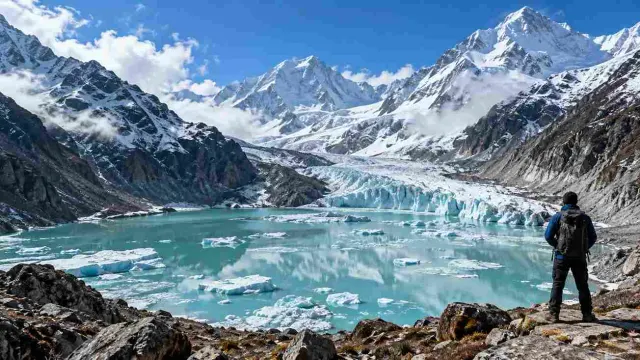
The climate change crisis in the Himalayan mountainous region is becoming increasingly severe, and Sikkim is emerging as one of the areas facing a potentially devastating consequence: glacial lake outburst floods (GLOFs).
The state has identified 40 vulnerable glacial lakes, of which 17 have been classified under the most critical Category-A status. With the memory of the devastating October 2023 glacial outburst flood still fresh, the growing vulnerability of these lakes raises an important question: Is Sikkim moving quickly enough to prevent another major disaster?
17 Lakes in the Most Critical Category
Of the 40 vulnerable glacial lakes identified in Sikkim, 17 are in Category-A, seven in Category-B and nine in Category-C, while 17 remain unclassified.
These figures indicate that the risk is not concentrated in a single location. A significant number of lakes require close attention, although their individual levels of vulnerability and geographical conditions differ.
Following the recent natural disaster near the Nepal-Tibet border, the Sikkim government has further tightened safety measures, reflecting growing concern over the instability of the Himalayan region.
The 2023 Flood Changed the Risk Assessment
The seriousness of the threat became clear during the October 2023 glacial outburst flood, which claimed more than 40 lives and caused extensive damage to infrastructure, including the Teesta Stage III dam.
The disaster demonstrated that the danger posed by glacial lakes extends far beyond the lakes themselves. A sudden release of water can travel downstream with enormous force, affecting lives, settlements and critical infrastructure.
For Sikkim, therefore, monitoring glacial lakes is no longer simply an environmental exercise. It is a disaster-prevention requirement.
Satellite Monitoring and Robotics
After the 2023 disaster, the Department of Science and Technology was appointed as the nodal agency to continuously monitor changes in vulnerable glacial lakes.
The department is using satellite imagery and robotics to monitor the lakes and identify changes that could indicate increasing danger.
This technological approach is particularly important in the Himalayan environment, where difficult terrain and extreme conditions can make frequent physical inspections challenging.
But monitoring itself cannot prevent a flood. Its real value will depend on whether changes detected through satellites and robotics can be converted into early warnings and timely preventive action.
Sako Cho: The Most Sensitive Lake
The risk is not identical across all 40 lakes. Each has its own geographical characteristics, requiring a separate mitigation strategy.
Specific plans have therefore been prepared for Sako Cho, South Lhonak and Gurudongmar lakes.
Among them, Sako Cho has been identified as the most vulnerable. Its detailed project report has already been submitted to the National Disaster Management Authority (NDMA).
This lake-specific approach is significant because attempting to apply a single engineering solution to every glacial lake could ignore differences in terrain, water levels, drainage systems and downstream risks.
Different Lakes, Different Solutions
For South Lhonak Lake, flood-control infrastructure has been proposed to reduce the potential impact of an outburst.
The situation at Gurudongmar Lake is more complex because of its religious significance. Authorities have therefore proposed the construction of a barrier wall in its spillway channel, while taking the lake's religious importance into consideration.
The differing proposals demonstrate that glacial flood management in Sikkim is not simply about lowering water levels. It involves balancing engineering requirements, geographical realities and local cultural considerations.
Can Engineering Reduce the Risk?
Authorities are adopting scientific methods to reduce water levels in vulnerable lakes. These include pumping, siphon systems, drainage construction and tunnelling.
Such measures could reduce the volume of water and therefore the potential force of an outburst. However, intervention in the high-altitude Himalayan environment is technically challenging.
The bigger challenge is that the underlying climate risk does not disappear simply because the water level of one lake is reduced. Continuous monitoring will remain necessary because environmental conditions can change over time.
India’s First Dedicated Glacial Flood Management Protocol
Another important development is the work underway to prepare the country's first dedicated glacial flood management protocol.
This could provide a broader framework for dealing with GLOF risks, rather than relying only on lake-specific interventions.
The effectiveness of such a protocol, however, will ultimately depend on how well scientific monitoring is connected with disaster preparedness, early-warning mechanisms and ground-level response systems.
The Larger Warning from Sikkim
Sikkim's 40 vulnerable glacial lakes represent more than a list of potential disaster sites. They are a warning about the changing risk profile of the Himalayan region.
The 17 Category-A lakes require particularly close attention, while the remaining vulnerable and unclassified lakes cannot be ignored. The October 2023 disaster has already demonstrated the consequences of underestimating glacial flood risks.
The immediate priority is therefore clear: identify the most dangerous lakes, monitor them continuously, reduce water levels where technically feasible and establish systems capable of warning communities before an outburst occurs.
Sikkim has begun moving in that direction through satellite monitoring, robotics, engineering interventions and the proposed national protocol. The real test will be whether these measures can turn scientific information into preventive action before another glacial lake becomes a disaster downstream.
Reader Feedback
Was this article useful?
Stay Connected
Get the next important story before you miss it.
Subscribe to the newsletter for trusted updates, or join our WhatsApp channel for quick top-story alerts from The Eastern Times.
WhatsApp Channel
Prefer instant alerts? Join our WhatsApp channel for top stories and breaking updates.
Join on WhatsApp